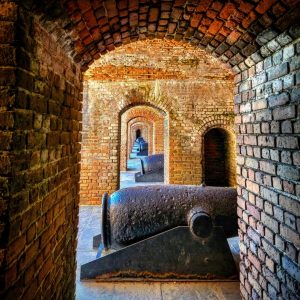
 The Key West Butterfly Conservatory: The One Decision That Governs Everything
Dry Tortugas National Park: A Walk Through an Island Fort
Everything here is decided by how you get on and off the island. Plan from that backwards.
An island fort seventy miles out to sea is the most logistically constrained location in this guide, and the constraint is the whole story: access is by boat or seaplane, on a schedule, with a weight allowance and a departure time that does not move.
That governs the photography completely. There is no returning to the car for a lens. There is no waiting for better light, because the vessel leaves when it leaves. There is no equipment beyond what was carried, and no mains power. And the hours available on the island are fixed by a timetable rather than by the sun — which means the light a photographer gets is whatever the light is during those hours.
So the plan has to be built backwards from the transport, and it has to be short, specific and complete before departure. A location like this rewards preparation more than any studio does.
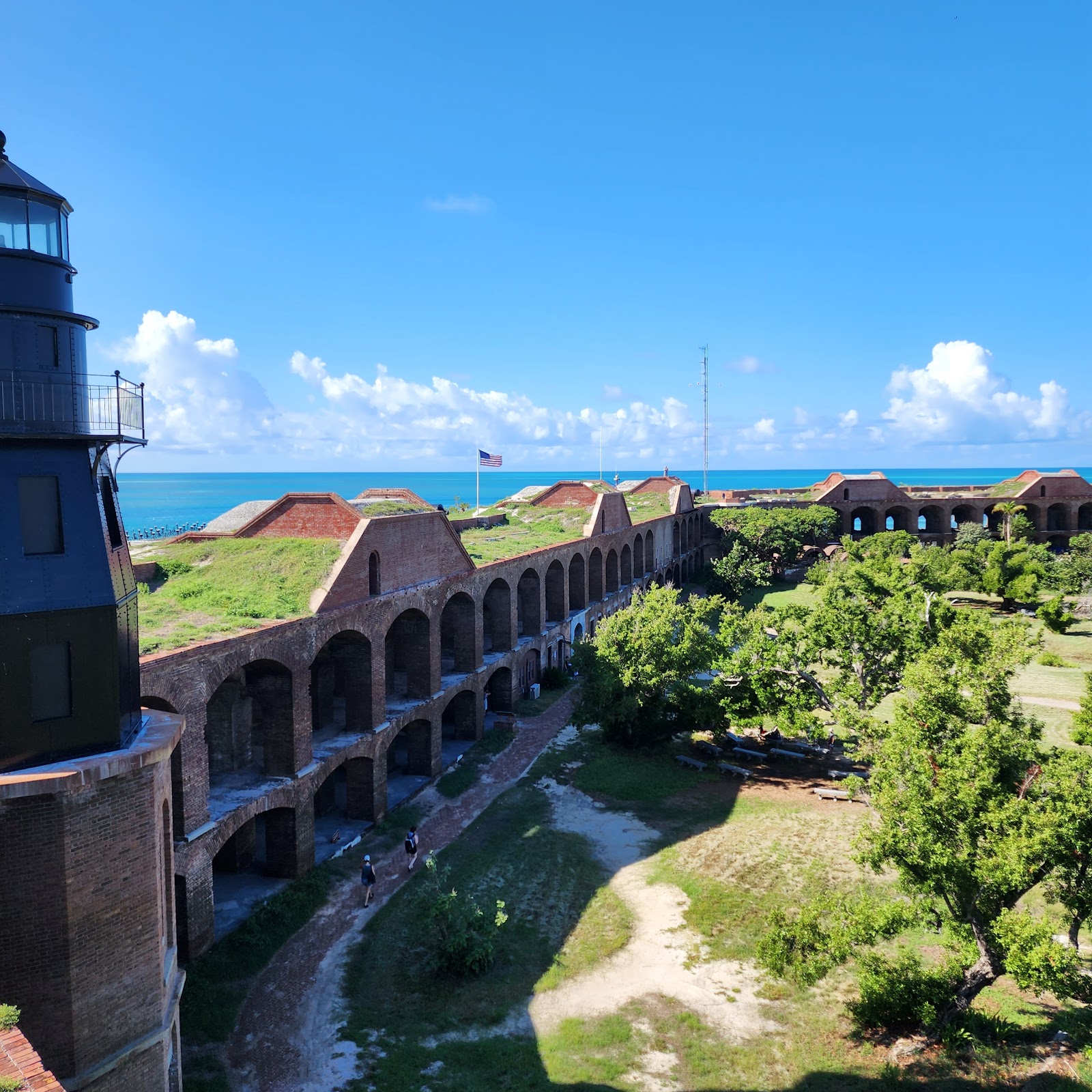
What it gives in return is a set of frames available nowhere else: a vast nineteenth-century brick fort, water in every direction, and the clearest, brightest light in the country. Walked in the order a day there actually works, that resolves into four zones.
We have not photographed a wedding at Dry Tortugas National Park; masonry forts and remote island light behave consistently. Permits, transport, group limits, what may be carried and whether a ceremony is possible at all are questions for the National Park Service and the transport operator — and those answers determine whether the day happens.
Dry Tortugas National Park at a glance
| Where | Seventy miles west of Key West, Florida |
| The constraint | Access by boat or seaplane, on a fixed schedule, with a weight limit |
| Four zones | The approach, the arches, the walls, and the water |
| Carry | One body, two lenses, one small source, and a cloth. No stands |
| Ask first | Permits, transport, group limits, what may be carried |
The approach, and the arches
The approach is the first zone and it is one most photographers waste, because it happens before anyone is thinking about pictures.
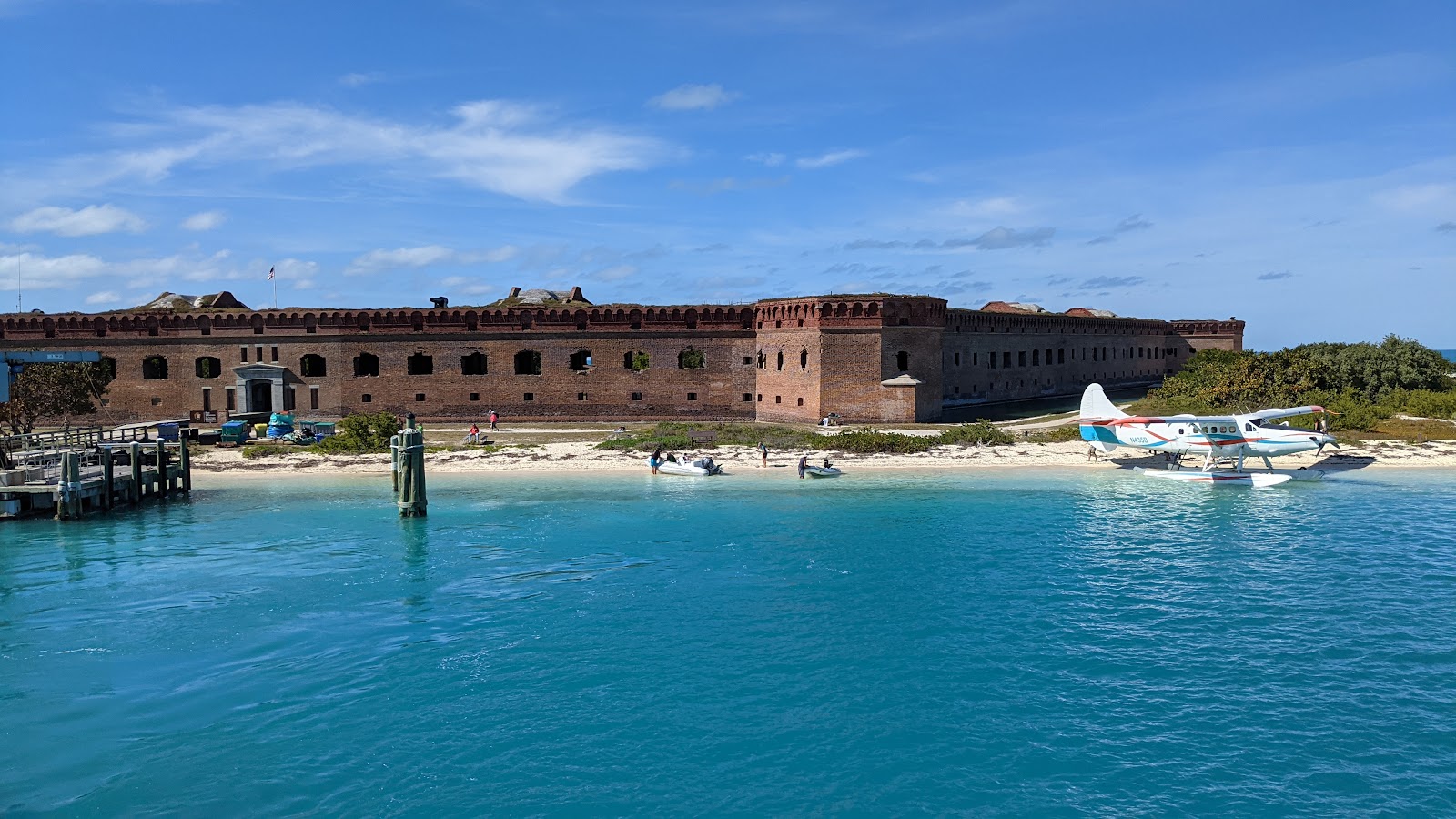
A fort seen from the water as it is approached is the only frame that shows what it is: a vast masonry structure alone on a sandbank in open sea, with nothing else in any direction. That cannot be photographed from the island, because from the island there is no vantage point far enough away. It has to be taken on the way in or the way out, from a moving vessel, in whatever light there is.
Which means a lens ready, an exposure set, and a decision made in advance about whether the fort or the couple is the subject — because both is not available at that distance. A long lens compresses the fort into a solid mass; a wide one shows how small it is against the sea.
From a boat everything moves, so a faster shutter than instinct suggests, and a strap on. From a seaplane the frame is aerial and the glass is in the way, so the lens goes close to the window and any reflection in it has to be checked.
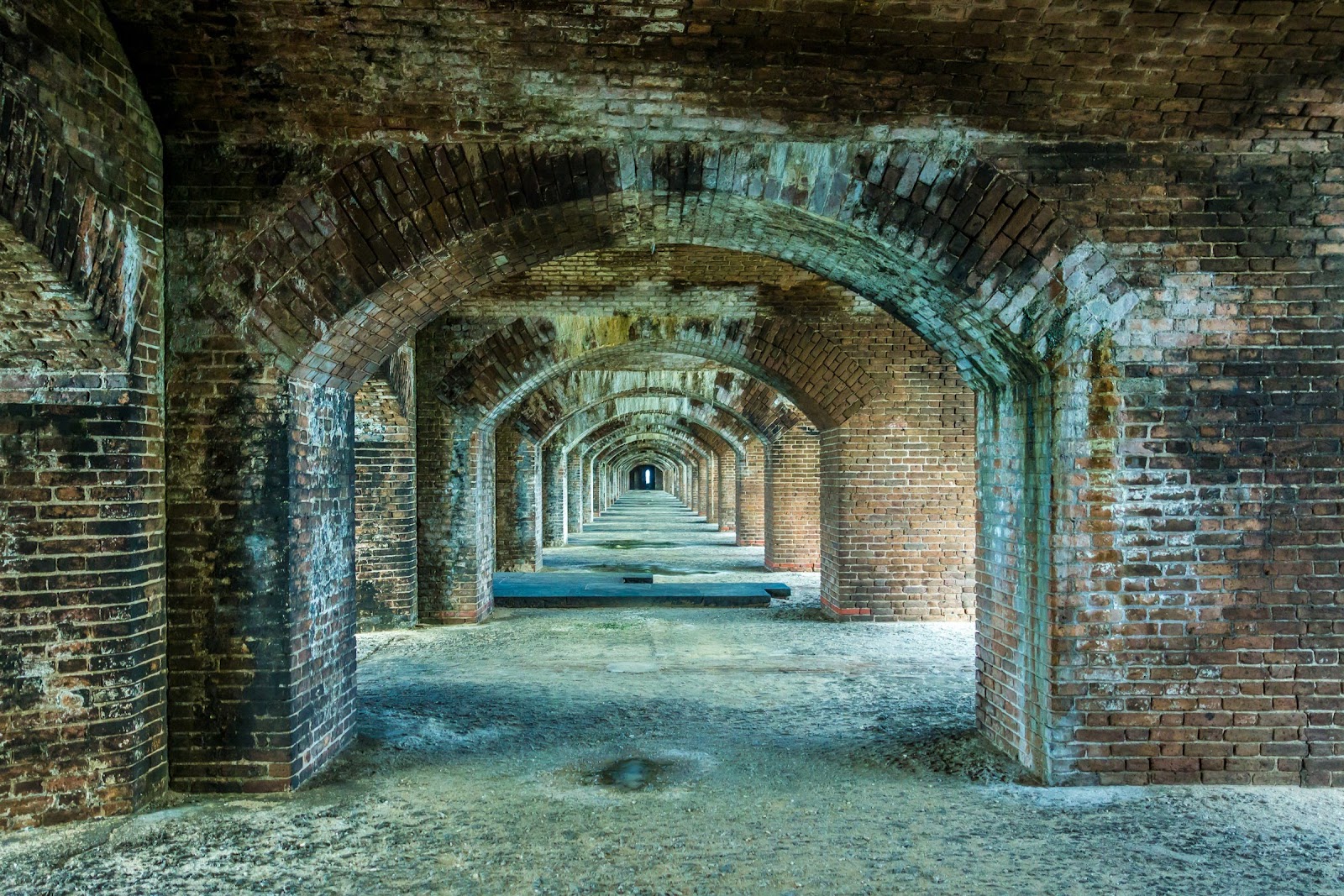
The arches are the second zone and they are the reason this place is photographically remarkable. A nineteenth-century masonry fort is a structure of deep arched openings and vaulted casemates — which, under a near-vertical tropical sun, is the only good light on the island.
The physics is the same as a veranda’s at a heavier scale. An arch has a solid top, solid sides and one open face, so it blocks the vertical component of the sun entirely, restricts the light to a horizontal band, and bounces it off the brick floor and reveals to fill under the chin. That gives good directional light at any hour of any day, which at this latitude is close to miraculous.
Two or three metres inside an opening, facing out, is the working position, and the test is a catchlight in the eyes with no bright patch on the top of the head. One test frame at three depths settles it.
The arch is also a framing device and the fort has them in series, which means looking along a row gives repetition and recession with the far end darkening by itself — the cheapest separation available anywhere, and the frame this structure exists to give.
Brick is a warm mid-toned reflector rather than a dark absorber, which means it returns a useful amount of light with a warm cast — helpful, and needing a custom white balance set on a face in position, because the cast arrives from one side and global correction cannot separate it. And brick reads as brick only under raking light, so the positions where light skims a wall are the ones worth using.
The walls, the water, and what to carry
The walls are the third zone and they give what the arches cannot: scale and sky.
From the top of a masonry fort there is a horizon in every direction and nothing else in any of them — which makes the couple-as-figures composition genuinely available, with two people small against an enormous emptiness. The requirement is that the figures be readable: separated by tone, placed where the eye lands, and with the exposure set for the sky rather than for them, because a tropical sky is several stops above a face and clips irrecoverably.
Exposed walls have no shade, though, which means they are a two-window zone: the first hour and the last hour, when the sun is low enough to come across faces rather than down onto them. In the middle of the day the wall tops are unusable for faces and excellent for architecture, which is a reasonable division.
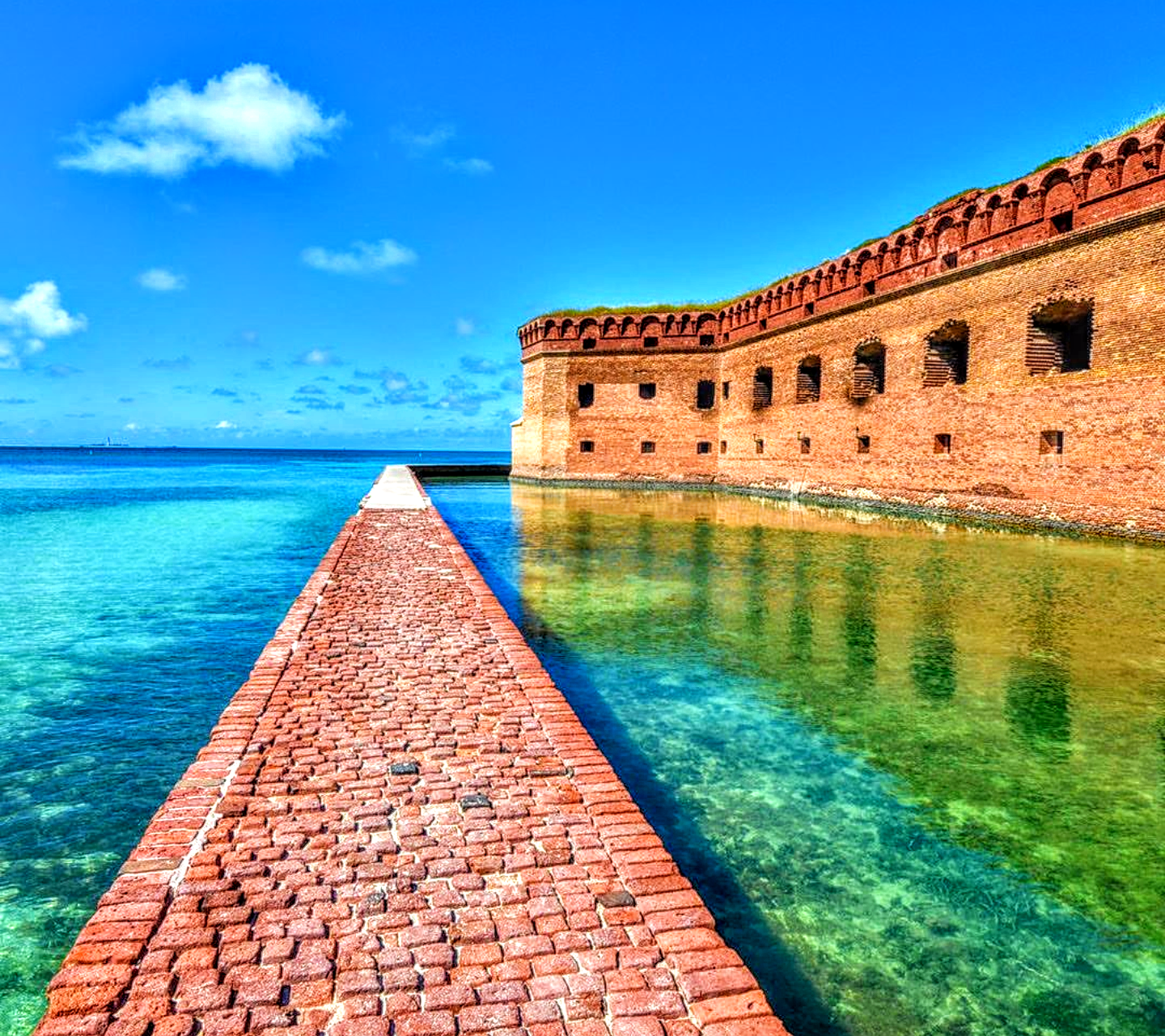
The water is the fourth zone and here it does something it does almost nowhere else in this guide: it is genuinely clear. Shallow tropical water over pale sand is transparent and turquoise, which inverts the usual camera-height advice — a low camera across the surface gives a mirror, but a high camera looking down gives a view through to the bottom, and here the view through is frequently the better picture.
A polariser is the essential accessory for that: it cuts the surface reflection so the water becomes transparent rather than silver, and it deepens the sky at the same time. It is the one filter that genuinely earns its weight on a trip with a weight limit.
Which brings the carrying decision, and it should be made deliberately because it cannot be revised. One body, two lenses covering wide and moderately long, one small source in a hand or on a bracket, a polariser, spare batteries and cards, and a cloth. No stands — there is nowhere safe to put one on a conserved masonry structure and no reason to, since the arches supply the light.
The cloth matters more than it sounds, because salt spray on the crossing settles on a front element, and the humidity here means condensation repeatedly rather than once. A body carried from an air-conditioned cabin into this air fogs immediately, so equipment should be out and acclimatised before arrival rather than after.
And the rules are the fourth constraint and the most absolute. This is a national park and a conserved nineteenth-century structure, which means rules about where people may walk and stand, what may be set up, group sizes, and whether a ceremony is permitted at all. Those answers belong to the National Park Service, they should be settled long in advance, and they are not a photographer’s to interpret.
The working assumption is: nothing set against the masonry, nothing on the ground, small numbers at any one position, and a short route that a party can walk in the time the transport allows.
- Photograph the fort from the water on the way in; it cannot be done from the island
- Two or three metres inside an arch, facing out, works at any hour
- Wall tops are a two-window zone: first hour and last hour only
- Carry a polariser — here it makes the water transparent rather than silver
- No stands. Acclimatise equipment before arrival, not after
The light, and the Florida year
The light at this latitude is the most extreme in the country and it is worth stating numerically. Dry Tortugas lies at about twenty-four and a half degrees north, and at midsummer the midday sun is within roughly a degree of vertical — not high, vertical.
That means no shadow side to a face in the open, black eye sockets, a hard line under the chin and a bright patch on the top of the head. There is no technique for it, which is why the arches matter so much: they are not a stylistic choice but the only answer available on the island.
It also means the sun’s azimuth changes very fast around noon, so a shaded position can become an unshaded one within twenty minutes. Checking rather than assuming is the habit, and on a schedule that cannot be extended it is a costly thing to get wrong.
The second consequence of the latitude runs the other way. Because the sun sets at a steep angle here, twilight is short — roughly twenty-two to twenty-five minutes of civil twilight, against well over an hour on the northern plains in June. In practice a day trip will not be on the island for it, which means the dusk frame is not available at all unless the arrangements are unusual. That is worth knowing rather than hoping.
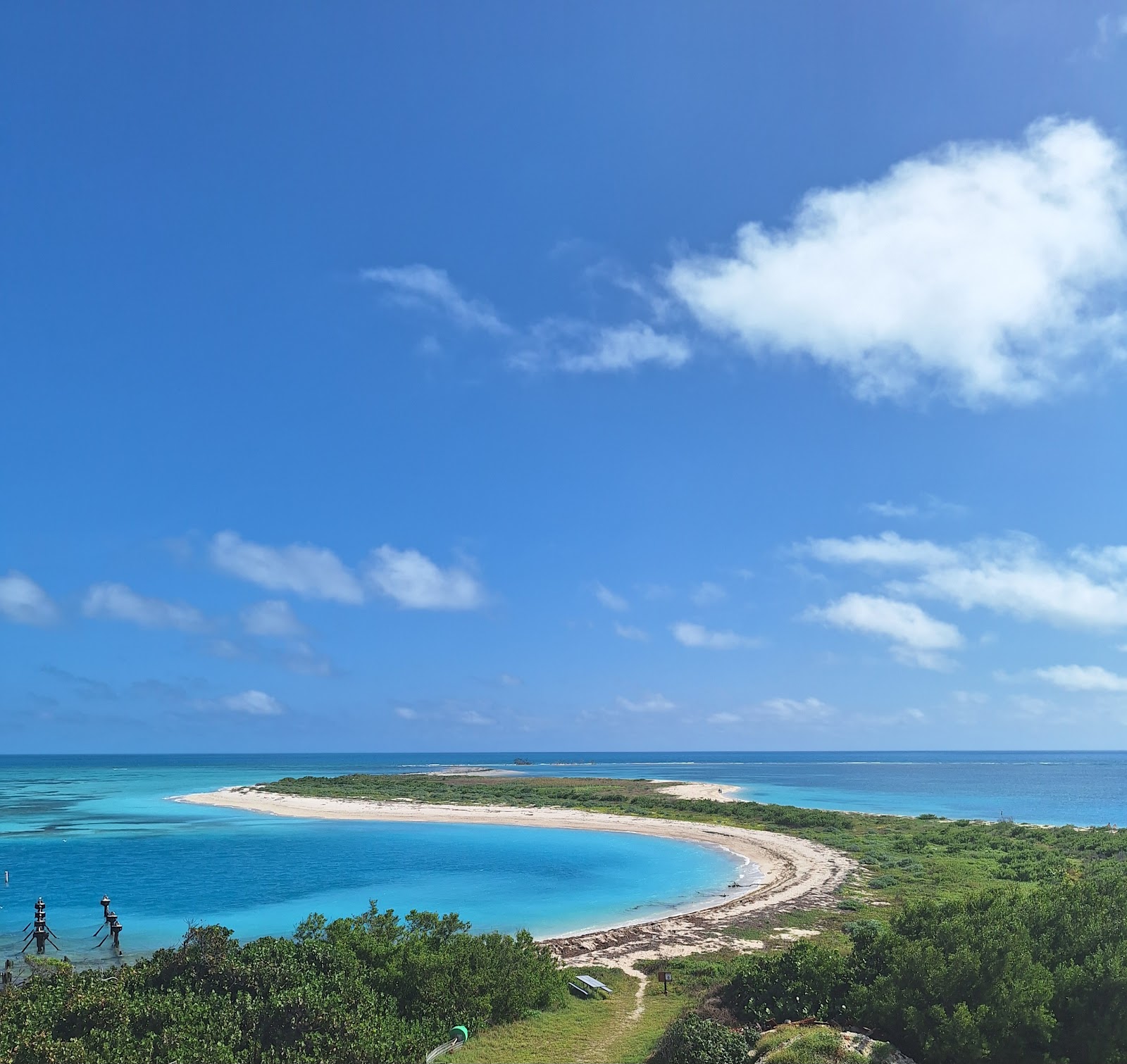
The air over open ocean is the compensation and it is exceptional. With no land upwind and no dust, the visibility here is among the best in the country: the horizon is a hard line, the water holds colour to the edge of sight, and the sky is a deep saturated blue that a polariser deepens further. Long views work here in a way they do not over land.
The seasons are two and they are wet and dry, and for a location reached by sea the difference is about the crossing rather than the light. The dry season, roughly December into April, brings calmer seas, lower humidity, clearer air and comfortable temperatures — and a midday sun at about forty-two degrees above the horizon, which is a usable angle rather than a vertical one. That makes the dry season the season, without qualification.
The wet season, roughly May into October, is hot and very humid with afternoon thunderstorms, and it carries the hurricane season from June into November with a peak from August into October. On an island seventy miles offshore, weather is not an inconvenience but a question of whether the transport sails at all — which makes a date in that window a genuine risk to the day rather than to the pictures.
The trade winds are the constant and they matter twice here. They moderate the heat and keep shaded positions comfortable. And they determine sea state, which determines whether a crossing happens and whether it is pleasant — a rough crossing with camera equipment is a real consideration, and a veil on an exposed wall in a steady easterly will not behave at all.
The last note is the honest one. This is a magnificent location and a demanding one, and a wedding here is a logistical undertaking in which photography is one component among several. A couple who understand that in advance will get extraordinary pictures; a couple who treat it as a venue with a car park will not.
More frames from Dry Tortugas National Park
Dry Tortugas National Park wedding photography: common questions
What governs everything here?
Access. Boat or seaplane, on a fixed schedule with a weight allowance — so the plan is built backwards from the transport and completed before departure.
Which frame can only be taken from the water?
The fort itself, alone on a sandbank with nothing in any direction. From the island there is no vantage point far enough away.
Why are the arches essential rather than optional?
Because at this latitude the midsummer midday sun is within a degree of vertical, and an arch is the only structure on the island that blocks it.
What should be carried?
One body, two lenses, one small source in a hand, a polariser, spares and a cloth. No stands — the arches supply the light and the masonry is conserved.
Is the dusk frame available?
Usually not. Twilight here is about twenty-two minutes and a day trip will not be on the island for it, unless the arrangements are unusual.
Which season?
December into April, without qualification. Calmer seas, clearer air, lower humidity, and a midday sun at a usable angle rather than a vertical one.
More Florida venue guides
We are writing a photographer’s guide to every venue we would happily shoot in Florida. Here are three more, plus the full index:
- The Ernest Hemingway Home, Key West: One Frame, and How It Is Made
- Fort Zachary Taylor, Key West: What It Suits, and What It Does Not
- The Key West Butterfly Conservatory: The One Decision That Governs Everything
Planning a wedding at Dry Tortugas National Park?
Plan backwards from the boat. Tell us your date and we will build it that way.