 The Blue Ball Barn, Wilmington: A Walk Through a Converted Barn

The Bottle & Cork, Dewey Beach: The Light Through a Day
A room built for bands at night has no daytime at all. That makes the shorelines the schedule.
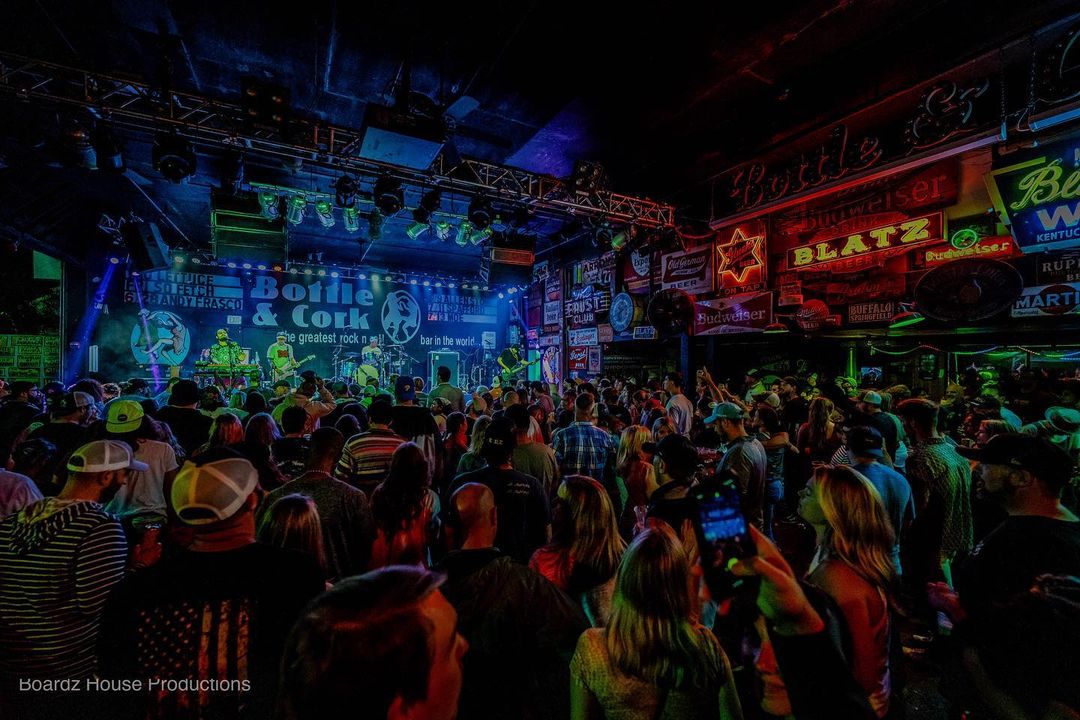
A music venue is built for one purpose and one time of day: a crowd, after dark, with a lit stage at one end. Everything about the room follows from that — the surfaces are dark so the stage reads, the windows are few or absent, the ceiling carries rigging, and the floor is built for standing rather than sitting.
Which means the building has no daytime in any photographic sense. The room at eleven in the morning is the same room as at eleven at night, only emptier, and a photographer expecting the light to develop through the day will find that it does not.
That is a freedom rather than a limitation, and on this particular strip of land it is a considerable one. Dewey Beach sits between the Atlantic and Rehoboth Bay, a few hundred metres apart — which means there are two shorelines facing opposite directions within a five-minute walk, and they are the only things on site that change through the day.
So the schedule is built outdoors and the room is the filler. This is that day in order. We have not photographed a wedding at the Bottle & Cork; music venues behave consistently. Which areas are included, whether the stage lighting can be set and what the covered alternative is are questions for their team.
The Bottle & Cork at a glance
| Where | Dewey Beach, Delaware, between ocean and bay |
| Morning | The ocean side, east-facing, frontlit and empty at first light |
| Midday | Ocean sidelight, or the room — which is the same at any hour |
| Evening | The bay side, west-facing, calm and reflective at sunset |
| After dark | The room as designed: a lit stage against a dark house |
Morning and midday: the ocean, and the unchanging room
The morning belongs to the ocean, which is east of the strip and therefore frontlit at sunrise. In that hour the beach has texture, the water has colour, the sun comes out of the water rather than from behind anything, and the sand is empty — which in a resort town is true at no other time of day.
It takes twenty minutes and a destination chosen the night before. And in a strip town the walk is genuinely short, which makes the sunrise excursion more practical here than at most venues.
Through the middle of the day the ocean side gives sidelight, which is the best beach light: with the sun south of the beach’s axis, one side of a face is lit and the other is filled by the sand, which reflects strongly upward. That fill is why a beach needs less equipment than a field. Its cost is uplight under the chin, corrected by having something solid on one side — a dune, a wall, a shelter — and the diagnosis is to look at the chin in the first frame.
Meanwhile the room is available and unchanging, which is the practical point. Because the interior does not develop, every indoor frame is movable and can be scheduled around the couple rather than the sun — and nothing indoors is lost by stepping out for twenty minutes when an outdoor window arrives.
That makes the middle of the day the right time to do the technical work in the room, and three measurements taken once govern the whole evening.
The ambient, which in a room with dark surfaces and few windows is several stops below a normal interior. Measure it rather than estimating, because eyes adapt and meters do not.
The bounce, which a music venue usually refuses: the ceiling carries rigging and is dark, and the walls are dark too, so a flash aimed upward returns very little. One test frame confirms it in five seconds and the answer is to light directly into a modifier instead.
And the colour, which in a venue like this is a mixture: house lights of one era, later fluorescents in the service areas, modern LED exit and safety lighting, bar lighting, and a stage rig which may be tungsten, LED or both, with gels in it. Pick the temperature that should be correct, set white balance to it, and let one gelled source own the faces where legibility matters.
One observation specific to a music room: the floor is the surface nobody photographs and it has character — worn boards, painted concrete, spilled history. A low camera uses it, as a texture and as a plane receding into depth, and most photographers frame it out simply by standing up.
Evening: the bay, and the room as designed
The evening belongs to the bay, which is west of the strip. Rehoboth Bay is shallow and sheltered, which means it goes genuinely calm as the land cools and the onshore breeze drops — so a mirror surface is available rather than hoped for, at exactly the hour the sun is setting into it.
A low camera across still water reflecting a sunset sky, with a couple standing at the edge, is the best frame this location gives. Camera height is the governing variable because shallow water is transparent from above: low across the surface sees a mirror, high looking down sees sediment and weed. Half a metre is the whole difference.
The twenty-five to forty minutes after sunset belong to the bay without question, because the sky holds colour in the west and the water doubles it. And there is one frame in that window that uses both waters, needing a short walk rather than a drive: the western sky over the bay is warm while the eastern sky over the ocean has gone deep blue.
Then the room becomes what it was designed to be, and the photography turns into a matter of using the building’s own light rather than replacing it.
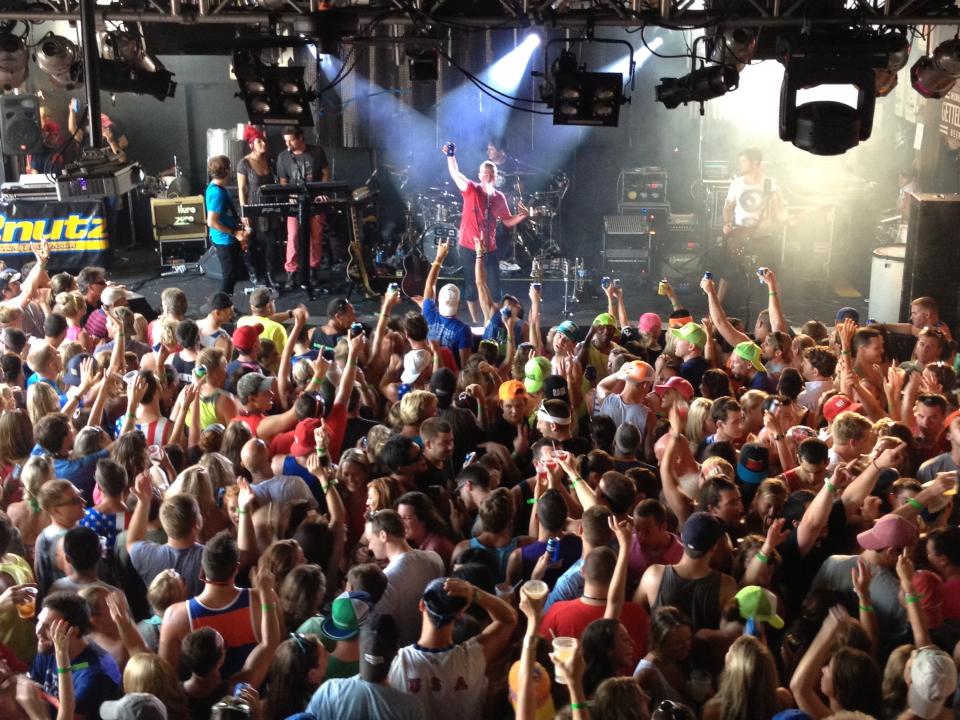
The stage is the asset. A lit stage against a dark house gives the most complete separation available in any building — a subject in a pool of light with absolute darkness around and behind, requiring no equipment at all if the rig can be set. And the setting is what to ask about: a warm wash from the front at a low angle is a better portrait light than anything else in the building, plus a backlight from above for hair separation.
What to avoid is the default, which in a music venue is frequently a rig aimed down from overhead and gelled strongly. Overhead fills eye sockets with shadow and cuts a line under every chin. And saturated gels are worse: a coloured gel is a narrow-spectrum source, so skin lit by it has almost no information in two of its three colour channels and no editing recovers what was never recorded. Coloured light belongs behind or above a couple, and asking for the wash set open white is entirely reasonable.
For the crowd and the dancing, one source direct into a modifier, close, off the camera axis, gelled warm to match the room, at about a stop above the ambient. Fall-off does the rest: in a dark room a subject three metres in front of anything else sits against natural blackness, which is free separation.
And the dancing needs a decision rather than a default. A slow shutter with modest flash records the room’s own light and shows movement as trails, which reads as a crowd and looks like the place; a fast shutter with more flash freezes everything and loses the room. Both are legitimate — choosing in advance and holding to it produces a consistent set.
- Ocean at first light; it is the only hour the sand is empty
- Do the room’s three measurements once, in the middle of the day
- Camera low at the bay; shallow water is transparent from above
- Ask for the stage wash warm, from the front, and open white
- Decide slow-shutter or frozen for the dancing, and hold to it
The coast, and the Delaware year
The two waters run on different seasons, which is worth knowing when a date is chosen.
The ocean has a long thermal lag: sea water warms and cools far more slowly than land, so the Atlantic here is coldest in spring and warmest in September. That makes late spring the foggiest season on the ocean side, because warm air over cold water condenses — and fog is a transformation rather than a loss, erasing the horizon so that ocean and sky become one field of tone with a couple as the only thing in frame with edges.
The same lag makes September the best month on the coast: warmest water, clearest air, crowds gone, sunset at a civilised hour.
The bay, being shallow, warms and cools quickly and is more reliably calm in the shoulder seasons, when the land-sea temperature difference driving the breeze is smaller. For the mirror frames a still May or October evening beats a breezy July one.
Summer is the season a resort music venue was built for: hot, humid, busy and long-evened. The crowds are the real photographic constraint outdoors rather than the light, which means first light and long lenses. The humidity makes fogging severe — a body carried from an air-conditioned interior into July air fogs on every surface at once and does not clear quickly, so a bag opened twenty minutes early is the whole fix, and in a room this cool the difference is large.
Autumn brings nor’easters, genuine coastal storms with sustained wind and heavy surf rather than mere rain, which on a barrier strip is a serious weather event. At a venue that is entirely enclosed that costs a decision rather than a picture — the room is the alternative, which is exactly what it is good at — but it removes both shorelines for the day, and both timed frames with them.
Salt and sand are what the location does to equipment. Airborne salt settles on a front element and exposed metal, attracts moisture and etches coatings over time, so a damp cloth at the end of the day is routine. Sand is worse in the short term: a grain in a zoom barrel or on a sensor is a repair rather than a clean, which means minimal lens changes and everything bagged between positions.
Wind is the constant on a narrow strip and it comes from both sides with very little to break it — no lightstands, a veil that will not behave, and anything unweighted moving. The bay shore in the lee of the strip is the calm option when the sea breeze is up, which is most summer afternoons.
Winter is cold, windy and empty, and for this venue the emptiness is the point. Both shorelines are unpopulated, the December midday sun at this latitude reaches only about twenty-eight degrees so the whole short day is raking light, and both timed frames fall at civilised hours rather than before six and after eight. The room, being windowless, is exactly the same in January as in July — which is the whole argument for a winter date here.

More frames from The Bottle & Cork

The Bottle & Cork wedding photography: common questions
Does the room's light change through the day?
No. A music venue has dark surfaces and few windows by design, so it is the same at eleven in the morning as at eleven at night — only emptier.
Is that a problem?
It is a freedom. Every indoor frame is movable, so the schedule is built around the two shorelines and nothing indoors is lost by stepping out.
What is unusual about the location?
Two shorelines facing opposite ways within a five-minute walk — the Atlantic east and Rehoboth Bay west, on a strip a few hundred metres wide.
Can you bounce flash in the room?
Usually not. The ceiling carries rigging and is dark, and the walls are dark too. One test frame confirms it; light directly into a modifier instead.
What should be asked of the stage rig?
A warm wash from the front at a low angle, a backlight for hair, and the wash set open white — saturated gels leave two colour channels empty.
Why is a winter date arguable here?
Because the windowless room is identical in January, both shorelines are empty, and both timed frames fall at civilised hours rather than before six and after eight.
More Delaware venue guides
We are writing a photographer’s guide to every venue we would happily shoot in Delaware. Here are three more, plus the full index:
- The Crooked Hammock, Rehoboth Beach: What It Suits, and What It Does Not
- The Delaware Art Museum, Wilmington: One Frame, and How It Is Made
- The Hagley Museum, Wilmington: Field Notes on a Mill Valley
Planning a wedding at The Bottle & Cork?
A room with no daytime, and two shorelines that have one. Tell us your date.