 The Rio, Las Vegas: A Walk Through an Off-Strip Resort
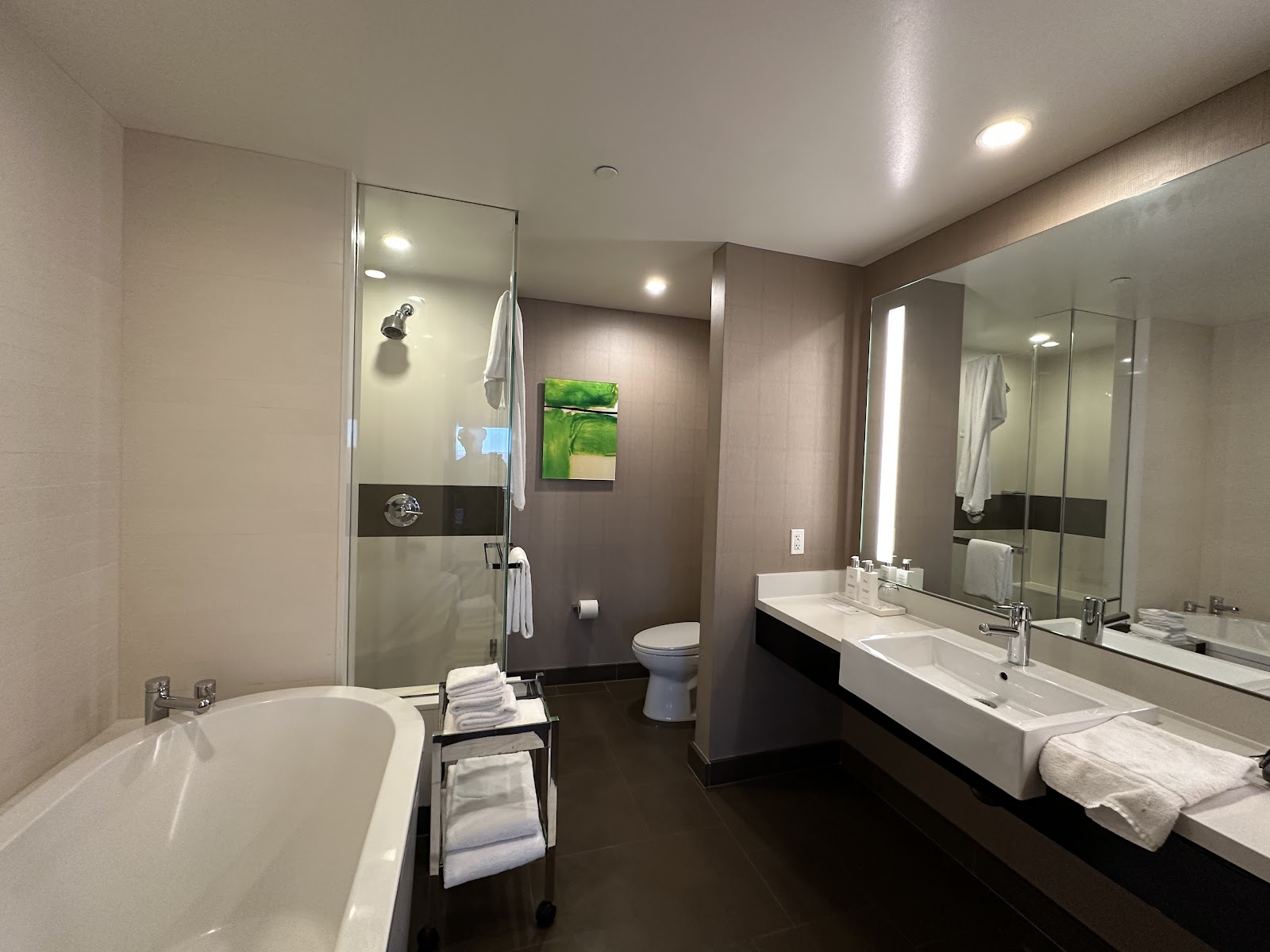
The Vdara, Las Vegas: One Frame, and How It Is Made
A window from floor to ceiling is the best light in a desert city. It is also the hardest exposure.
A modern hotel with full-height glazing gives a frame that older Strip resorts cannot, because they have no windows in their public spaces at all.
The frame is this. A couple stands beside a window that runs from floor to ceiling. Light comes in from the side, soft, large enough to wrap both faces. Beyond the glass the Las Vegas valley is visible — the Strip, the ring of desert, the mountains on the horizon. Their faces are correct, the view is correct, and the picture is plainly of this city rather than of a hotel room.
Getting all three of those right at once is the difficulty, because a bright desert exterior and an interior face differ by more stops than a sensor holds. Five decisions close that gap.
We have not photographed a wedding at the Vdara; full-height glazing and desert light behave predictably. Which spaces are included, which way the glazing faces and whether the glass is tinted are questions for their team.
The Vdara at a glance
| Where | Las Vegas Strip, Nevada |
| The frame | A couple at full-height glazing with the valley legible beyond |
| The difficulty | A desert exterior and an interior face differ by more stops than a sensor holds |
| The solution | One timed window, or one added source, and never a compromise between them |
| Ask first | Glazing orientation, tint, spaces included, lighting control |
Decisions one to three: the orientation, the distance, the tint
The first decision is which glazing, and it is settled by orientation rather than by view. A window carrying direct sun is not a soft source, it is a hard one with a hard edge, and in this climate that is more extreme than almost anywhere — the sun is high, the air is very dry, and there is nothing to scatter the beam. A sunlit full-height window produces a brilliant stripe across the floor and a face that is half blown and half black.
So the working window is the one in shade at the hour being used, which means asking which way each space faces and at what time. The desert helps here in one respect: the sky away from the sun is genuinely bright, because there is nothing in the air to dim it, so a shaded window in Las Vegas is a stronger source than a shaded window in a humid city.
The second decision is the distance from the glass, and it is the same as at any window: closer is not better. At half a metre the fall-off across two faces is severe enough that the far one goes dark; at two to three metres the light is directional but even across both. With a full-height window there is a bonus — because the source extends to the floor, the light wraps upward as well as sideways, which fills under the chin in a way a normal window does not.
The third decision is the tint, and it is worth checking in the first frame rather than in editing. Modern glazing in a hot climate is frequently coated or tinted for solar control, which does two things. It cuts the light, sometimes by a stop or more, which matters less here than it would anywhere else. And it shifts the colour, usually green or blue, which lands on anything near the glass as a localised cast that global white balance cannot separate from the subject.
The fix is a custom white balance set on a face in the actual position, or one gelled source owning the faces. What does not work is correcting globally, which neutralises the face and turns the view outside magenta.
A fourth practical note belongs here: full-height glazing reflects. From certain positions the glass shows the room behind the camera, including the photographer and any light stand, which is solved the same way mirrors are — stand where the camera will stand, look at the glass, and move whatever is showing.
Decisions four and five: the exposure, and the timing
The fourth decision is the exposure, and it is where this frame is usually lost. A bright desert valley outside and a face lit by window light inside can differ by four or five stops, which exceeds the usable range of almost any single exposure once skin tone and highlight detail are both required.
There are three honest resolutions and a fourth that is not.
Expose for the faces and let the view go white. This is legitimate and frequently the right answer for a portrait: the glazing becomes a bright field, the couple reads perfectly, and the picture is about them. It is not the frame described at the top of this piece.
Expose for the view and light the faces. This is the frame: the ambient set so the valley outside is correct, the faces then lifted by one source to match. It requires a source with enough power to compete at close range with a desert exterior — which means close, in a modest modifier, rather than far away in a large one. Gelled to daylight, with white balance set accordingly, so the faces and the view agree.
Or wait for the two to converge, which is the fifth decision and the best one.
Because the gap between inside and outside closes on its own. In the roughly twenty-five minutes after sunset the valley falls towards the brightness of the interior, and for a short period they are close enough that one exposure holds the lit room, the couple and the whole of Las Vegas beyond the glass. No equipment is needed. It is the single best frame the building gives.
It is shorter here than in a humid climate, because the very dry air gives less afterglow — twenty-five minutes is generous, and it should be treated as a scheduled ten minutes with the couple already in position rather than something to wander into. In a summer wedding it falls well into the reception; in December, with sunset in mid-afternoon, it may precede the ceremony entirely.
The fourth resolution — a compromise exposure that is neither — is the one to avoid. A frame with a slightly grey view and slightly dark faces has failed at both jobs, and it is what automatic metering produces every time. Choose, then commit.
- Use the glazing that is shaded at the hour, not the one with the best view
- Two to three metres back; full-height glass wraps upward as well as across
- Check the glass for tint in the first frame, not in editing
- Choose: faces correct, view correct, or wait for the crossing
- Never accept the compromise exposure that metering gives you
The rest of the building, and the desert year
A modern hotel of this kind has a second characteristic worth planning for: its interiors are pale, hard-surfaced and evenly lit, which means they give no natural separation. The wall behind a subject is as bright as the face in front, and the picture flattens — and nothing about that is recoverable, because the information was never recorded.
The fixes are geometric. Distance between subject and background so fall-off does some work. The darker end of the room, which every room has. A background that is depth rather than a near wall — a corridor, a doorway, a further space. And a source brighter on the face than the room is on the wall.
Reflective surfaces are the second condition: polished stone, glass, metal and lacquer are the contemporary vocabulary and each shows a badly placed light at full brightness. Fifteen seconds of checking from the camera position solves it.
Colour is the third: neutral downlights, warm accent fittings, illuminated screens, coloured uplighting installed for the event, and daylight through tinted glass. Pick the temperature that should be correct, set white balance to it, and switch off or overpower whatever else lands on skin.
Ceilings here are typically lower than in a grand ballroom, which means bounce flash returns something usable — worth one test frame on arrival, because a dark ceiling absorbs.
Outdoors, the desert gives two windows and no middle. The sun reaches roughly seventy-seven degrees above the horizon at midday in June at this latitude, and the very dry air scatters almost nothing, so the shadows are harder than the same angle gives in a humid climate and the range between lit and unlit exceeds what a sensor holds. With close to three hundred sunny days a year, cloud is a bonus rather than a plan.
So it is the first hour after sunrise, the last hour before sunset, and the twenty-five minutes after it. Open shade in the desert is better than it sounds, because pale ground bounces light up into the shadows a high sun carves — the cost being uplight under chins, so shade with a wall on one side beats shade in the open.
The year is two and a half seasons. Summer has daytime highs regularly above forty degrees Celsius, which makes outdoor blocks a matter of minutes — and makes a full-height window more valuable, because it gives the view without the temperature. The monsoon from July into September brings occasional afternoon thunderstorms and blowing dust, and a thunderstorm seen through full-height glazing is a genuinely good frame rather than a cancellation.
Winter is the good season: mild, the clearest air of the year, and sunset in mid-afternoon, which puts the crossing at a civilised hour. It is also when the view is best, because spring and summer haze — dust in spring, heat haze in summer — flattens the mountains on the horizon in a way October and January do not. For a venue whose main asset is a view, that is worth knowing.
More frames from The Vdara
The Vdara wedding photography: common questions
Which window should be used?
The one in shade at the hour being used, not the one with the best view. Direct sun through glass in this climate is an unusably hard source.
How far from the glass?
Two to three metres. Closer and the fall-off darkens the far face. A full-height window also wraps light upward, which fills under the chin.
Why check for tint?
Because solar-control glazing shifts colour, usually green or blue, as a localised cast on anything near it that global white balance cannot separate from the subject.
How do you handle the exposure difference?
Choose one: expose for the faces and let the view go white, expose for the view and light the faces, or wait for dusk when they converge. Never compromise between them.
What is the best frame in the building?
The crossing, about twenty-five minutes after sunset, when the valley falls to the brightness of the interior and one exposure holds room, couple and city.
When is the view itself best?
Autumn and winter. Spring dust and summer heat haze both flatten the mountains on the horizon; October and January are clear.
More Las Vegas, NV venue guides
We are writing a photographer’s guide to every venue we would happily shoot in Las Vegas, NV. Here are three more, plus the full index:
- The Venetian, Las Vegas: A Resort Whose Logic Is Painted Sky
- The Wynn Las Vegas: A Resort That Turns Inward
- The Aria, Las Vegas: The Light Through a Day
Planning a wedding at The Vdara?
Choose the exposure, or wait for the crossing. Tell us your date.