 Choctaw Hall: What a Gazebo Ceremony Does to the Photographs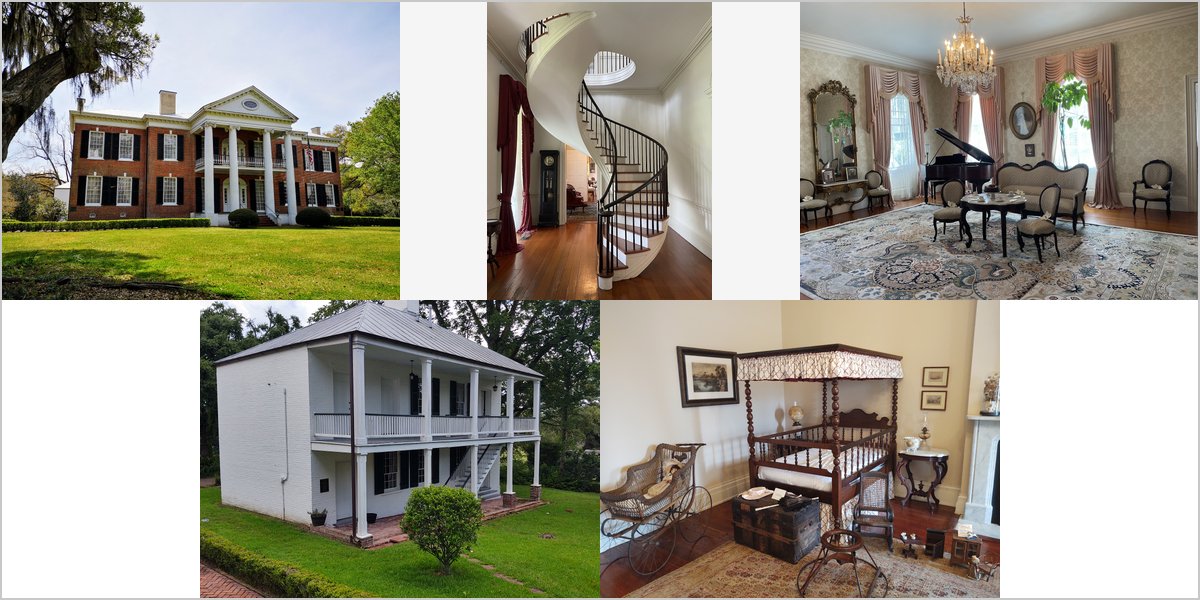
The Auburn Museum: Field Notes on a Freestanding Spiral Stair
A spiral stair with no central support is the rarest thing in this building, and it is photographed from exactly two positions.
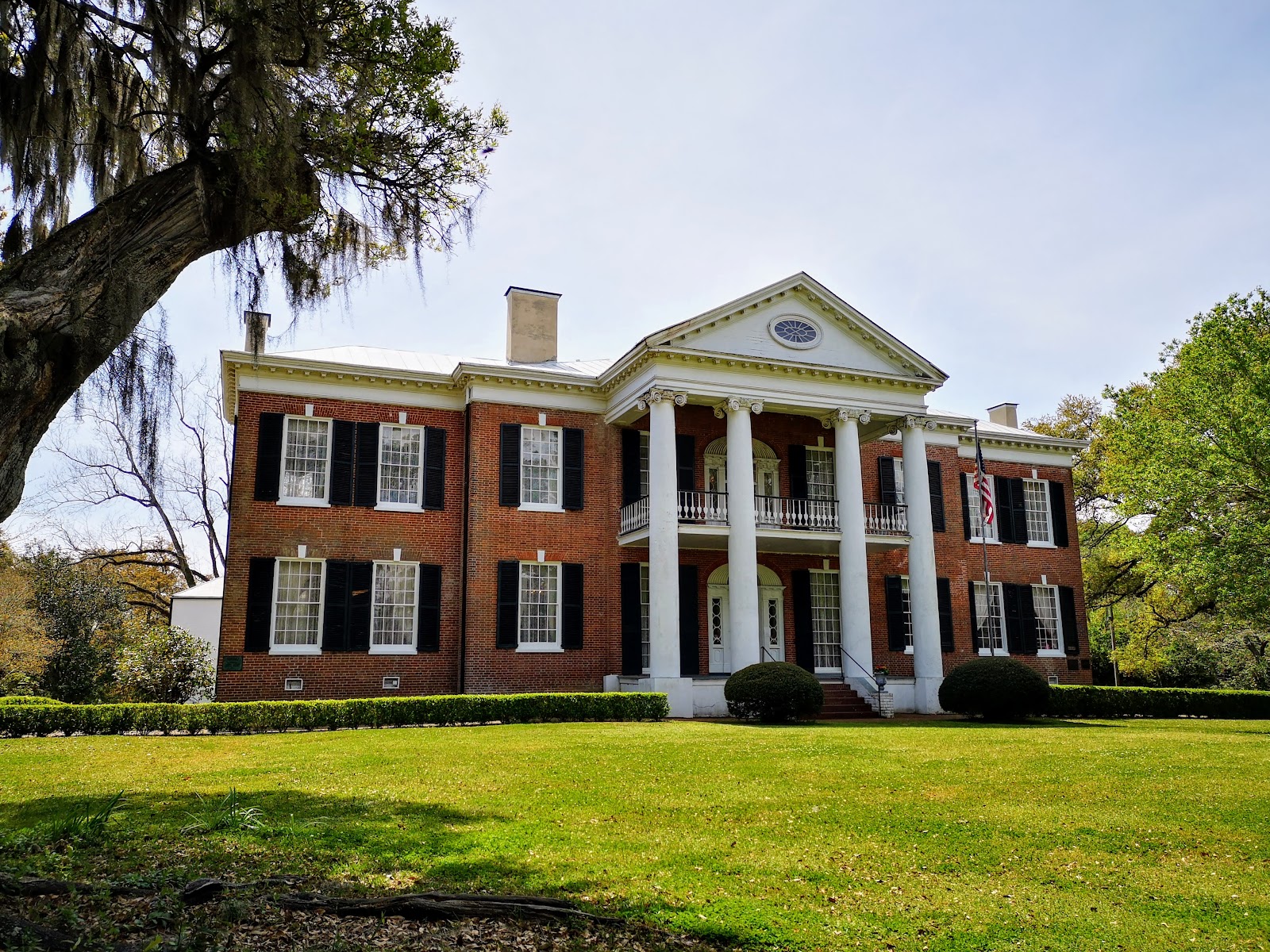
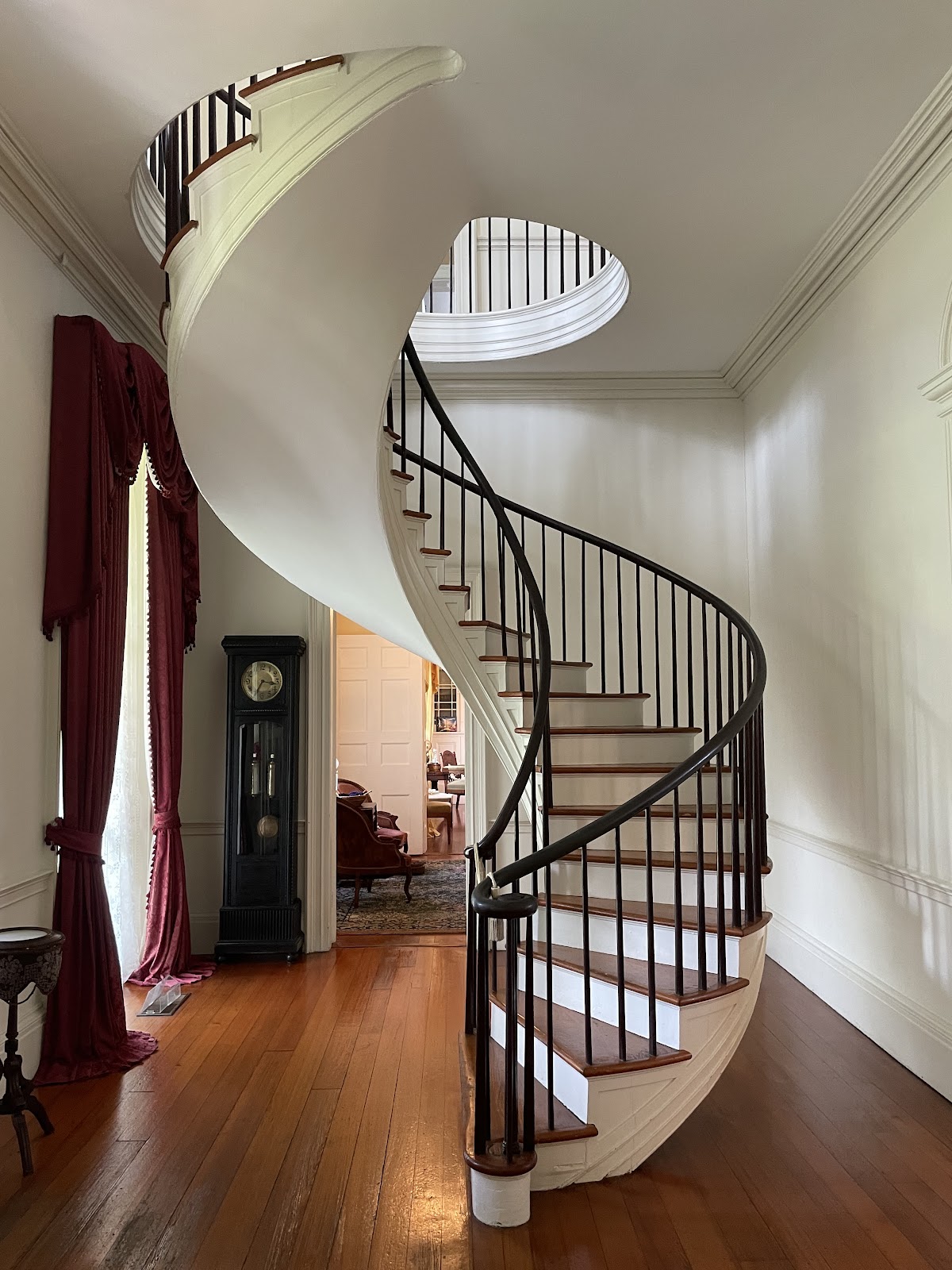
Auburn stands on parkland in Natchez, Mississippi, an early nineteenth-century brick house with a columned portico, now operated as a museum. Its interior is known for a freestanding spiral staircase — a helix that rises through the hall without a central column supporting it.
For a photographer that stair is the building’s one genuinely distinctive subject, and a helix behaves unlike any other architectural feature. It is not a backdrop you place people against; it is a three-dimensional curve whose whole interest is geometric, and it reveals itself from very few positions. Most photographs of spiral stairs fail in the same way: taken from eye level at the bottom, where the curve is foreshortened into an ordinary flight of steps and the thing that makes it remarkable is invisible.
These are field notes on that problem, plus the rest of the house. We have not photographed a wedding at Auburn; freestanding spiral stairs behave identically wherever they are built. What access a wedding has to the hall and the stair, and whether anyone may stand on it, are questions for their events team — the second is a conservation question and the answer is often no.
The Auburn Museum at a glance
| Where | Parkland in Natchez, Mississippi |
| Character | Early 1800s brick mansion with a columned portico, now a museum |
| The subject | A freestanding spiral staircase, unsupported at its centre |
| The error | Shooting it from eye level at the bottom, where the curve vanishes |
| Ask first | Whether anyone may stand on the stair at all |
Problem one: a helix only reads from directly beneath or directly above
The geometry of a spiral is a repeating curve receding along an axis, and that axis is vertical. Photograph it from the side and you are looking across the axis, which compresses the curve into a series of overlapping diagonals — visually busy and structurally unreadable. Photograph it along the axis, from directly underneath looking straight up or from the top looking straight down, and the spiral resolves into the nested concentric curve that is the whole point of it.
So there are essentially two positions, and both are uncomfortable. Directly beneath, camera pointing vertically up, a wide lens gathers the full helix winding away towards a ceiling light — that is the frame, and it is the one every photograph of a good spiral stair is. From the top looking down gives the same geometry inverted, with the additional option of a subject standing at the bottom as a small figure at the centre of the spiral.
Getting the camera truly vertical matters more than it sounds. A helix is symmetrical about its axis, so a frame even a few degrees off axis loses the concentric nesting and the curve goes lopsided. Level it deliberately — the camera’s own electronic level is the right tool — and centre on the axis rather than near it.
The wide lens this needs also distorts, and here that is useful rather than harmful: exaggerated perspective makes the spiral appear to recede further than it does, which strengthens the effect. This is one of the few situations where wide-angle distortion is working for you, provided no faces are near the frame edge.
Problem two: the light is almost always from one small source above
Stair halls in houses of this period are usually top-lit — a skylight, a lantern or a single high window at the head of the stair — because that was the only way to light a windowless internal hall before electricity. So the light in the frame comes from the far end of the axis you are shooting along, which means you are shooting almost directly into the source.
That produces very high contrast: a bright patch at the top of the frame and steeply falling illumination down the spiral towards the camera, with the treads nearest you several stops darker than the ones furthest away. No single exposure holds both ends comfortably.
The resolution is usually to accept it and expose for the middle, letting the source clip small and the nearest treads go dark. A spiral stair photographed as a bright helix winding up into light, with the foreground falling away into shadow, is honest to how the space looks and it reads as depth. Fighting the gradient with flash flattens the spiral and removes the sense of height.
If people are in the frame, they need to be near the light rather than near the camera, for the same reason — a figure at the top of the spiral is lit; a figure at the bottom is a silhouette. That is a placement decision, not a lighting one.
- Shoot along the axis — directly beneath looking up, or from the top down
- Level the camera precisely; a few degrees off axis breaks the symmetry
- Use the wide lens’s distortion deliberately to exaggerate the recession
- Expose for the middle; let the top light clip and the foreground fall dark
- Place people near the light source, not near the camera
Problem three: you probably cannot put anyone on it
This is the constraint that decides the whole approach and it needs establishing before the day. A freestanding historic stair is a conservation object as well as a structure, and museum properties commonly prohibit standing, sitting or grouping on them — sometimes entirely, sometimes limited to one or two people on the lower treads.
If nobody may stand on it, the stair becomes an architectural photograph rather than a portrait location, and that is a perfectly good outcome: the pure geometric frame from beneath is arguably stronger without a figure in it, and it belongs in the gallery as a detail image alongside the dress and the rings. What must not happen is arriving with a plan that requires a bridal party arranged up the spiral and discovering on the day that it is not permitted.
Where a limited number is allowed, one figure is better than several. A spiral is a strong pattern and a single person interrupts it cleanly; three people scattered up it break the pattern without replacing it with anything. Put one person on the lower curve, looking up or along, and let the geometry carry the rest of the frame.
Tripods are the related question. The exposures this hall needs are slow, and if tripods are restricted the practical result is a higher ISO and a wider aperture, which costs the depth of field that keeps the whole spiral sharp. Worth knowing in advance, because it changes what the frame can be.
The rest of the house, and the parkland outside
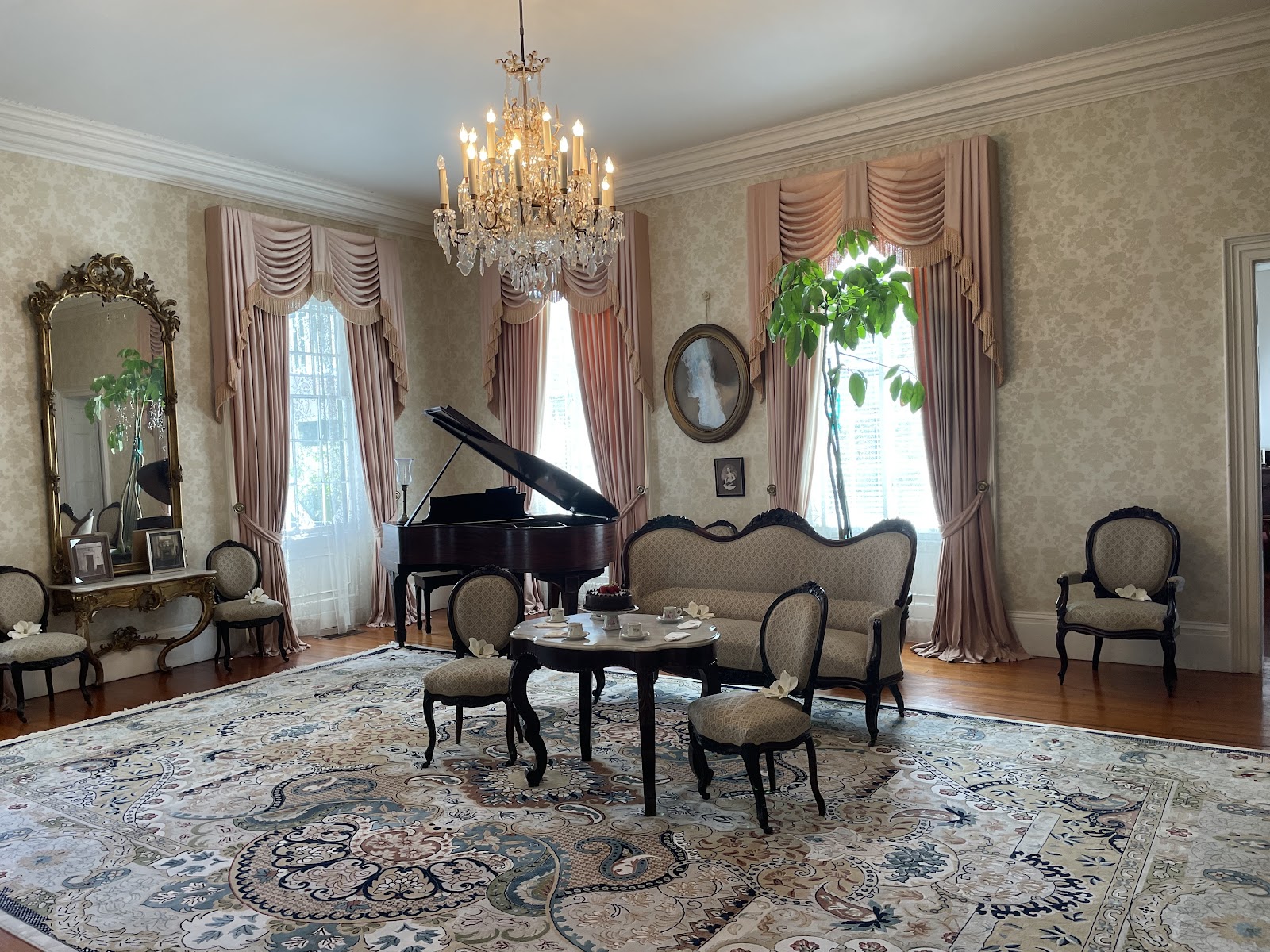
Away from the stair, Auburn is a period brick house with the conditions that implies: tall windows, dark furnishing, patterned surfaces, modest room sizes and restricted camera positions. The reliable method is to switch the lamps off, work the window light, and bounce a bare flash off a pale ceiling where more is needed — in a small furnished room that is a larger source than any modifier which would fit. Set white balance per room; warm brick and dark wood bounce strongly warm.
The columned portico is the exterior set piece and it follows the rule that applies to every classical front: it needs low raking light to show the columns as round, and it is at its worst in flat midday light where the portico reads as a flat shape. Which hour rakes it depends on its orientation, which is a ten-minute site visit rather than a guess.
The portico also provides the best shade on the property. A deep overhang gives hard-edged full shade with a bright open view in front of it, and a couple standing two metres inside that line facing out gets a large soft key with a dark surround — the most reliable good light available outdoors here, and available all day.
The parkland setting brings the standard Natchez conditions. Mature trees mean dappled light through the middle of the day, which cannot be corrected and must be avoided by position. The last ninety minutes are when the grounds are worth working, because low sun comes in under the canopy and backlights the leaves. Summer heat and humidity are severe, which limits time outside and fogs any lens brought out of air conditioning for ten to twenty minutes — acclimatise the kit before the outdoor block rather than during it.
One sequencing note. Because the stair depends on top light, it is best in the middle of the day when the sun is high enough to put light through a skylight or upper window — which is exactly when outdoors is unusable. That is a convenient division: the stair and interiors at midday, the parkland and the portico in the last ninety minutes.
What works in your favour
- A freestanding spiral stair — a subject almost no wedding venue offers
- Top-lit stair hall gives real depth and a strong graphic frame
- A deep portico providing dependable hard-edged shade all day
- Parkland with good backlit frames in the last ninety minutes
- Stair and interiors are best at midday, when outside is unusable
What to plan around
- The spiral reads from only two camera positions, both awkward
- Standing on a historic stair is often prohibited outright
- Top light creates a several-stop gradient down the spiral
- Slow exposures need a tripod, which may itself be restricted
- Severe heat and humidity; dappled light under mature trees at midday
More frames from The Auburn Museum
The Auburn Museum wedding photography: common questions
How do you photograph a spiral staircase properly?
Along its axis, not across it — from directly beneath looking straight up, or from the top looking down. From the side the curve compresses into overlapping diagonals and the geometry is unreadable. Level the camera precisely, because a few degrees off axis breaks the symmetry.
Why do my stair photos look like ordinary steps?
Because they were taken from eye level at the bottom, where the helix is foreshortened. The nested concentric curve that makes a spiral remarkable only appears when you shoot along the vertical axis.
How do you expose a top-lit stair hall?
Expose for the middle and accept the gradient — let the light source clip small and the nearest treads fall dark. A bright helix winding up into light with the foreground in shadow is honest to the space. Flash flattens the spiral and removes the height.
Can the wedding party stand on the stair?
Often not. A freestanding historic stair is a conservation object and museum properties commonly prohibit it, or allow one or two people on the lower treads. Establish it before the day — a plan requiring a party arranged up the spiral can collapse on arrival.
If one person is allowed, how many should you use?
One. A spiral is a strong repeating pattern and a single figure interrupts it cleanly, whereas three people scattered up it break the pattern without replacing it. Put one person on the lower curve, looking up, and let the geometry do the work.
When should the stair be photographed?
Midday, because it depends on top light through a skylight or high window and needs the sun high enough to deliver it. That is convenient, since midday is exactly when the grounds outside are unusable.
More Natchez, MS venue guides
We are writing a photographer’s guide to every venue we would happily shoot in Natchez, MS. Here are three more, plus the full index:
- Choctaw Hall: What a Gazebo Ceremony Does to the Photographs
- Dunleith Historic Inn: A House With a Good Side at Every Hour
- Longwood: How to Photograph a House That Was Never Finished
All Natchez, MS Wedding Venues →
Planning a wedding at The Auburn Museum?
A spiral stair is two positions and one conservation question. Tell us your date and we will confirm both before the day.