 Indianapolis Zoo: Reading a Day From Open Grounds to Underwater Glass
The Morris Performing Arts Center, South Bend: A Walk Through a Historic Theatre
A 1920s theatre has four spaces and they need four different approaches. In order, it makes sense.
A restored theatre of the 1920s is four buildings in one, and reading it as a single venue is how a day goes wrong. There is a glazed lobby at the front, an ornate foyer behind it, an auditorium that goes properly dark, and a stage with its own lighting rig — and each of those is a different photographic problem with a different answer.
Taken in the order a wedding day moves through them, the building explains itself. The lobby has the daylight. The foyer has the ornament. The house has the darkness. The stage has the drama. And the street outside has the one thing none of the interiors can give, which is a sky.
Ten minutes of walking on arrival produces the whole plan, and the plan is worth having, because a theatre gives very little to a photographer who improvises in it.
We have not photographed a wedding at the Morris Performing Arts Center; restored theatres of this period behave consistently. Which spaces are included, whether the stage lighting can be set, and what may be attached are questions for their team.
The Morris Performing Arts Center at a glance
| Where | Downtown South Bend, Indiana |
| The four spaces | Glazed lobby, ornate foyer, dark house, lit stage |
| Where the light is | The lobby, and the stage rig if it can be set |
| The best frame | Couple on a lit stage from the middle of a dark house |
| Ask first | Spaces included, stage lighting control, fixings, balcony access |
The lobby and the foyer
The lobby is the first space and it is the only significant daylight in the building, which makes it more valuable than its size suggests. A glazed street frontage behaves like a large window: the conditions are the shaded side or an overcast day rather than direct sun, and about three metres back from the glass so a row of people is evenly lit rather than dropping off the far end.
That makes the lobby where the large formals belong. It is also where the arrival and departure frames happen, and it has normal ceiling heights, which means bounce flash works — a distinction worth establishing with one test frame, because the auditorium behind it will return nothing at all.
South Bend sits at about forty-two degrees north, where the midday sun reaches roughly seventy-one degrees above the horizon in June and barely twenty-five in December. So a south-facing frontage is a high soft source in summer and carries direct low sun through much of a winter afternoon — and because the city sits in the lake-effect snowbelt, persistent winter overcast means the direct-sun problem frequently does not arise at all between November and March.
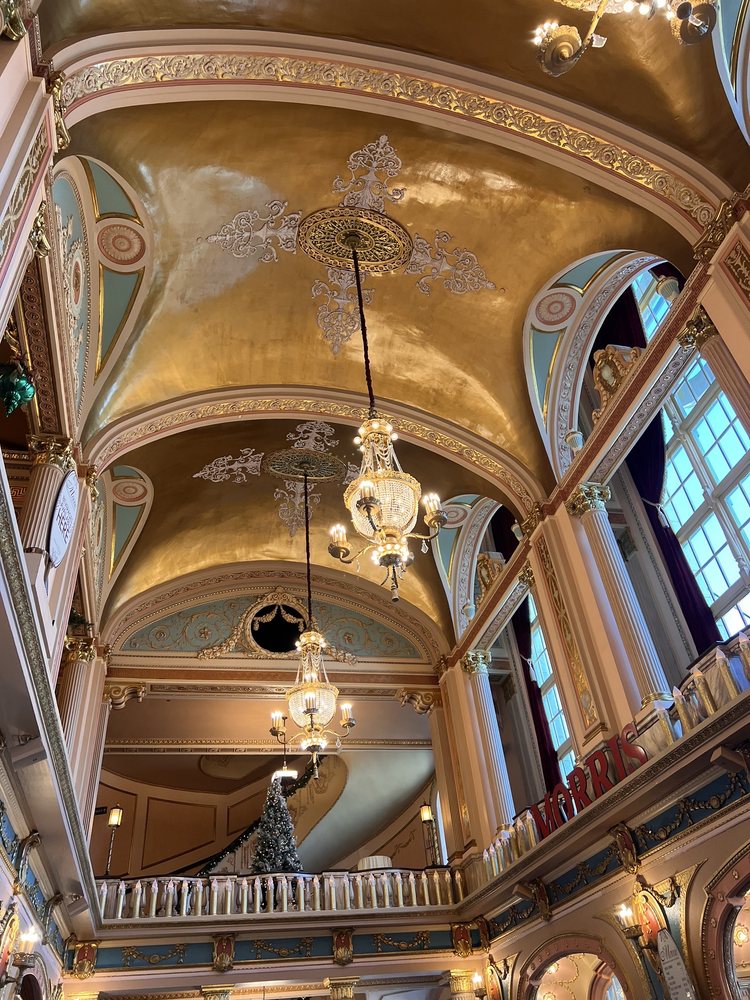
The foyer behind is the ornamental space and it is the building’s architectural showpiece: plasterwork, gilding, painted decoration, mirrors, chandeliers and a stair. Four things follow.
Ornament reads only under raking light. A source pointed at decorated plaster flattens it into one tone, while the same source placed to skim it lifts every profile. The two or three positions where the existing light already grazes a surface are worth finding on arrival and they carry a disproportionate share of the good frames.
Mirrors and gilded metal will show a badly placed light at full brightness, in a way nothing removes afterwards. The discipline is fifteen seconds: stand where the camera will stand, look at every reflective surface in the frame, and place the source where none of them sees it — usually forward of the reflecting plane and outside the frame edge on the far side.
Chandeliers and decorative fittings are the best background material in the building. At a wide aperture, with real distance behind a subject, they become warm points of light — and the frequent error is a bright fitting immediately beside a head, which pulls the eye off the face every time and is solved by moving the couple a step.
And the stair is the single best architectural feature in most theatres of this period. It gives elevation, so a photographer above a group sees faces rather than the backs of heads; a natural line for a descent; and a vertical composition with rows of people. It needs light from one side, because overhead light on a stair shadows every eye socket at once.
The house and the stage
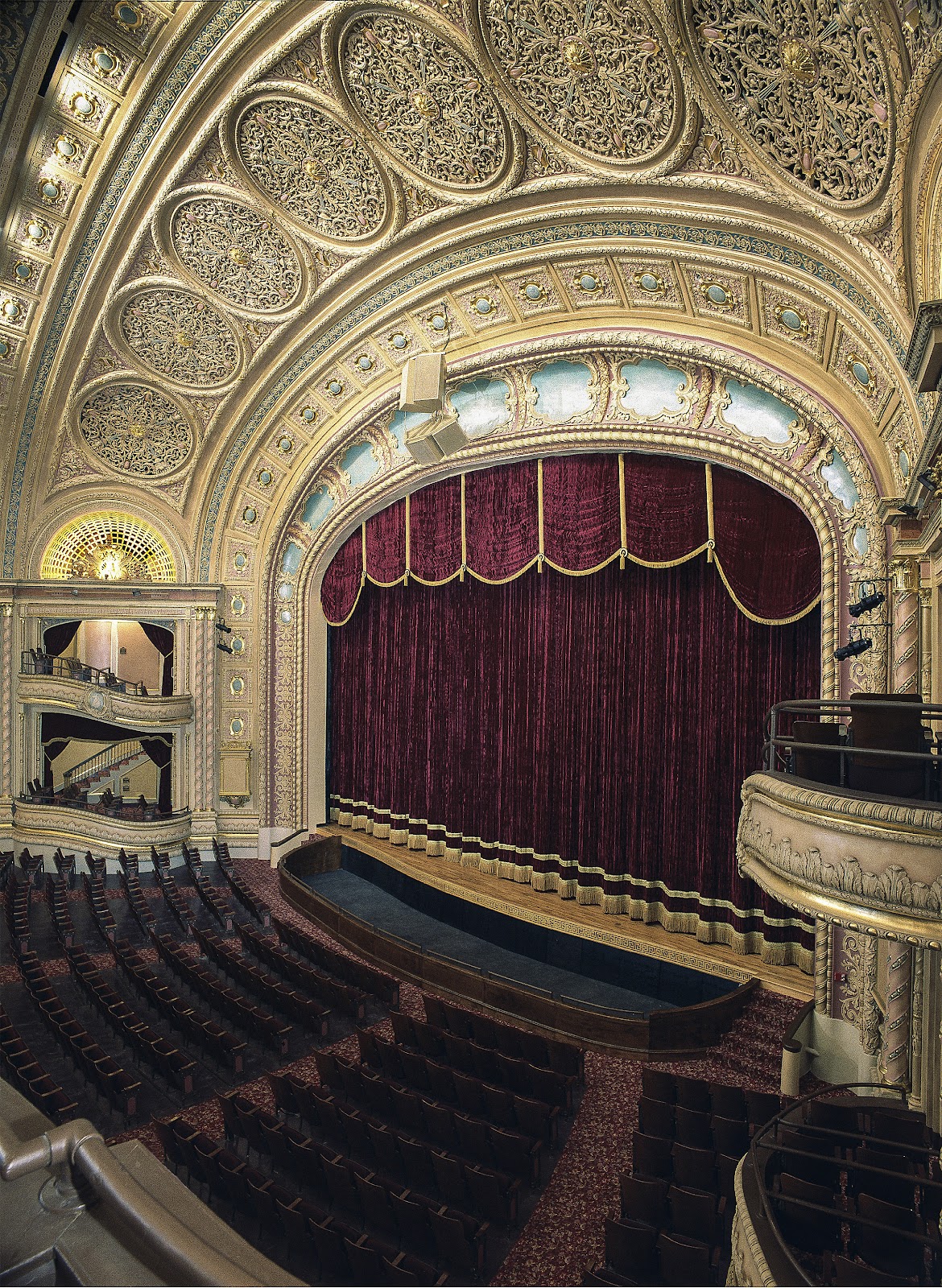
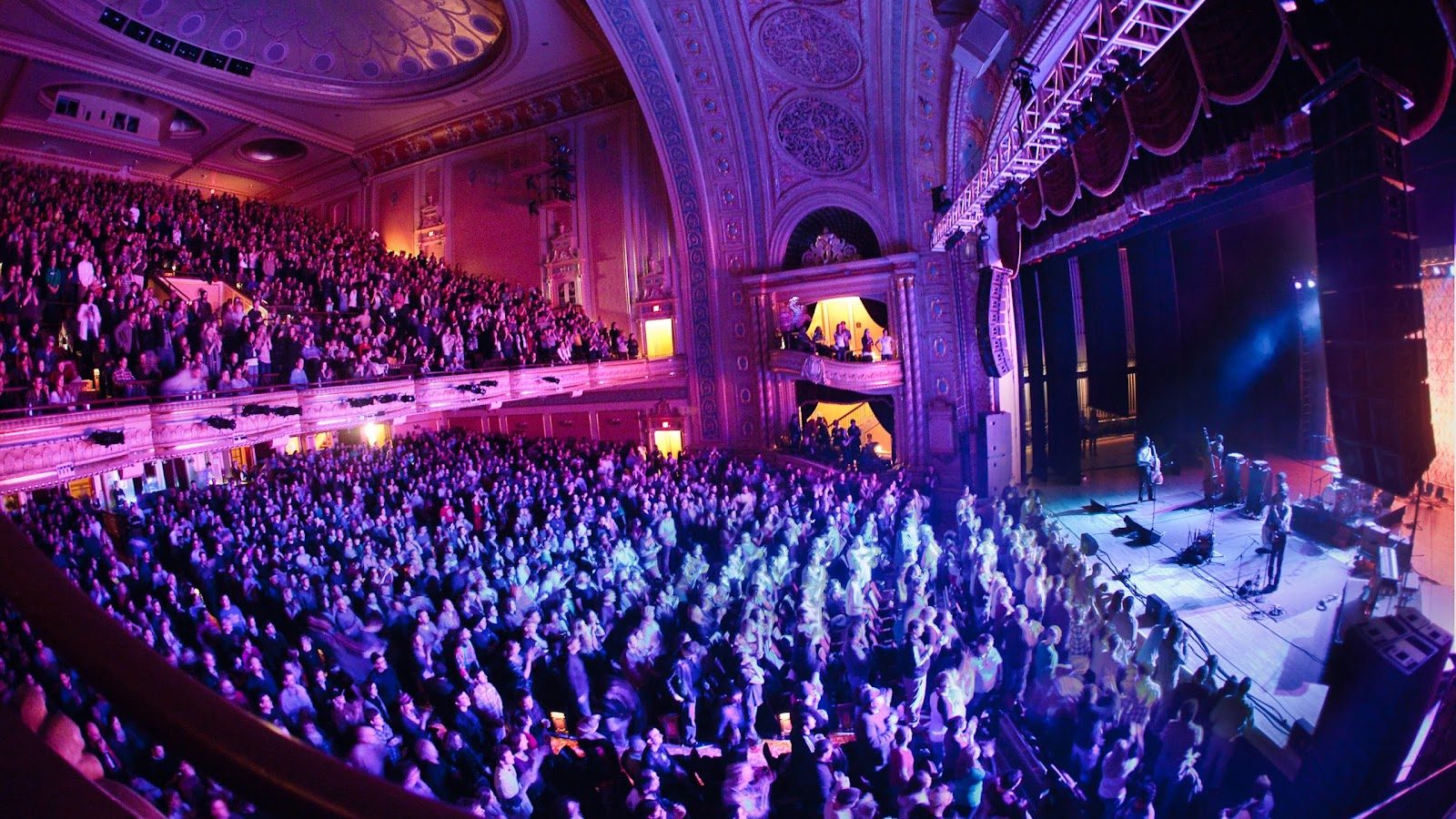
The auditorium is the third space and it is the darkest place in the building by design. A house is built so that a lit stage reads from a dark room, which means the surfaces are deliberately dark and absorbent, the ceiling is high and usually dark, and the ambient is several stops below a normal interior.
Two consequences. Bounce flash returns essentially nothing, so any frame made in the house needs a source direct into a modifier, close, and probably handheld — because a raked floor between fixed seats has nowhere safe for a stand. And the ambient should be measured rather than estimated, since eyes adapt and meters do not.
The compensation is that the house offers two frames nowhere else can. Rows of seats photographed from the stage, receding into darkness, are a strong repeating pattern with real depth — one of the few compositions where a wide lens genuinely helps. And a balcony, where there is one, gives elevation over a party that no ground-floor venue offers.
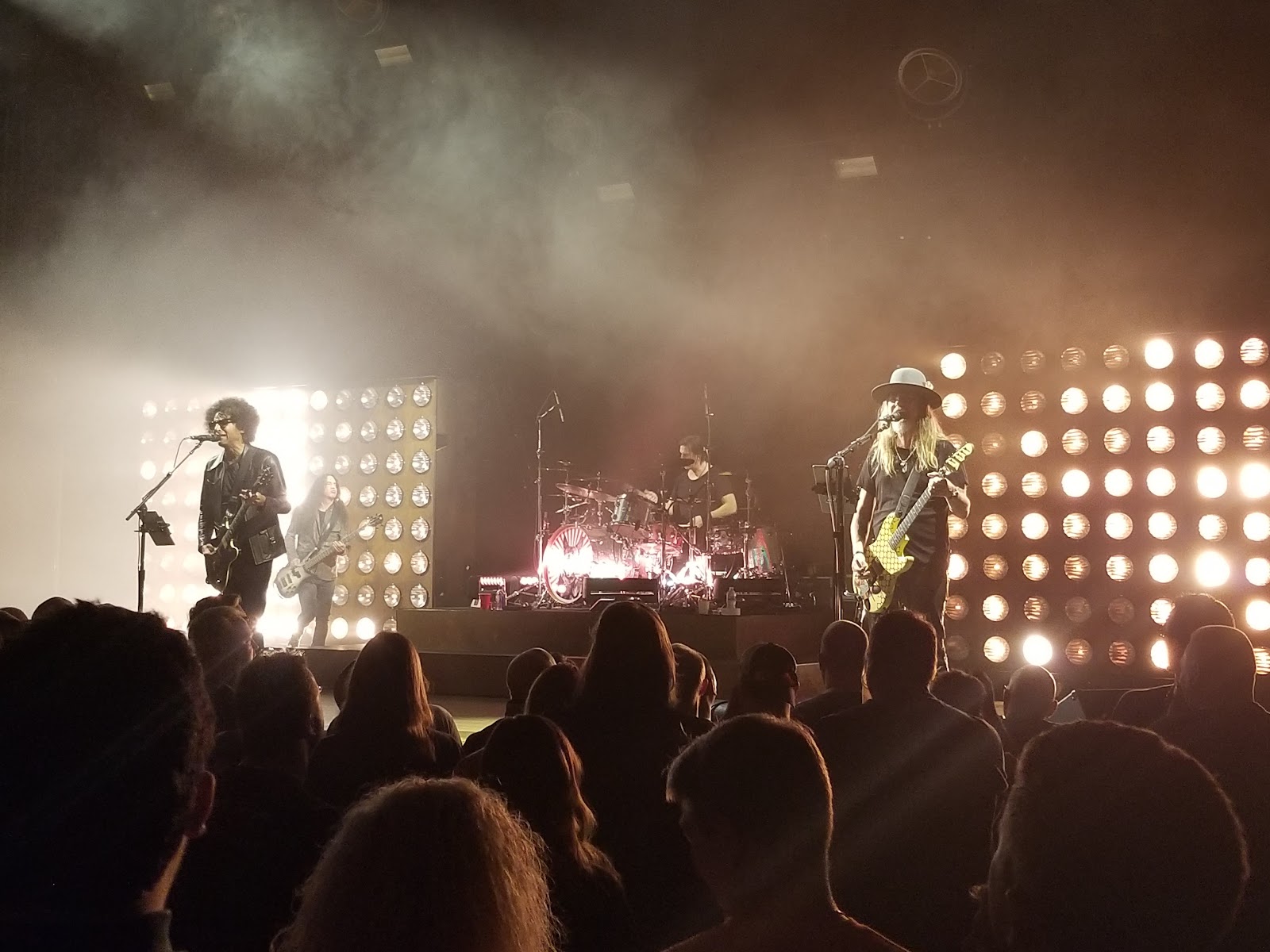
The stage is the fourth space and it gives the building’s best frame: a couple on a lit stage photographed from the auditorium sits in a pool of light with absolute darkness around and behind, which is the most complete separation available in any building and needs no equipment at all if the rig can be set.
The setting is the part worth asking about, because a stage lighting rig is a controllable instrument and most venues will help. A warm wash from the front at a low angle is a better portrait light than anything else in the building; a backlight from above separates hair from the darkness; and a side light rakes across faces to give shape. Those three are the standard theatrical set and they amount to a professional portrait setup that is permanently installed.
What to avoid is the default, which is a downlit stage from directly overhead — that is what a rig set for a play frequently gives, and it fills eye sockets with shadow and cuts a line under every chin. Asking for the front wash rather than accepting the overhead is the single most useful request available here.
Coloured gels deserve a specific warning. A saturated gel is a narrow-spectrum source: it puts most of its energy into one part of the spectrum, so skin lit by it has almost no information in two of its three colour channels and no editing recovers what was never recorded. Coloured light belongs behind or above a couple, never on their faces, and asking for the wash to be set open white is a reasonable request.
Colour generally is the standing difficulty in a theatre, because these buildings carry fittings from several eras: original tungsten-register house lights, later fluorescents in the aisles and service areas, modern LED exit and safety lighting, and a stage rig that may be tungsten, LED or both. Pick the temperature that should be correct, set white balance to it, and let one gelled source own the faces where legibility matters.
And the practical limits are worth naming: the floor slopes, the seating is fixed, the aisles are narrow, and large groups cannot be arranged anywhere except on the stage in rows or in the lobby. Establish one or two camera positions in advance and accept that repositioning mid-ceremony is not available.
- Large formals in the lobby, three metres back from the glass
- Find the positions where light already grazes the plasterwork
- Check every mirror from the camera position before the light goes on
- Ask for a warm front wash at a low angle, not the overhead default
- Ask for the wash open white — saturated gels leave two channels empty
Outside, and Indiana's year
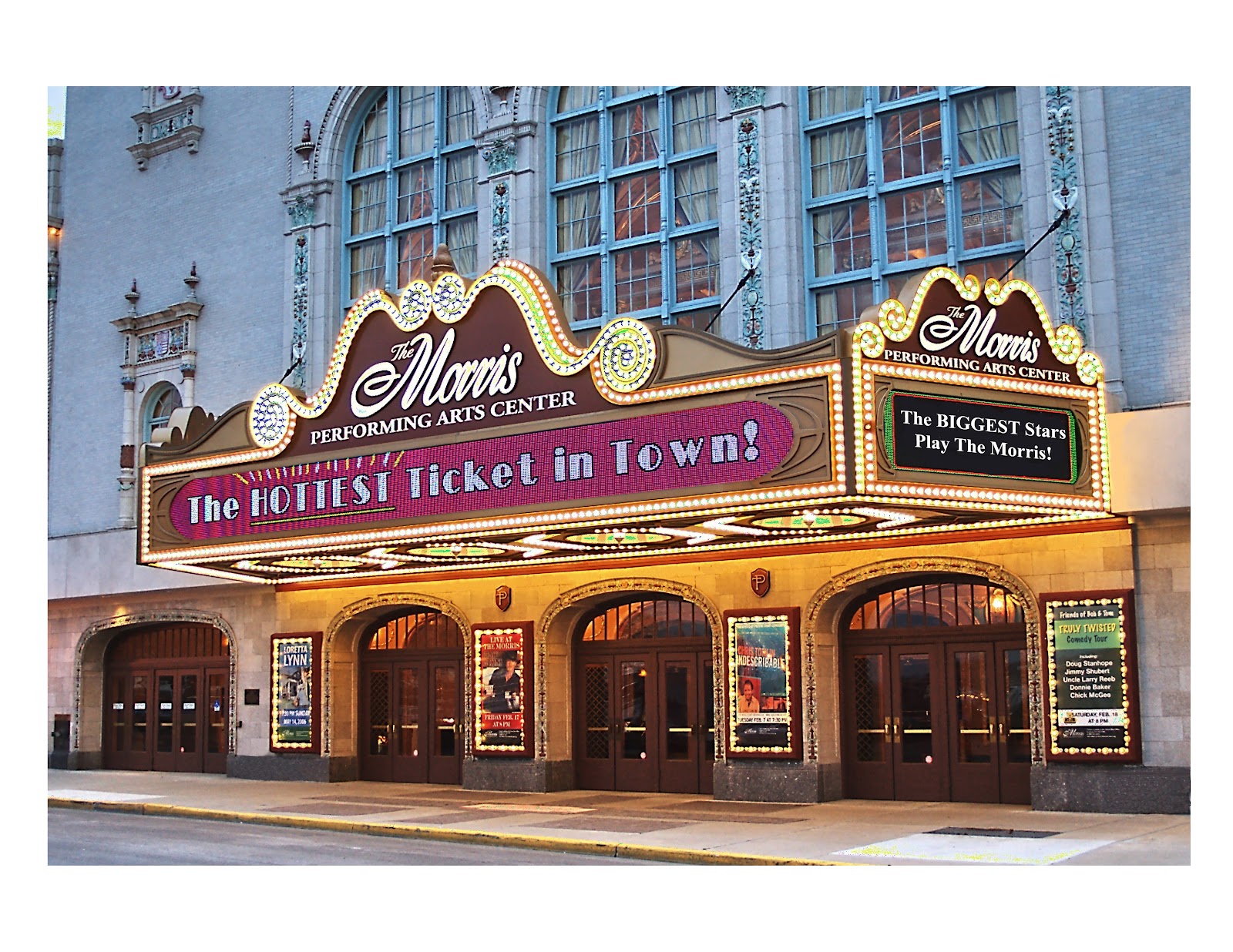
Because the building has no daylight except in the lobby, the outdoor frames matter more here than at most venues — and in a small city a historic theatre is one of the few buildings that can actually be photographed whole, because the streets are wide and there is room to stand back.
The facade and the marquee are the identifying frames and they are worth two versions. Daylight, where the lettering and the architecture read; and after dark, where the marquee is the light in the picture. The second needs the usual rule, because illuminated signage is narrow-spectrum and does not render skin: the marquee goes behind or above the couple, and one gelled source of your own lights the faces, gelled warm to match the signage with white balance set to the gel.
The timed frame is the twenty-five to forty minutes after sunset, when the sky still holds colour while the marquee and the facade lighting come up so one exposure holds couple, building and sky. That is the one picture the interior cannot give, and it is worth ten scheduled minutes — which costs nothing indoors, because the auditorium and foyer do not change through the day.
South Bend’s distinguishing climatic feature is that it sits in the lake-effect snowbelt southeast of Lake Michigan, and it changes what to expect for months. Cold air crossing relatively warm lake water picks up moisture and drops it downwind, which means substantially more snow than places at the same latitude away from the lake — and persistent overcast, with winters among the cloudiest anywhere in the country outside the Pacific Northwest.
That is genuinely good news for this building. Overcast is the best soft source there is, which means the lobby glazing gives even, shadowless, flattering light through the whole winter with no direct-sun problem at all. And snow turns the ground into an enormous reflector, so the lobby in February is brighter and softer than in June, with light arriving from below as well as above.
Snow outdoors is the best natural fill available, lifting exactly the shadows a low sun carves while fooling a meter by about two stops — and a lit marquee above snow at dusk is the strongest exterior frame this kind of venue gives anywhere.
The short December day is the constraint: sunset in the middle of the afternoon compresses the outdoor block into a couple of hours, so the street positions should be decided in advance rather than explored.
Summer is hot and humid, and the humidity rather than the heat is the photographic fact — moist air softens shadows and slightly flattens distance. Severe afternoon thunderstorms are a real possibility from late spring, which at an indoor venue costs a decision rather than a picture, and wet pavement reflecting a lit marquee is a better frame than the dry version.
The humid fogging problem matters at a theatre because the house is cooled hard: a body carried straight out into July air fogs on every surface at once and does not clear quickly, so a bag opened twenty minutes early is the whole fix. Autumn is the best light of the year — humidity down, air clear, low sun at a civilised hour, usually mid-to-late October.
More frames from The Morris Performing Arts Center
The Morris Performing Arts Center wedding photography: common questions
What are the four spaces?
A glazed lobby with the only daylight, an ornate foyer with the architecture, a dark auditorium, and a lit stage. Each needs a different approach.
Where do the large formals belong?
The lobby, three metres back from the glass. It is the only significant daylight and it has ceilings low enough for bounce flash to work.
What is the best frame in the building?
A couple on a lit stage photographed from the dark house — the most complete separation available anywhere, and it needs no added equipment.
What should be asked of the stage rig?
A warm front wash at a low angle rather than the overhead default, plus a backlight. That is a professional portrait setup already installed.
Why avoid coloured gels on faces?
Because a saturated gel is narrow-spectrum: two colour channels have almost no data, and no editing recovers what was never recorded.
Does the cloudy winter hurt?
The opposite. Persistent lake-effect overcast means the lobby glazing gives even soft light all winter, and snow makes it brighter and softer still in February.
More Indiana venue guides
We are writing a photographer’s guide to every venue we would happily shoot in Indiana. Here are three more, plus the full index:
- The Oliver Mansion, South Bend: A House Built Before Electric Light
- The Studebaker Mansion, South Bend: The Light Through a Day
- Abe Martin Lodge, Nashville: The Venue’s Own Logic
Planning a wedding at The Morris Performing Arts Center?
Four spaces, walked in order. Tell us your date and we will plan each one.