 The Venetian, Garfield: The Building’s Own Logic
The Park Loft, Jersey City: The Problem, and Four Ways Out of It
No view, and a room that gives you nothing. Four ways out.
Almost every venue on this side of the Hudson sells the same thing, which is the view. This one does not have it, and that changes the whole job.
Park Loft is a converted industrial space in Jersey City — a loft, which is to say a large open floor in a building put up for manufacturing or storage rather than for assembly. What that gives a wedding is volume, character and flexibility. What it gives a photographer is a big dim room with columns in it.
That is the problem, stated plainly, and it has four parts.
The first is that the light is on one side. An industrial floor has windows in its perimeter walls and nothing in the middle, so there is a bright band along the glazed elevation and a deep falloff away from it. A room like this is not evenly lit and cannot be made so without equipment.
The second is the columns. A long-span industrial floor is held up by posts, and those posts are in the middle of the room where the dance floor and the tables are. They are load-bearing, they are not moving, and they will be in frame.
The third is the ceiling. Exposed structure, ducts, sprinkler pipes, conduit and lighting track overhead is the aesthetic of the building type and it is also a bounce problem — an open serviced ceiling absorbs and scatters anything you aim at it, so the standard trick of lifting a room by bouncing off the ceiling frequently does not work here.
And the fourth is that there is no view to fall back on. At a glass venue on the waterfront, a photographer having a difficult hour indoors can walk to the window and make a skyline frame. Here the windows look at a street.
None of that makes this a bad venue. Industrial lofts produce distinctive, atmospheric, thoroughly un-generic photographs, and a set made here will look nothing like the five other Jersey City weddings that month. But the good frames come from four specific manoeuvres rather than from working the room as though it were a hotel.
The first is the windows, which in a building of this type are the single best light source available anywhere in this city.
The second is to use the structure — the columns, the beams, the repetition — as architecture rather than treating it as an obstruction.
The third is to bring light and use the darkness, because a large dim room is a black studio and separation comes free.
And the fourth is to leave, because the district outside has brick, scale and, from the right street, a view after all.
Each of those in detail, then the year.
The Park Loft at a glance
| Where | A converted industrial loft floor in Jersey City, NJ |
| The problem | Light on one side, columns in the middle, an open ceiling, and no view |
| Four ways out | The windows, the structure, bringing light, and the district outside |
| The best asset | Large multi-pane industrial windows — the best light in the city |
| Ask first | Which elevation the windows face, and whether lights on stands are permitted |
Ways one and two: the windows, and the structure
The windows first, because they are genuinely exceptional and most people underuse them.
Industrial buildings were glazed before electric light was cheap, which means the window openings are enormous by domestic standards — often floor to ceiling, in continuous banks, divided into small panes by steel or timber glazing bars. A bank of glazing like that is a softbox several metres tall and many metres long, and there is nothing in a hotel that compares to it.
Three properties make it better than a modern glass wall. It is taller relative to the room, so the light comes from above as well as beside, which fills eye sockets rather than skimming across them. It is divided, so the glazing bars break the source into a grid — which produces a faint but real structure in the highlight on a face and, more usefully, a graphic pattern when you shoot toward it. And it is usually old glass, which is slightly irregular and scatters more than modern float glass, so the light is softer than the aperture size alone would predict.
Work at right angles to it, a metre and a half back, and it is as good as window light gets. Work along it and you get a run of identical positions, which is useful for family groups — everybody lit the same way without moving a light.
Shoot toward it deliberately as well. A subject placed against a bank of industrial glazing, exposed for their face with the windows blown, gives a high-key graphic frame with the grid of bars as the whole background. That is a completely different picture from the same subject lit by the same window, and it takes no equipment.
One thing to establish in advance: which compass direction the glazing faces. In a building where the windows are the only light, aspect is the most consequential fact about the booking. An east-facing bank is a hard beam early and soft skylight for the rest of the day; a west-facing bank is soft all morning and takes direct sun in the last hours, which in a loft means a room full of long raking beams and floating dust — spectacular, and a four-stop contrast problem.
There is a latitude note attached to that. At about forty and a half degrees north the sun’s setting azimuth swings something like sixty degrees across the year, from well north of west in late June to well south of west in late December. So a west-facing bank of windows takes direct sun at a substantially different angle in January than in July, and a bank facing north-west may get direct light in midsummer and none at all in winter. Check it for the actual date rather than trusting a summer scout.
Now the structure, which is the second way out and the one that turns a liability into a style.
The columns are in the room and they will be in frame, so the choice is whether they look accidental or deliberate. Deliberate means using them: put one just inside the frame edge as a vertical, or shoot down a line of them so they repeat and converge, or place a subject beside one so the post gives the frame a spine. A column sitting randomly behind somebody’s head looks like carelessness; the same column at the third of the frame looks like composition.
Shooting down the line is the strongest frame the room offers. A long-span floor has its posts in a regular grid, and a long lens along one row compresses them into a rhythm receding to a vanishing point, with beams overhead doing the same thing. A figure in that space reads as small inside a large pattern, which is exactly the effect an industrial building should produce.
The overhead structure wants raking light rather than frontal. Exposed beams, ducts, conduit and rivets are all relief, and relief shows when light comes across it. A light placed high and to one side, almost parallel to the ceiling plane, throws every pipe and bracket into its own shadow; the same light aimed up at the ceiling flattens it to a grey mass.
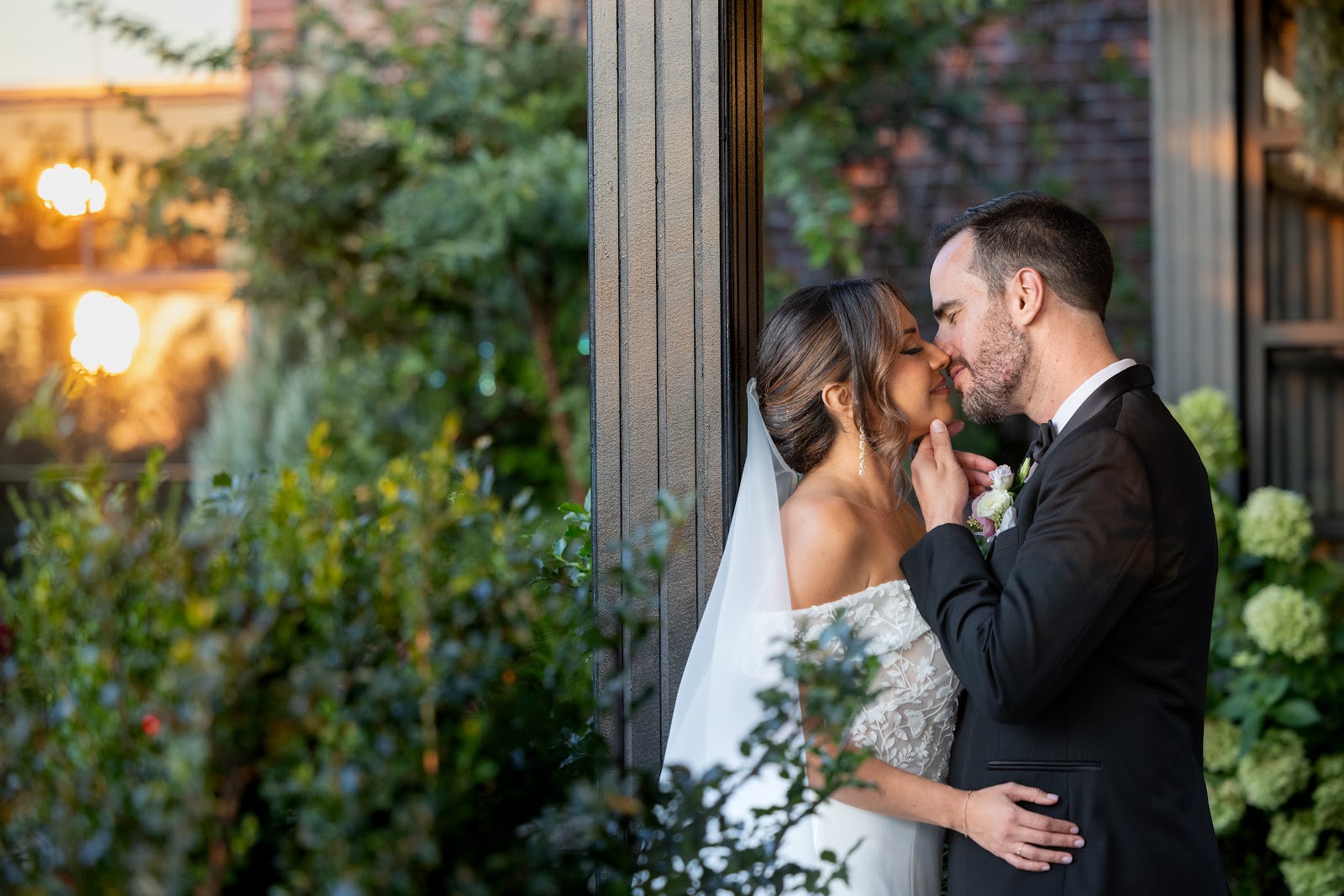
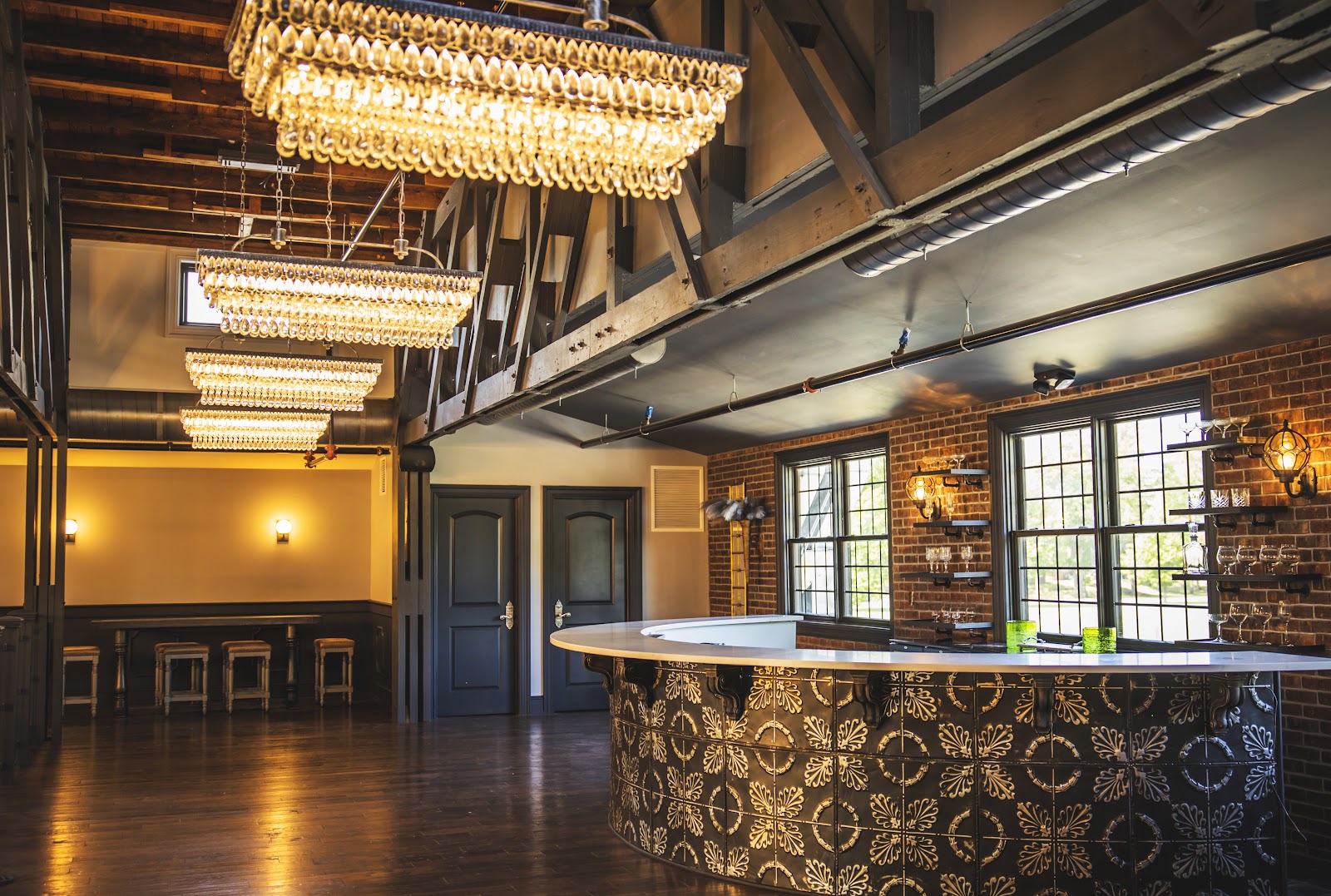
And the brick, if the walls are brick, is the friendliest material in the building. Brick is warm, matte and finely textured, it holds its colour in shade rather than going blue the way limestone does, and it takes low raking light extremely well. A brick wall two metres behind a subject at a moderate aperture is one of the most reliable backgrounds anywhere. In an overcast, it still reads warm when everything else has gone grey.
Ways three and four: bring light, and leave the building
The third way out is the one that makes the reception work, and it starts with a question that has to be asked before the date.
Ask whether lights on stands are permitted, where, and at what hours. Converted industrial venues vary enormously on this — some are entirely relaxed, some restrict stands in the guest area for safety reasons, which is reasonable — and the answer changes the whole plan. Get it in writing.
Assuming they are, the technique in a big dim loft is the opposite of the technique in a hotel ballroom. Do not try to lift the room. An open serviced ceiling will not give you a useful bounce, and a room this large would need far more output than is practical to raise by a stop. Instead, light small and let the darkness do the work.
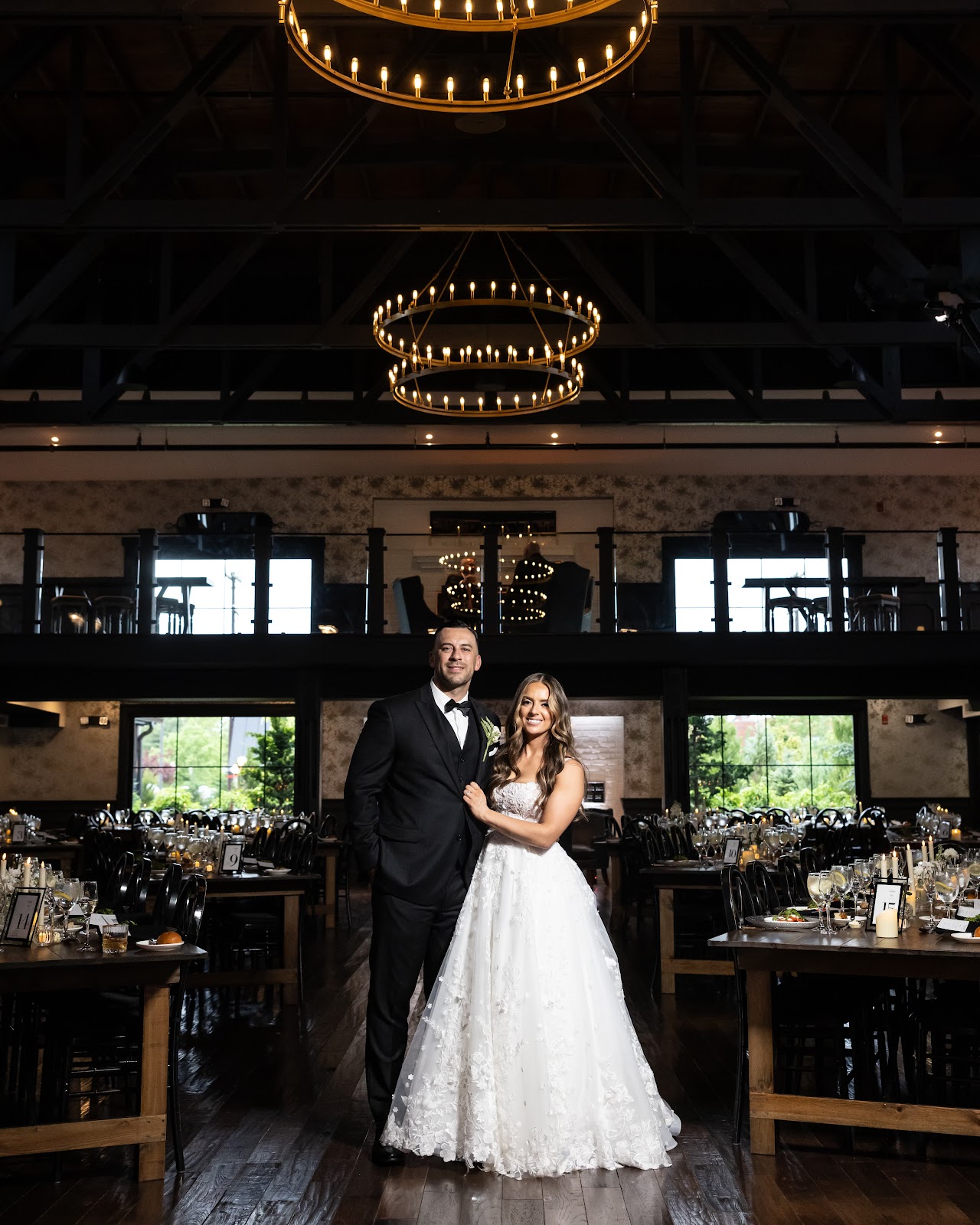
A large dim space is a black studio. A subject lit by a single modifier at one end of it separates completely from the background, because the background is four or five stops down and records as nothing. That is separation for free, without a long lens and without a wide aperture, and it is the single most useful property of a venue like this.
So: one light, close, feathered, on a stand, and a subject placed with a lot of empty dark room behind them. That produces a clean, dramatic, deliberate portrait in about ninety seconds, and it can be repeated in six positions along the floor without moving anything but the stand.
For the wider reception frames, accept that the room will be dark and light the people rather than the space. A small on-camera source bounced off a nearby wall — a brick wall works well, and adds warmth — plus whatever the house scheme is doing, is usually enough. If the house scheme is festoon or pendant lighting, which in lofts it very often is, those bulbs are a feature: get them in frame, let them clip, and they read as warmth rather than as blown highlights.
Mixed colour is the thing to manage. A converted building accumulates lighting — original fittings, added track, festoon, LED uplighters, exit signage — at different temperatures and with different spectra, and no single white balance reconciles them. Choose the dominant source, balance for that, gel your own light to match it, and let the rest fall where it falls. Averaging is what makes industrial interiors look grey and dead.
The fourth way out is to leave, and in this district that is worth twenty minutes.
Jersey City was a manufacturing and rail city before it was anything else, and the streets around a converted loft carry the evidence: brick warehouses, loading bays, cobbles in places, rail relics, painted signage faded on masonry. Those are the plain strong backgrounds that a photographer needs and they are free. A brick wall in raking light, a loading dock as a stage, an alley as a compressed corridor — all within a five-minute walk.
Scale is the thing to use out there. A warehouse elevation is large and repetitive, and two small figures at the base of one is a stronger frame than a tight portrait against the same wall. Stand back and let the building be the subject.
And there is a view after all, if you walk to it. This is the west bank of the Hudson, and from the right street-end or waterfront path the Manhattan skyline is visible across the water — front-lit and warm at sunset, because the low sun is behind you on this side rather than behind the towers. A large clock face survives on the waterfront nearby as a landmark. Ask how far the nearest open sightline is and time the walk, because if it is ten minutes rather than twenty-five it changes the evening plan entirely.
That is the honest hierarchy for the end of the day. If the water is within a short walk, take the wedding party there for the balance point — twelve to fifteen usable minutes after sunset, when the skyline lights and the sky are within a stop of each other. If it is not, make the frame inside against the windows, with the room dark and the glazing grid as the background, which is a genuinely good photograph and needs nothing from the geography at all.
Jersey City, and the year
Three numbers from the latitude — about forty and a half degrees north — set the day, and at a venue whose light comes through one elevation they matter more than usual.
The midsummer noon sun reaches about seventy-three degrees. In a loft that means very little direct light enters the windows at all through the middle of a summer day, because a near-overhead sun skims past a vertical opening rather than coming through it. So a July afternoon in here is soft, even skylight — pleasant, undramatic, and stable for hours. That is a genuinely useful condition and it is the opposite of the outdoor situation at the same hour.
The midwinter noon sun sits near twenty-six degrees, which comes deep into the room all day. A low sun through a divided industrial window lays a grid of bright panels across the floor and the far wall, and it does so from mid-morning until mid-afternoon. That is the most dramatic light the building ever gets and it is a winter-only phenomenon. A photographer who only knows this venue in summer has not seen it.
And civil twilight runs about thirty minutes in midsummer, of which the useful balance point is twelve to fifteen — relevant only if the water is within reach, as discussed above.
The seasonal inversion is worth stating plainly because it is unusual. Most venues in this library are better in the shoulder seasons. This one is photographically best in deep winter, when the low sun comes through the glazing, and most comfortable in the shoulders. Summer gives the softest and least interesting light of the year indoors.
Air clarity matters only for the walk to the water, and there it matters a lot. Cold dry winter air over the harbour is far more transparent than summer air, so the skyline resolves with real detail in January and February and softens into a pale grey mass in July and August. If a skyline frame is part of the plan, the season is the single largest variable in how good it will be — and compose tight in summer, because haze accumulates with distance.
Comfort is the practical seasonal question in a converted industrial building and it is worth asking about directly. A large volume with single glazing, an uninsulated shell and an open roof structure is expensive to condition, and the honest range of outcomes runs from excellent to noticeably hot in a metro-area July and noticeably cold in a January cold snap. Ask what the heating and cooling actually are, because a room at thirty degrees with a hundred and fifty people in it photographs as a room at thirty degrees.
Dust is the other industrial-building note, and it is a mixed blessing. An old floor with an open structure above it has dust in the air, and dust in a raking beam is visible — which is why a winter afternoon in here produces genuine visible light shafts. That is the best thing the building does and it is also what puts specks on a sensor. Check the sensor before the ceremony rather than after.
Late September into early November and late April into May are the comfortable windows, with reasonable temperatures, decent air clarity, and sunset at a civil hour so a walk to the water is viable. Summer gives long evenings — sunset after eight in late June, balance point near half past eight, comfortably inside a reception — and hazy distance. Winter gives short days, the best interior light of the year, the clearest skyline, and a balance point before five that falls during cocktails and has to be a named item on the timeline.
One weather note that is actually good news for this venue. Rain does not matter here. A loft wedding is entirely indoors by design, and a wet evening costs you only the walk to the water — which, if it happens, is replaced by the window frame described above. At a waterfront glass venue a storm costs you the whole reason for being there; here it costs you an optional twenty minutes. For a couple weighing an outdoor-dependent venue against this one, that resilience is a real argument and it is rarely made.
The other side of the same coin: there is nothing outdoors here to lose and nothing outdoors to gain. Everything this venue offers is made rather than found, which is why the four manoeuvres matter and why the question about lights on stands should be the first one asked.
More frames from The Park Loft
The Park Loft wedding photography: common questions
What is the problem with a loft?
Four things at once. The light is on one side only, because an industrial floor has perimeter glazing and nothing in the middle, so there is a bright band and a deep falloff. The columns holding the long span are in the middle of the room and will be in frame. The open serviced ceiling absorbs anything you bounce at it, so the usual trick of lifting a room from the ceiling does not work. And there is no view to fall back on when an hour indoors is going badly.
What is the best thing about it?
The windows, and they are genuinely exceptional. Industrial buildings were glazed before electric light was cheap, so the openings are enormous — often floor to ceiling in continuous banks, divided into small panes. That is a softbox several metres tall, taller relative to the room than a modern glass wall, so the light comes from above as well as beside and fills eye sockets rather than skimming them. Old irregular glass also scatters more than modern float glass, making it softer than the size alone predicts.
How should the columns be handled?
Deliberately, because they are not moving. A column sitting randomly behind somebody’s head looks like carelessness; the same column placed at the third of the frame looks like composition. The strongest frame the room offers is a long lens down a row of posts, compressing them into a rhythm that recedes to a vanishing point with the beams overhead doing the same — a figure in that space reads as small inside a large pattern, which is exactly what an industrial building should do.
How do you light a big dim room?
Do not try to lift it. An open serviced ceiling gives no useful bounce and the volume is too large to raise by a stop at any practical output. Instead treat it as a black studio: one light, close and feathered, with a lot of empty dark room behind the subject. The background is four or five stops down and records as nothing, so separation comes free without a long lens or a wide aperture. It takes about ninety seconds and repeats anywhere on the floor.
Is this venue better in a particular season?
Yes, and it inverts the usual advice: it is photographically best in deep winter. A midwinter noon sun near twenty-six degrees comes deep into the room from mid-morning to mid-afternoon, laying a grid of bright panels across the floor from the divided glazing — the most dramatic light the building ever gets, and a winter-only phenomenon. A near-overhead summer sun skims past a vertical window instead, so July gives soft, even, undramatic skylight for hours.
Does rain matter here?
Almost not at all, and that is a genuine argument for this kind of venue. The wedding is indoors by design, so a wet evening costs only the optional walk to the waterfront, which is replaced by a frame against the windows with the room dark and the glazing grid as the background. At a waterfront glass venue a storm costs the whole reason for being there. Worth asking about instead: what the heating and cooling actually are, because a large single-glazed volume with an open roof can be hot in a metro July and cold in a January snap.
More Jersey City, NJ venue guides
We are writing a photographer’s guide to every venue we would happily shoot in Jersey City, NJ. Here are three more, plus the full index:
- The Battello, Jersey City: The Light Through the Day
- The Hudson House, Jersey City: One Frame, and How It Is Made
- The Liberty House, Jersey City: The Venue’s Own Logic
Planning a wedding at The Park Loft?
No view, four manoeuvres, and rain that does not matter. Tell us your date.