 The Venetian, Garfield: The Building’s Own Logic
The Hudson House, Jersey City: One Frame, and How It Is Made
The window does not have to be in the photograph.
This guide is about a single photograph and about a technique that most wedding photographers never use, although it is a hundred years old and takes four minutes to set up.
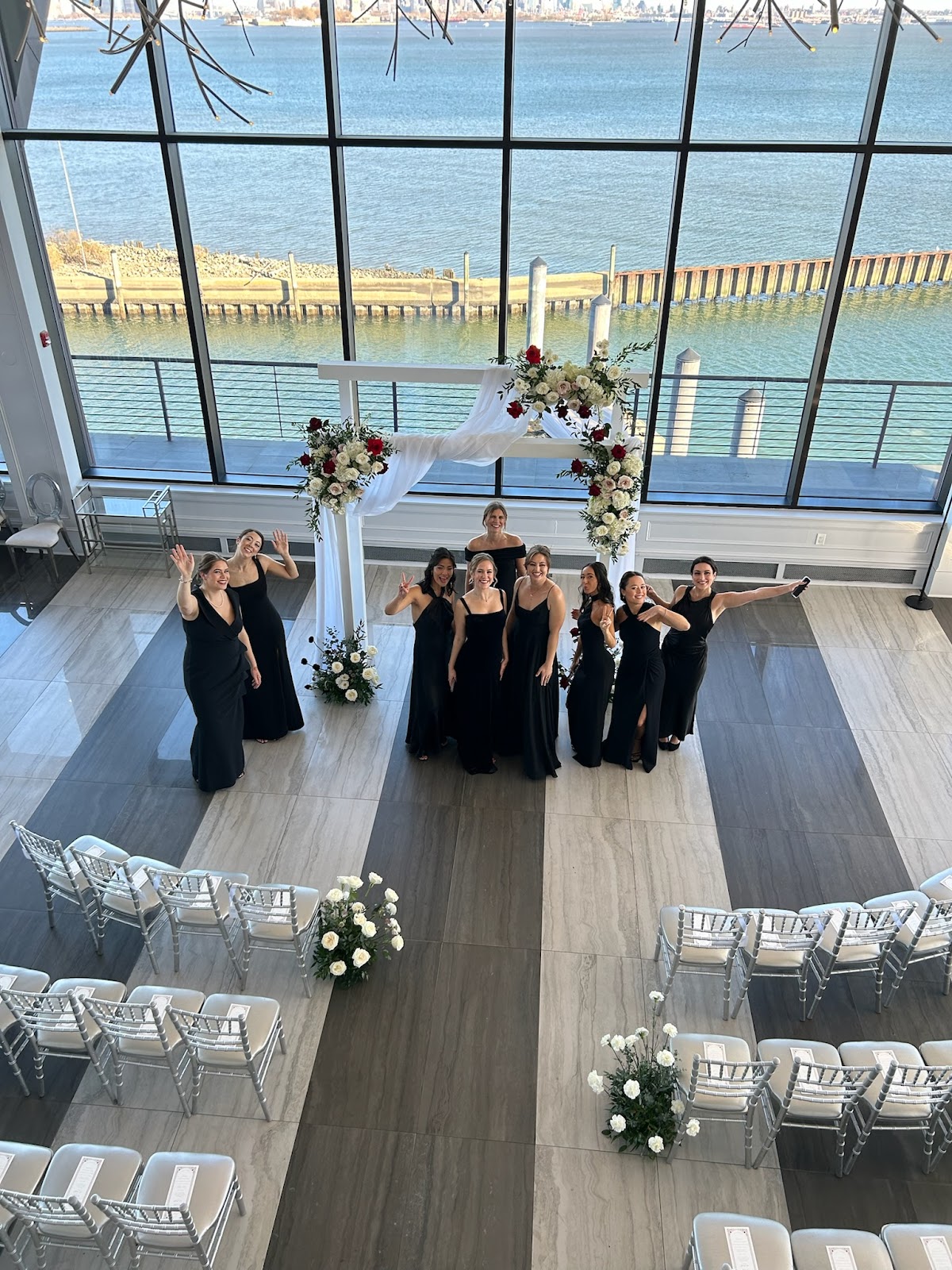
Hudson House sits on the waterfront on the Jersey City side of New York Harbour, with the water immediately outside and the Manhattan skyline and the Statue of Liberty across it. Like most venues on this shore it is largely glass, and like most venues on this shore its whole photographic argument is what is on the other side of that glass.
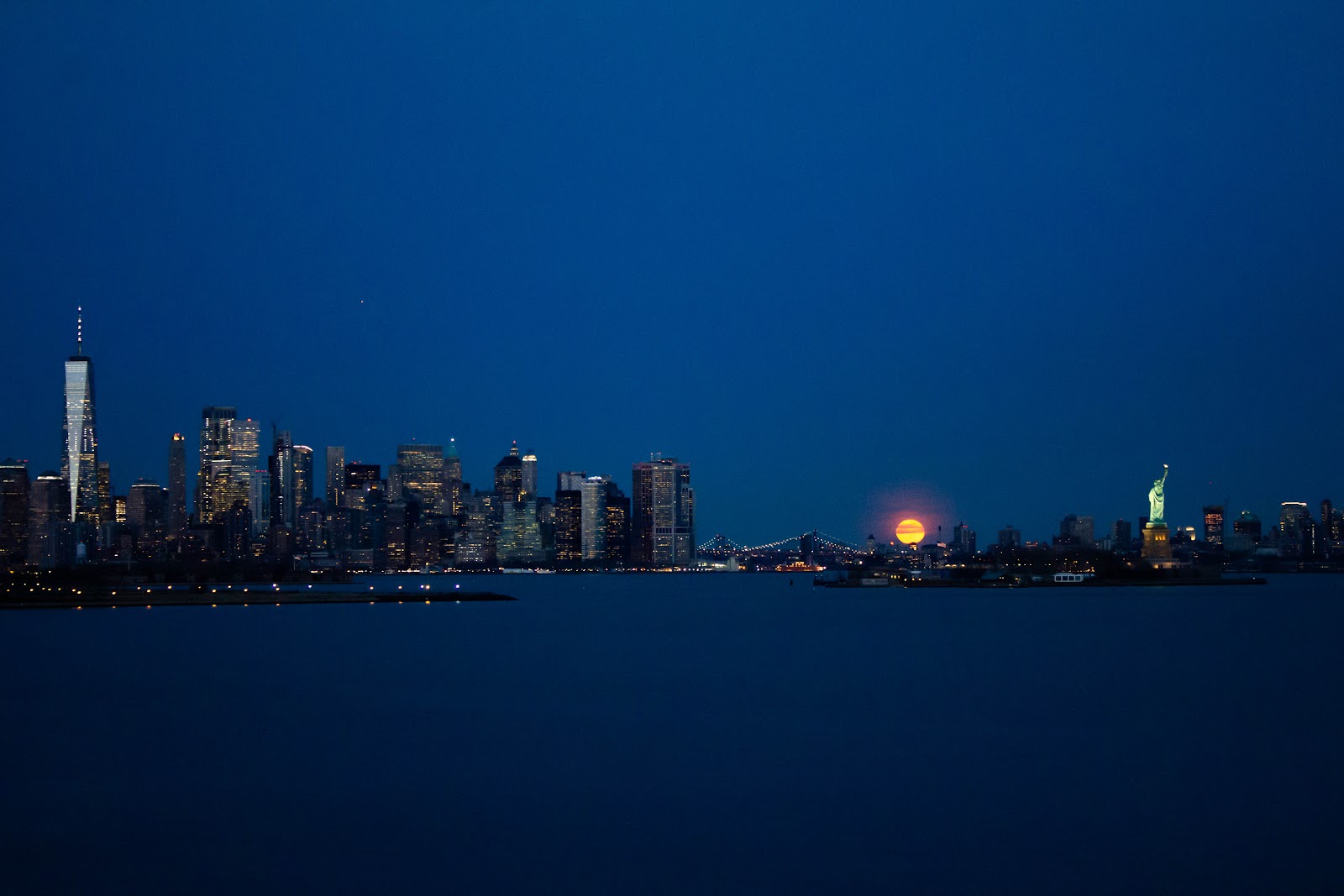
The frame worth building is this: the couple, indoors, at night, lit by one small source, with the lit skyline sharp behind them — and no evidence anywhere in the picture that there is a pane of glass in between.
That sounds like a small ambition and it is not. A window is normally the enemy of a night frame. It reflects the room, it reflects the photographer, it reflects every light you brought, and it puts a milky veil over the city. The standard result is a photograph of a couple with a dim smeared cityscape behind them and a ghost of a chair floating in the middle of it.
Done properly, the same frame looks as though it were made outdoors on a balcony that does not exist, in weather that would not have allowed it. That is worth having, and at a venue where outdoor access may be limited, shared or closed by wind, it may be the only way to get the view at all.
It works because of one piece of physics. A pane of glass with a dark space on the camera side and a bright scene on the far side transmits almost everything and reflects almost nothing that matters. The reflections you normally see are reflections of the room you are standing in. Remove the room’s light and the glass effectively disappears.
So the frame has two halves and they are made separately. The city is exposed by its own light, long, on a tripod, with the room dark. The couple are exposed by one light of yours, short, aimed so that nothing of it touches the glass. The two exposures are independent, which is what makes the frame controllable.
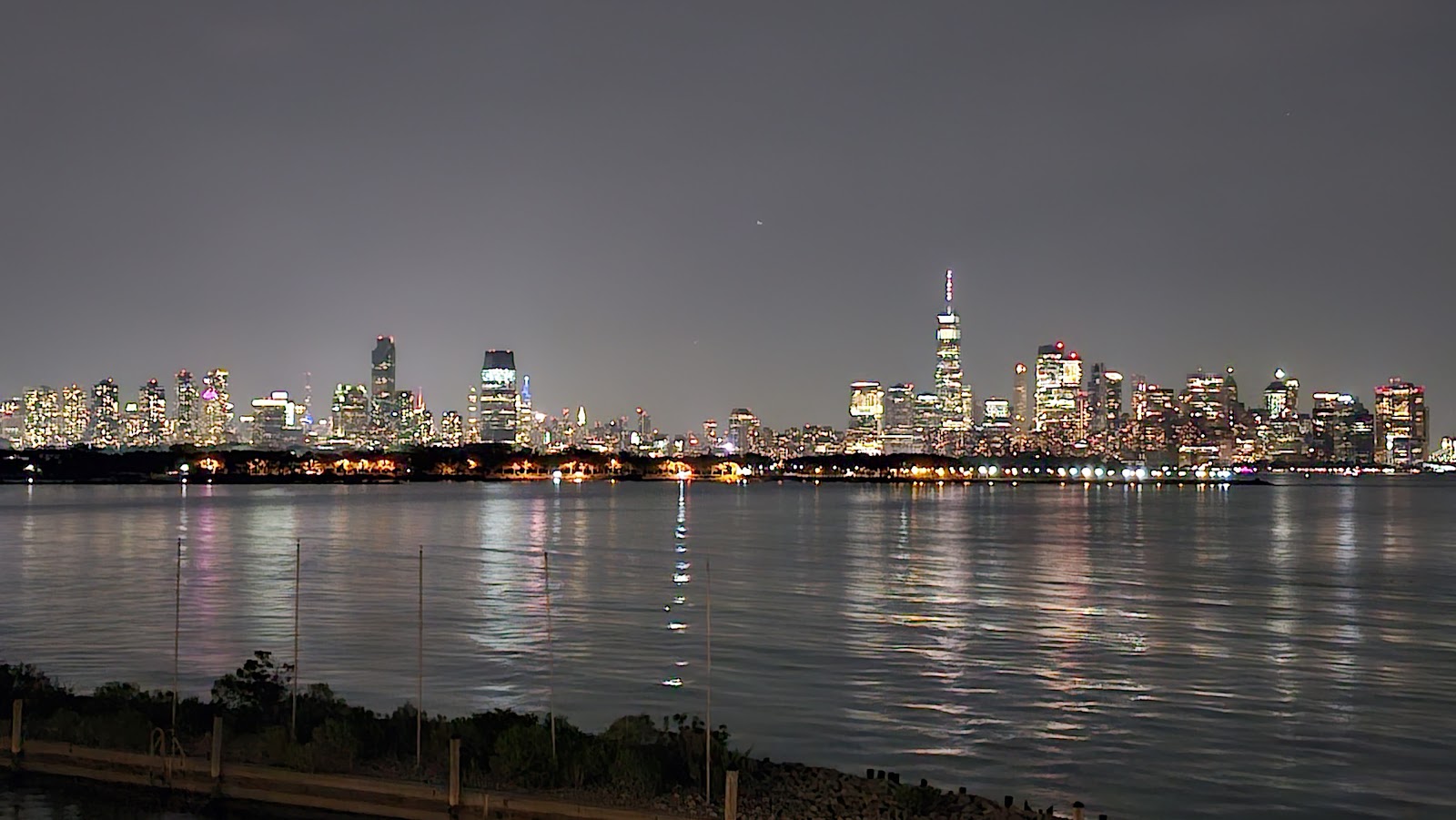
Timing matters too, and here the latitude sets it. Jersey City is at about forty and a half degrees north, so civil twilight runs about thirty minutes in midsummer, and the genuinely useful window — where the skyline lights and the remaining sky are within a stop of each other, so both hold detail — runs twelve to fifteen minutes. Make the frame inside that and the background has a graduated blue sky in it. Make it an hour later and the background is lit windows against black, which is simpler and still good.
Both versions are worth having and they take the same four minutes of setup. What follows is how to build it, what else the building gives you, and what the harbour does to the year.
The Hudson House at a glance
| Where | A waterfront venue on the Jersey City side of New York Harbour |
| The frame | Couple lit indoors at night with the sharp lit skyline behind and no visible glass |
| Why it works | A dark room side means the pane transmits nearly everything and reflects nothing |
| The setup | Four minutes: tripod, room lights off, one light kept off the glass |
| The window | Twelve to fifteen minutes at the balance point, or any time after dark |
Building the frame
First, choose the pane, because they are not all equal.
Walk the glazing and look for three things. A clean pane, because a smear or a salt deposit will be sharply rendered on a long exposure at a small aperture and cannot be removed afterwards. A section with the composition you want behind it, which usually means the widest uninterrupted span rather than the one nearest the tables. And an absence of mullions in the middle of the frame — a vertical glazing bar running through the couple’s heads is the one fault that no technique fixes.
Ask whether the pane can be cleaned. Venues on a saline harbour front clean their glass regularly and will often do a section on request if asked in advance rather than at eight in the evening.
Second, kill the light on your side. This is the whole technique and it is the step people skip.
Every light in the room behind you reflects off the glass and lands on top of the city. Switch off what can be switched off, and for what cannot, move so that its reflection falls outside your frame — which usually means getting the camera very close to the glass and slightly off perpendicular. A black cloth or a dark jacket held against the pane around the lens removes the last of it, and if you work at this venue regularly, a piece of black card with a lens-sized hole in it is worth carrying.
Wear dark clothing. You are standing a foot from a mirror.
Third, put the camera against the glass. Not near it — against it, with the front of the lens or the hood touching or nearly touching the pane. At that distance there is no air path for a reflection to form in front of the lens, and the pane’s own surface is far enough outside the depth of field to be invisible. This single move solves ninety per cent of the problem.
If the composition requires standing back, accept that you are now managing reflections rather than eliminating them, and compose them deliberately — a reflected chandelier placed knowingly in the sky reads as a decision, and one floating in the middle of a building reads as a mistake.
Fourth, expose the city. Tripod, base sensitivity, f/5.6 or f/8, and whatever shutter speed that requires — typically a second to a few seconds. Meter the lit windows and pull back slightly so they hold rather than clip. Focus manually on the buildings, because autofocus through glass at night is unreliable and a live-view magnification on a lit edge takes ten seconds and is certain.
At that aperture the whole city is sharp, which is the point. A soft background here wastes the entire reason for being at this venue.
Fifth, light the couple. One small source, warmed slightly with a gel so it sits in the same world as the city’s own sodium and tungsten, placed well off to one side and angled so that not one degree of it strikes the glass. A light aimed even loosely toward the pane will bounce straight back into the lens and flood the frame.
Power it so the couple sit roughly at or just under the brightness of the lit buildings. Brighter and they look pasted on; much darker and they are a silhouette, which is a different and also good frame but not this one.
Their exposure is controlled by the flash and the city’s by the shutter, which means the two are independent. That is the whole elegance of it: you can make the city brighter without touching them, or them brighter without touching the city.
Sixth, tell them what is happening. A long exposure means they have to hold still for a second or two — not rigidly, but without walking — and it is worth saying so, because an unbriefed couple will shift and the flash will freeze them cleanly while the ambient smears a second ghost alongside. That ghosting is occasionally lovely and usually not.
Make six frames. Vary their pose rather than the camera, and make two with no light on them at all, as silhouettes against the city, because that version takes twenty seconds and is sometimes the better picture.
Total time: four minutes of setup, three minutes of shooting. The only thing that has to happen in advance is choosing the pane and testing the reflection, and that is a ten-minute job on arrival while the room is still empty.
What else the building gives
Away from that frame, this is a glass waterfront venue and it has four things going for it and one governing geographical advantage.
The advantage first, because it applies to the whole Jersey shore and most people get it backwards. You are on the west bank. Manhattan and the statue are to the east. So when the sun is low at the end of the day it is behind you, lighting the west-facing walls of everything across the water — the skyline is front-lit and warm at sunset here, not silhouetted, with the sky deepening to blue behind it. From the Manhattan side you would be shooting into the sun at a dark outline. The geography does the work.
So the first asset is the twenty minutes before sunset, when the towers go from grey to gold and the modelling on them is at its strongest of the day. Shoot through it rather than waiting for a single moment, because the version at the start and the version at the end are different photographs.
The second asset is the water, and here it is better than a rooftop. The harbour is a tidal estuary, so the surface is usually moving and often choppy, which means it scatters rather than mirrors — lit windows become long shimmering vertical columns rather than a clean inverted image. Get the camera low and that column runs the full depth of the frame. It is the strongest compositional element available and it costs nothing but kneeling.
On a rare still evening the water flattens into a genuine reflection, which is cleaner and cannot be arranged.
The third asset is daytime window light, which at an east-facing waterfront venue is unusually good from mid-morning onward. Once the early sun has swung south, the glass takes only skylight and bounce off the river, which is soft, even and stable — the same at ten as at three. A subject side-on to the glass at a metre and a half is well lit at any hour, so preparation coverage can be scheduled around the wedding rather than around the sun.
There is a specific bonus in that. A mile or more of moving water outside a wall of glass is a huge low reflector, throwing light upward into a face from below, which fills eye sockets and softens a jaw for free. That is the reverse of the usual high-floor problem where there is no ground bounce at all. Stand people close enough to the glass to be in it.
Two corrections to apply across the whole set. The light is cool — open sky is a cool source, and modern glazing is coated to reject heat, which shifts transmitted daylight cooler and often slightly green — and those compound, so interiors here photograph bluer than the eye remembers. Warm the whole block rather than each frame, and set a white balance for the position you are shooting from, because a subject at the glass and one five metres back are lit by different colour.
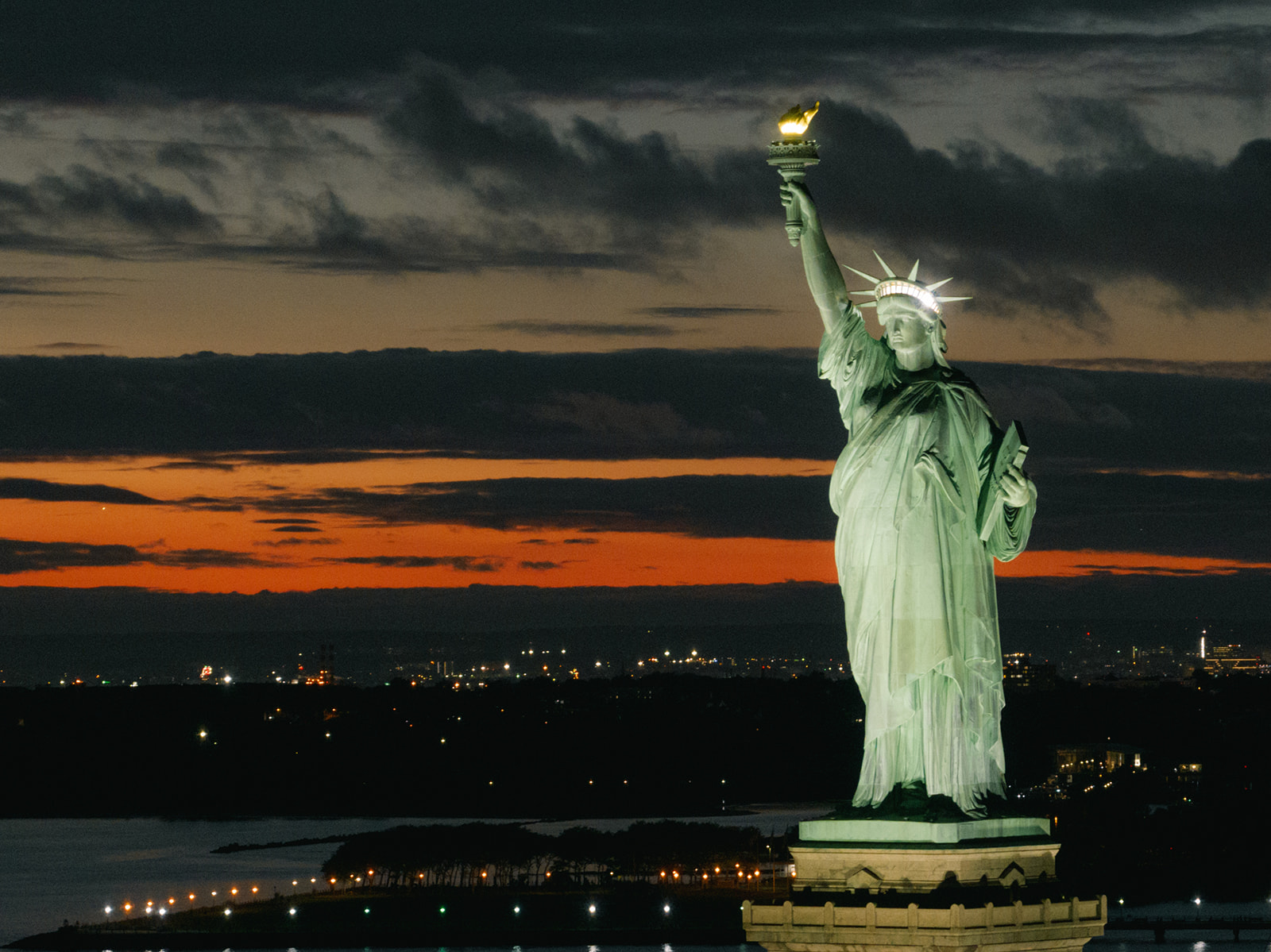
The fourth asset is the statue, which needs an expectation set. At a couple of kilometres across open water it is small in a wide frame and needs a long lens to be readable — and a long lens compresses the distance so much that the couple have to be far from the camera to be in shot with it, at which point they are small. The two versions that work are a long-lens landmark frame with no people in it, and a wide portrait in which the statue is a deliberate small element. The version couples ask for — normal portrait distance with a large statue behind — is not available from this shore. Say so early and offer the two that are.
The exception is a silhouette after sunset, when the statue is floodlit against a graduated sky and the couple are dark shapes: both are simplified to outlines, scale stops mattering, and it is the best statue frame the shore offers.
One thing to establish before the date: whether there is outdoor deck access, what a wedding actually gets there in writing, and what the wind is like. A waterfront edge with a mile and a half of open water to the east is genuinely exposed, and a westerly arrives with force — a veil becomes a two-person job and a lightstand needs sandbagging. If the answer is that there is no reliable outdoor access, the frame in the last section becomes the plan rather than the fallback, which is exactly why it is worth being able to make.
The harbour, and the year
At a venue whose subject is a mile and a half away, the year is mostly a question of how transparent the air is, and that varies more than most photographers expect.
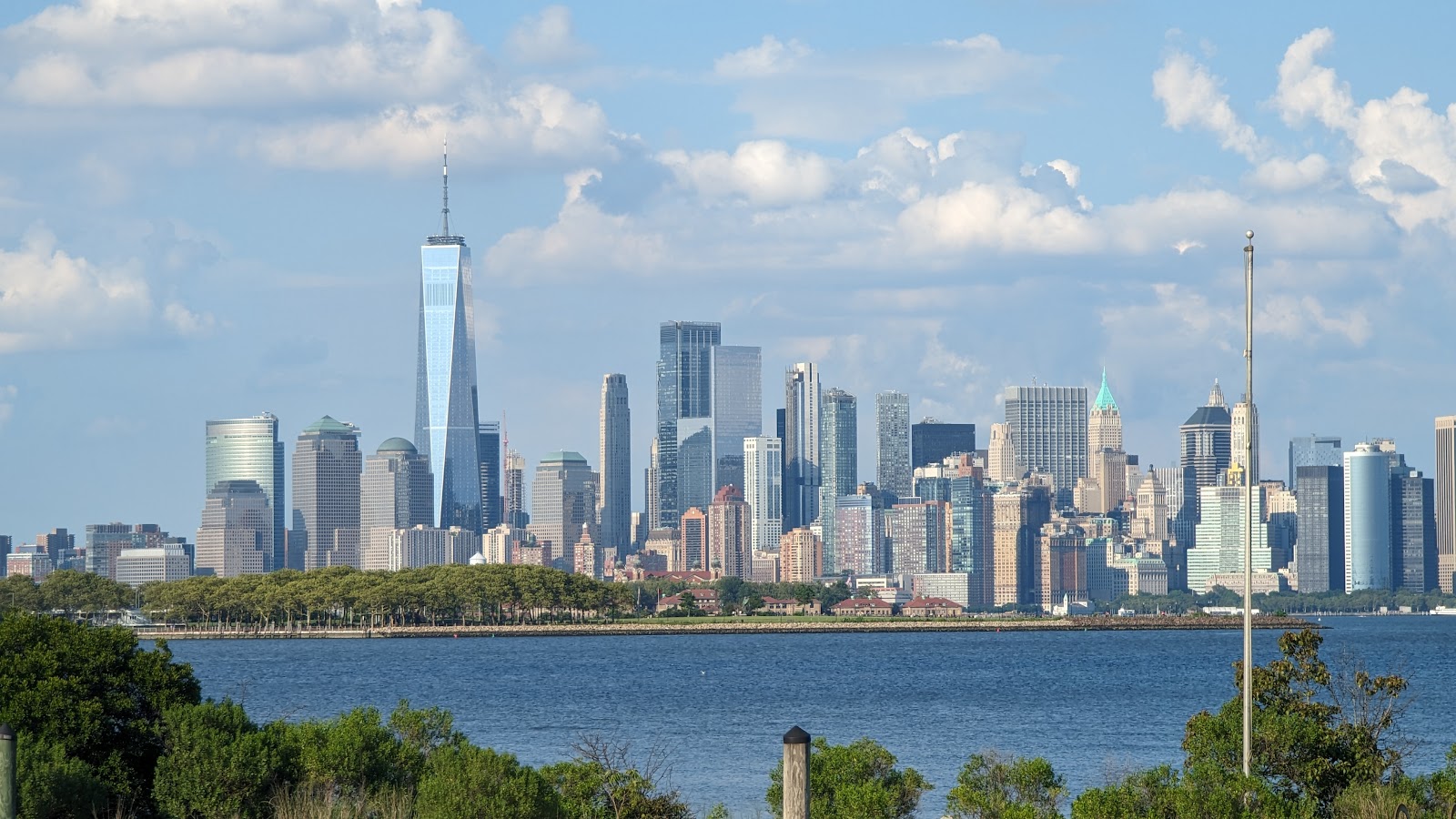
Winter is the clear season and it is not close. Cold dry air over the harbour is far more transparent than summer air, so the skyline resolves with genuine detail — individual windows, structural edges, the separation between towers — rather than dissolving into a pale grey mass. Add a midwinter noon sun near twenty-six degrees, low enough to rake the buildings from the south through the whole middle of the day, and January and February give the sharpest and most modelled views of the year.
For the frame in this guide, winter is doubly good. The balance point arrives before five in late December, which means the twelve to fifteen minutes fall during cocktails — inconvenient for a timeline and entirely convenient for a photographer, because the couple are available and nobody is mid-course. Put it on the schedule as a named item and it is the easiest version of the frame in the whole year.
Summer is the reverse on both counts. Sunset after eight in late June puts the balance point near half past eight, comfortably inside a reception, and the deck is pleasant. But metro-area summer humidity produces genuine haze, and a hazy skyline at that distance is a soft grey silhouette rather than a subject. July and August wide frames of Manhattan from this shore are routinely disappointing, and the honest thing to tell a couple is that the skyline will look better in their February engagement photographs than on an August wedding day.
There is a partial fix and it is worth knowing: haze accumulates with distance through the air, so a two-hundred-millimetre frame of one building group carries far less of it than a twenty-four-millimetre frame of the whole waterfront. In summer, compose tight. It is also the season to lean on the statue, which is nearer and therefore less affected.
Summer has one advantage for the night frame specifically. Warm air means less temperature differential across the glass, which means less condensation and less of the thermal distortion that a big difference between inside and out can produce at a long focal length. In deep winter, a heated room against freezing air outside can put a visible shimmer on a long-lens frame through glass, and occasionally fog the inner surface of the pane. If that happens, move to a shorter lens and ask whether the air handling near that glazing can be adjusted.
Late September into early November is the strongest shoulder and probably the best all-round window. The humidity drops out and the air clears markedly, temperatures are comfortable on an exposed waterfront, sunset lands around six so the balance point falls at a civil hour, and the light stays low enough that the skyline is modelled through the whole afternoon. Late April and May are the other good window, with clearing air and lengthening evenings.
One latitude note that matters at a venue with subjects spread across an arc of water. At forty and a half degrees north the sun’s setting azimuth swings something like sixty degrees across the year, from well north of west in late June to well south of west in late December. That changes the angle at which the low light strikes the skyline and which parts of it are lit rather than shaded by their neighbours. A composition that worked in July will be lit differently in January, so check the azimuth for the actual date rather than trusting a summer scout.
Two harbour notes. There is real traffic out there — ferries crossing regularly, tugs and barges working the river, and large vessels heading for the container terminals — and a ship passing behind a subject during the balance point is a strong and very specific frame. Ferries run often enough to plan on; the big ships cannot be scheduled but are worth watching for. Helicopters use the river corridor, which is a noise consideration for an outdoor ceremony rather than a photographic one.
And storms move through this metro quickly in summer, with the half hour afterwards being the best light of the year: washed air so the skyline finally resolves properly, wet decking reflecting the sky, and a low sun under a broken ceiling. If a cell goes through at six, do not pack.
The closing instruction is the same as the opening one. The window does not have to be in the photograph. Choose the pane on arrival, test the reflection while the room is empty, and the frame is four minutes’ work at whichever hour the evening allows.
More frames from The Hudson House
The Hudson House wedding photography: common questions
What is the one frame?
The couple lit indoors at night, with the lit skyline sharp behind them and no evidence anywhere that a pane of glass is in between. It works because a pane with a dark room on the camera side and a bright scene beyond transmits nearly everything and reflects almost nothing — the reflections you normally see are reflections of the room you are standing in, so remove the room’s light and the glass effectively disappears.
How do you get rid of the reflections?
Four things, in order of effect. Put the camera against the glass, so there is no air path for a reflection to form in front of the lens — that alone solves most of it. Switch off every light behind you, and move so that any you cannot switch off reflects outside the frame. Hold a dark cloth or jacket against the pane around the lens. And wear dark clothing, because you are standing a foot from a mirror.
How is the exposure set?
In two independent halves, which is what makes it controllable. The city is exposed by its own light — tripod, base sensitivity, f/5.6 or f/8, typically a second to a few seconds, metered on the lit windows and pulled back slightly so they hold. The couple are exposed by one small warmed flash, aimed so that not one degree of it strikes the glass. Shutter controls the city, flash controls the couple, and neither affects the other.
When should it be made?
Either inside the balance point, twelve to fifteen usable minutes after sunset, when the sky still holds a graduated blue behind the buildings; or any time after full dark, when the background is lit windows against black. Both are worth having and both take the same four minutes of setup. In late December the balance point falls before five, during cocktails — which is inconvenient for the timeline and very convenient for the photographer.
Can we have the Statue of Liberty large behind us?
Not from this shore. It is a couple of kilometres across open water: wide, it is a small vertical that has to be pointed out; long enough to read clearly, and the couple have to stand so far back that they become small. What works is a long-lens landmark frame with no people in it, a wide portrait with the statue as a deliberate small element, or — best of all — a silhouette after sunset, when it is floodlit against a graduated sky and both it and the couple are reduced to outlines.
Does the season matter?
More than at most venues, because the subject is a mile and a half away and haze is what softens it. Cold dry winter air is far more transparent, so January and February give the sharpest, most modelled skyline of the year. Summer humidity produces real haze and July wide frames are routinely disappointing — compose tight instead, since haze accumulates with distance. Late September into early November is the best all-round window. One winter caution: a heated room against freezing air can put a visible shimmer on a long-lens frame through glass, so shorten the lens if you see it.
More Jersey City, NJ venue guides
We are writing a photographer’s guide to every venue we would happily shoot in Jersey City, NJ. Here are three more, plus the full index:
- The Liberty House, Jersey City: The Venue’s Own Logic
- The Maritime Parc, Jersey City: Suits and Does Not Suit
- The Park Loft, Jersey City: The Problem, and Four Ways Out of It
Planning a wedding at The Hudson House?
Choose the pane on arrival, and the glass disappears. Tell us your date.