 The Stoweflake Mountain Resort, Stowe: One Frame, and How It Is Made
The Woodstock Inn, Woodstock: The Venue’s Own Logic
The green is the reason. Everything faces it.
A New England inn on a village green has an organising logic and it is the green itself.
The village green is a specific American form: a common at the centre of a settlement, originally shared grazing and militia ground, around which the significant buildings — church, town hall, the principal houses, the inn — were arranged facing inward. The green is the front, and everything addresses it.
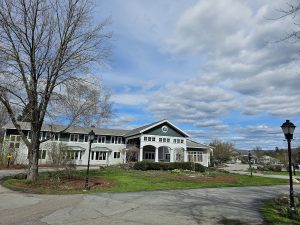
So the inn’s principal elevation, its entrance, its best rooms and its public spaces all look at an open rectangle of mown grass surrounded by white clapboard houses. That is the building’s reason and it is also its photographic character.
Three things follow. The best frames are on the green rather than in the grounds, because the green is what the building was designed to be seen from and to look at. The principal facade faces a single direction, which means it is lit at one part of the day and in shade for the rest. And the surrounding architecture is part of the venue whether or not it is on the booking, because it is in every frame taken on the green.
Woodstock’s green is one of the most intact in New England — Federal and Greek Revival houses in white clapboard, an elliptical common, mature trees — which makes the surrounding fabric an asset rather than a compromise.
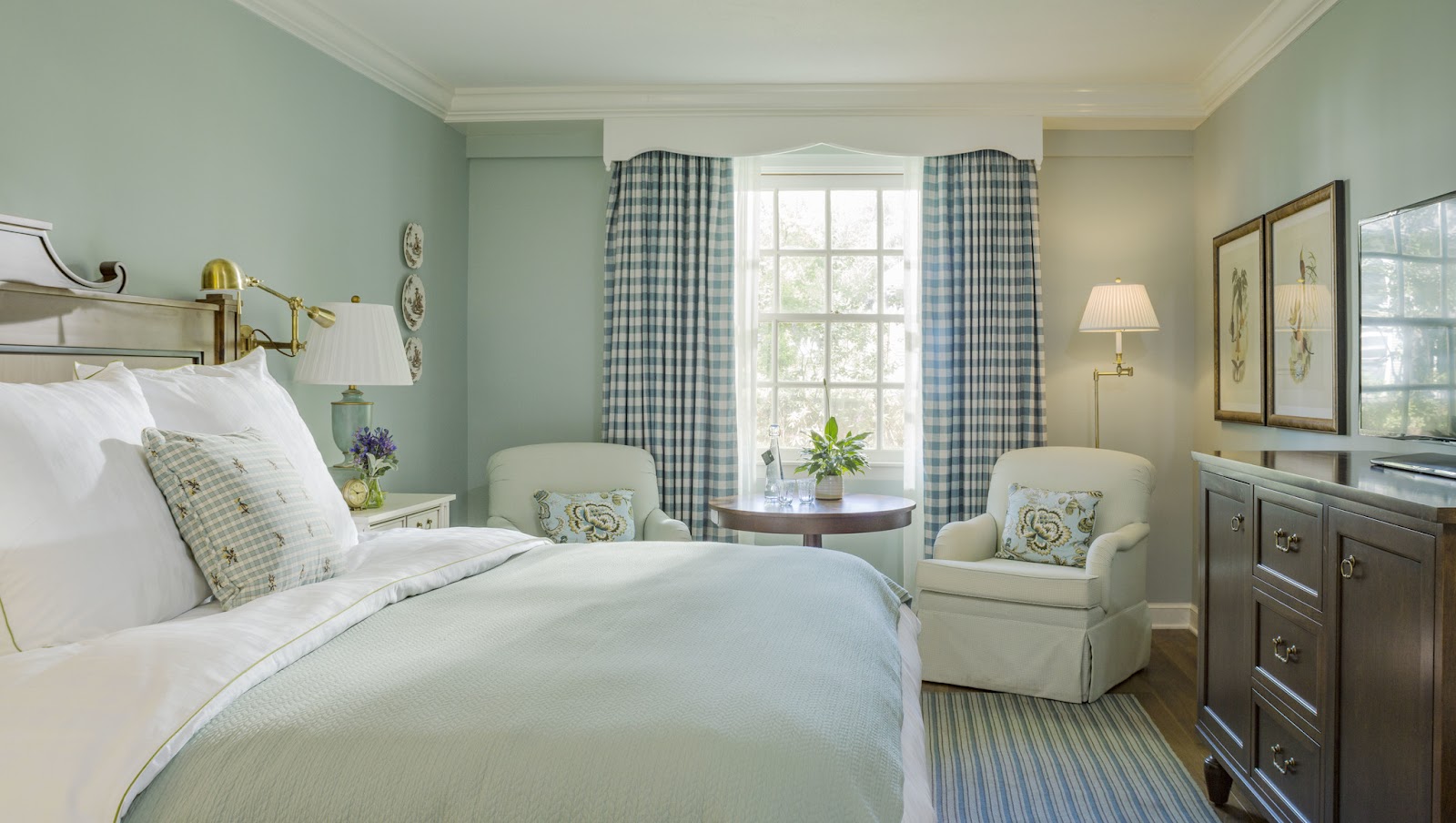
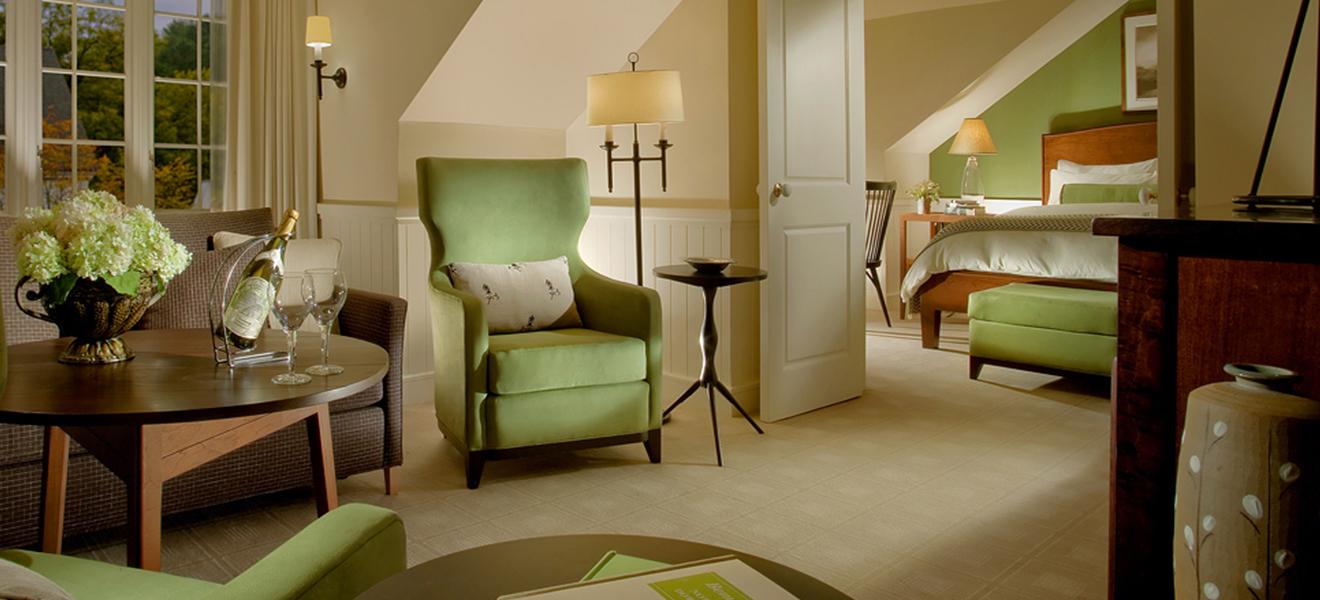
The second thing about the building type is scale. A substantial inn is larger than a house and smaller than a hotel, and its public rooms were designed for people to sit in rather than pass through: lounges with fireplaces, a dining room with fixed character, panelling and generous windows.
That gives domestic-feeling rooms at a usable scale, which is a better photographic proposition than either a converted house or a purpose-built hotel.
And the third is the material. New England vernacular is painted timber, and white clapboard reflects around eighty percent of incident light against skin’s thirty-five — which makes it the single hardest common facade to expose and the reason so much of this guide is about shade.
Woodstock sits at about forty-three and two-thirds degrees north at roughly seven hundred feet in the Ottauquechee valley, with Mount Tom rising above. The June noon sun reaches around sixty-nine and a half degrees, the December noon sun about twenty-two and a half, days run from about eight hours fifty-five to fifteen hours thirty, and civil twilight is roughly thirty-four minutes — long.
We have not photographed a wedding here. Which rooms are included, what access the green permits and the permitted hours are questions for the inn.
The Woodstock Inn at a glance
| Where | A large New England inn on the village green at Woodstock, Vermont |
| The logic | The green is the front; everything faces it |
| The material | White clapboard, which reflects about eighty percent and blows easily |
| The consequence | Open shade and overcast are the conditions this building wants |
| Ask first | Included rooms, what the green permits, permitted hours |
The white clapboard problem
Painted timber is the material of every building on this green and it sets the exposure problem that governs the whole day.
White paint reflects roughly eighty percent of the light falling on it. Skin reflects perhaps thirty to forty. In direct sun that gap puts the wall two stops or more above a correctly exposed face — which means a frame containing both will either blow the clapboard to white, losing the shadow lines and the trim that make the architecture legible, or hold the wall and leave faces two stops under.
In open shade the ratio collapses, because both surfaces are lit by the same soft skylight and the relationship becomes manageable. So the frames against white buildings are shade frames, and that means either an overcast day or an hour when the facade is in its own shadow.
Vermont gives a great many overcast days, and for this building stock that is a gift rather than a compromise. A flat grey sky produces a two-thirds-of-a-stop range across an entire white facade, which holds every detail of the trim, the muntins and the cornice without any help at all.
That is worth stating plainly because photographers arriving from brighter regions treat overcast as a problem. Here it is the correct condition.
Which hour the facade is in shade depends entirely on which way it faces, and that is the thing to establish on a site visit. A green is a rectangle and the buildings around it face four different ways — so at any hour some of them are in sun and some in shade, and the shaded ones are where the frames are.
That is the useful consequence of a green: there is always a correctly lit white facade somewhere on it, and finding which one takes thirty seconds of looking.
Keep the camera square. Federal and Greek Revival architecture is rigorously symmetrical, and a facade photographed with the camera tilted up converges the verticals so the building appears to lean back — immediately and obviously wrong on a classical composition. Raise the camera rather than tilting it, or correct afterwards and accept the crop.
The trim is what the exposure is protecting. New England painted architecture carries its character in thin linear detail — corner boards, window surrounds, cornice returns, a fanlight, columns on a porch — and all of that is white on white, separated only by shadow. Blow the highlights and the building becomes a flat white shape; hold them and every line reads.
Porches are the other consequence of the vernacular and they are the most useful outdoor space. A New England porch is optically a large soft source with a hard mask — light in from the open side, bouncing off the deck and ceiling, falling off with depth — and depth back from the edge is the whole control.
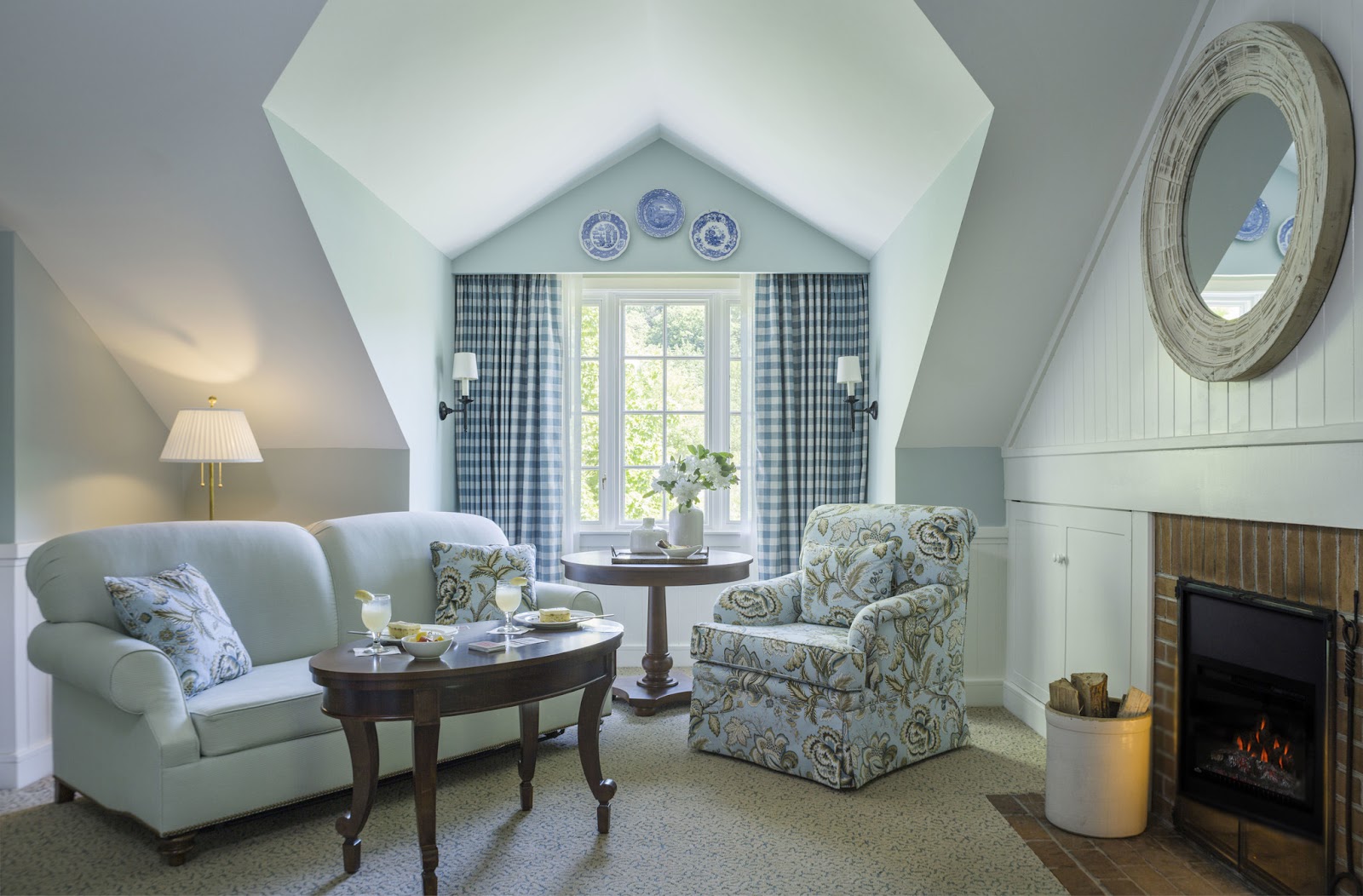
Porch ceilings in this tradition are frequently painted pale, often a light blue, and a pale ceiling is an efficient overhead reflector that fills eye sockets. That makes a New England porch measurably better than a porch with a stained timber ceiling, and it is worth looking up to check.
The green, the interiors and the village
The green itself is the best exterior space and it needs using as a designed object rather than as a lawn.
An elliptical or rectangular common surrounded by buildings facing inward is a composition: it has a boundary, a centre, mature trees at intervals, and a ring of white facades that reads as a continuous edge. A frame taken from the centre outward includes that edge; a frame taken from the edge inward has the green as foreground and the far buildings as background.
The second is the better picture. A couple on the green with the far side of the common behind them — white houses, mature trees, a church spire if there is one — is the frame the village is famous for, and it wants a moderate telephoto to compress the far edge rather than a wide lens that scatters it.
The trees on a New England green are usually large and old, and in Vermont they are frequently sugar maple — which means solid shade in summer and the state’s famous colour in autumn. A mature maple on a green casts a broad even canopy with no dapple, so a midday portrait under one is straightforward.
The green is also public. Unless the booking includes exclusive use, there will be people crossing it, and in Woodstock during foliage season there will be a great many. That is normal and it argues for early mornings.
Inside, the inn’s rooms divide the way any substantial inn’s do.
The public lounges are the best of them: panelled or papered, fireplaced, furnished to be sat in, with generous windows. A window in a room of ordinary ceiling height is much taller than it is wide, which gives strong horizontal direction with gentle vertical falloff — the best portrait light there is, and it needs nothing but a position a metre or two in and a three-quarter turn toward the glass.
Dark finishes are the constraint. Where the walls are panelled or deeply coloured, bounce returns very little and the answer is direct through a modifier with a rim behind. Where there is pale plaster or a light ceiling, bounce works normally — and in a New England interior the ceiling is usually the pale surface.
The fireplaces are worth a frame each. A lit fire is a small very warm practical source that gives a face a low warm key, and it needs the ambient dropped so it reads plus a gel to match, because firelight is warmer than any tungsten.
Gel warm throughout and drag the shutter so the fixtures register. An inn of this kind is lit by warm tungsten or warm LED in period fittings at modest levels, and a frame exposed only for flash renders the lamps dark and the room anonymous. A thirtieth to a sixtieth on a wide lens.
The village beyond the green is the third resource and it is unusually intact. Federal and Greek Revival houses, a covered bridge nearby, and the Ottauquechee river running through — all within a short walk.
A covered bridge is optically identical to a barn: a long enclosed volume with an opening at each end, giving a steep gradient and a bright rectangle at the far end. Deep inside, expose for the subject and let the far opening blow, or silhouette them against it. The timber lattice makes the interior more interesting than a plain barn’s, and the two frames are the same.
- Open shade or overcast for every white facade — direct sun is two stops too much
- At any hour some building on the green is correctly shaded; find it
- Keep the sensor plane parallel; never tilt up at a classical facade
- Shoot from the edge inward with a telephoto to compress the far side
- Look up at porch ceilings — a pale one fills eye sockets, a stained one does not
The Vermont year, and the crowds
Vermont has the most emphatic calendar in this library, and a village-green venue sits at the centre of it in both good and difficult ways.
Early October is the peak and it is the most famous autumn in America, for a botanical reason: sugar maple dominates these hillsides and produces a scarlet and orange that no other North American maple matches. Mixed with yellow birch, bronze beech and dark conifer, it gives the combination the state is known for.
The timing is predictable within a fortnight and it moves with elevation. In this valley the peak falls in the first half of October, with the higher ground a week or so earlier — so with Mount Tom rising above the village, the colour descends the slope over about ten days and a single date can catch peak somewhere on it.
The green itself is the frame: white clapboard, a ring of mature maples in full colour, and a church spire. That is the photograph Vermont is famous for and this is one of the places it is actually taken.
The honest cost is people, and it is substantial. Woodstock is among the most visited villages in New England and foliage season brings very large numbers — accommodation fills months in advance, the green is busy, and the roads are slow. A wedding in the first half of October here needs booking far ahead and needs its outdoor frames early in the morning.
That is a genuine trade rather than a quibble: the best fortnight of the year is also the busiest, and the two cannot be separated.
Late winter and early spring bring sugaring, which is the most specifically Vermont thing available. Sugar maple sap runs when nights freeze and days thaw — roughly late February into early April — and a sugarhouse boiling, with steam pouring into cold air, is a frame nothing else in this library offers. It is weather-dependent rather than calendrical and the run can be over in three weeks.
Mud season is the other half of spring and Vermont’s version is notorious. From late March into April the ground thaws from the top while staying frozen beneath, so meltwater cannot drain and unpaved surfaces become genuinely impassable. Late April and early May are also the least photogenic weeks of the year: the snow gone, the grass not greened, the trees not leafed.
Summer is green, humid and long-lit, with fifteen hours thirty of daylight at the solstice — the most schedule room of any season — and the green’s mature maples give genuine solid shade through the middle of the day.
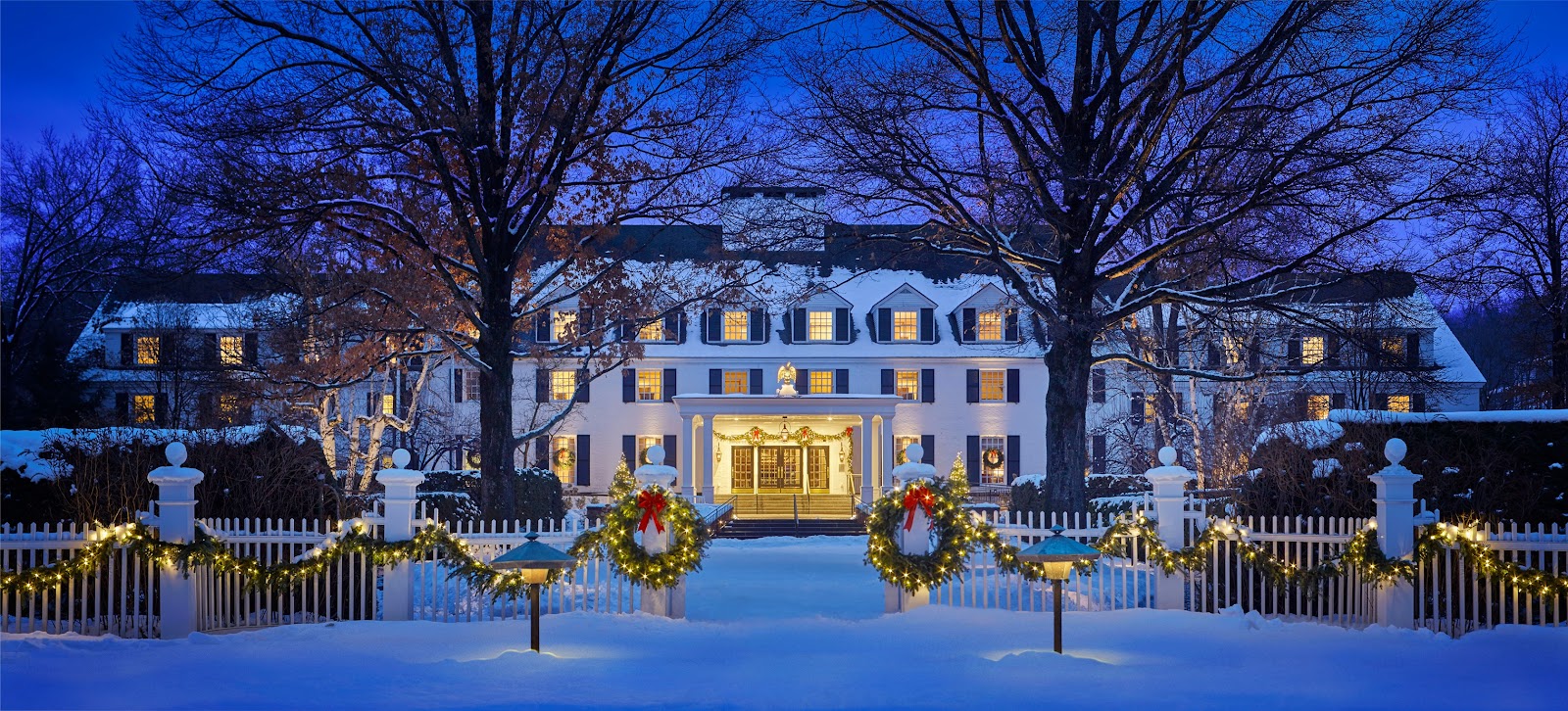
Winter is where a white-clapboard village becomes something else entirely, and it is worth taking seriously rather than avoiding. Snow suits this architecture better than any other condition: white ground against white buildings reduces the frame to tone and line, the trim reads as shadow against snow, and the whole composition simplifies.
Snow also solves the exposure problem by removing the contrast. A white facade under overcast with snow on the ground is a scene with perhaps a stop of range in it, which holds every detail effortlessly — and the snow bounces light upward into faces, which fills eye sockets for free.
The constraints are the cold and the light: about eight hours fifty-five of December daylight, and temperatures that limit how long a party stands on a green. A winter date here is a series of short excursions from a warm building, and the building is well equipped for that.
Civil twilight runs about thirty-four minutes, among the longest figures in this library — a genuine working dusk with three or four setups fitting comfortably. In December it arrives around half past four, which puts a lit exterior frame well before a reception; in June near nine-thirty, after dinner.
The frame worth scheduling at that hour is the inn and the green with the building’s windows lit against a deep blue sky. White clapboard takes artificial light well and reads warm against a cold sky, and on a village green with the far side dark it is the best exterior frame the venue has.
More frames from The Woodstock Inn
The Woodstock Inn wedding photography: common questions
Why is white clapboard difficult?
It reflects about eighty percent of incident light against skin’s thirty-five, so direct sun puts the wall two stops or more above a correct face exposure.
So what light do I want?
Open shade or overcast. Both surfaces are then lit by the same soft skylight and the ratio collapses — and Vermont provides plenty of overcast.
What is the advantage of a green?
The buildings around it face four ways, so at any hour some facade is correctly shaded. Finding it takes thirty seconds.
What is the signature frame?
From the edge of the green inward with a moderate telephoto, compressing the far side — white houses, mature maples, a spire.
Does snow help or hurt?
It helps substantially. White ground under overcast reduces the whole scene to about a stop of range, and the snow bounces light up into faces.
What is the cost of an October date?
Crowds. Woodstock is among the most visited villages in New England and foliage season fills it — book far ahead and shoot outdoors early.
More Vermont venue guides
We are writing a photographer’s guide to every venue we would happily shoot in Vermont. Here are three more, plus the full index:
- The Billings Farm, Woodstock: A Walk Through the Site
- The Burlington Waterfront: The Light Through the Day
- The Hilton Burlington: The One Decision That Governs Everything
Planning a wedding at The Woodstock Inn?
A building that faces a green. Tell us your date.