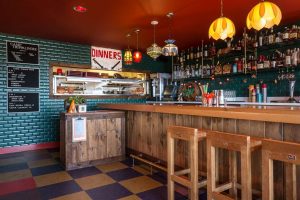
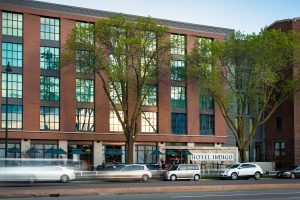
 The Hotel Indigo Madison: What It Suits, and What It Does Not
The Madison Museum of Contemporary Art: One Frame, and How It Is Made
One frame, from a roof, above a city with water on both sides.
This guide is about a single photograph and it depends on Madison’s geography, which is genuinely unusual.
The city centre is built on an isthmus — a narrow strip of land perhaps half a mile wide between two large lakes, Mendota to the north-west and Monona to the south-east. The state capitol sits on the high point of that strip, and the downtown runs along it.
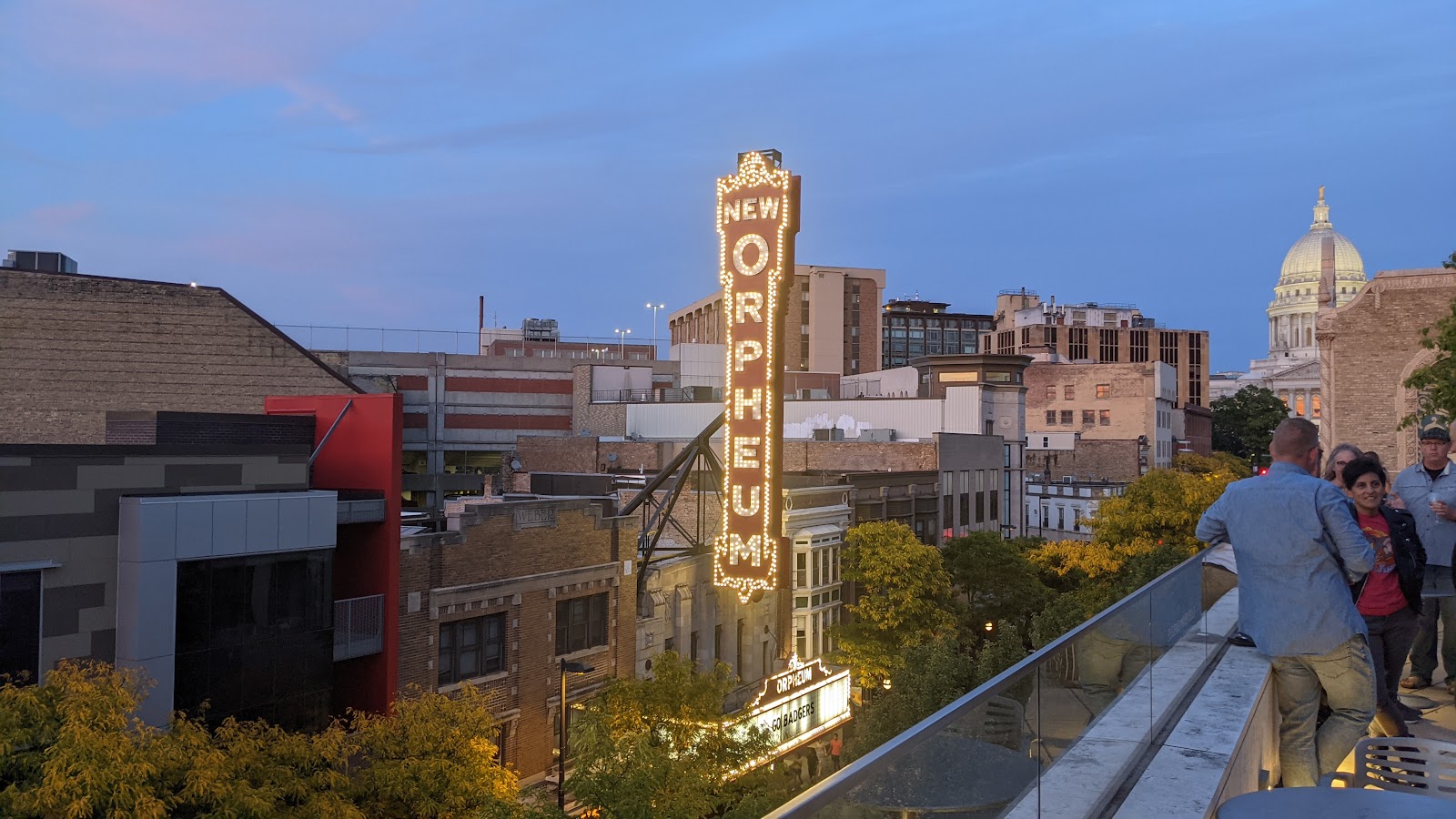
So a rooftop in central Madison has water on two sides. That is the frame: the couple on the roof terrace, with the isthmus behind them — the capitol dome, the downtown, and a lake visible beyond.
It is difficult for one specific reason, and it is not exposure. It is that the interesting thing is behind the subject and a long way off, which means the frame has to compress distance while keeping faces at a readable size — and those two requirements pull against each other.
The second thing that makes the frame possible is the rooftop itself. A contemporary art museum with a sculpture garden on its roof gives three things a ground-level venue in a downtown cannot: a horizon, unobstructed sky, and elevation so the city reads as a skyline rather than as the base of the building opposite.
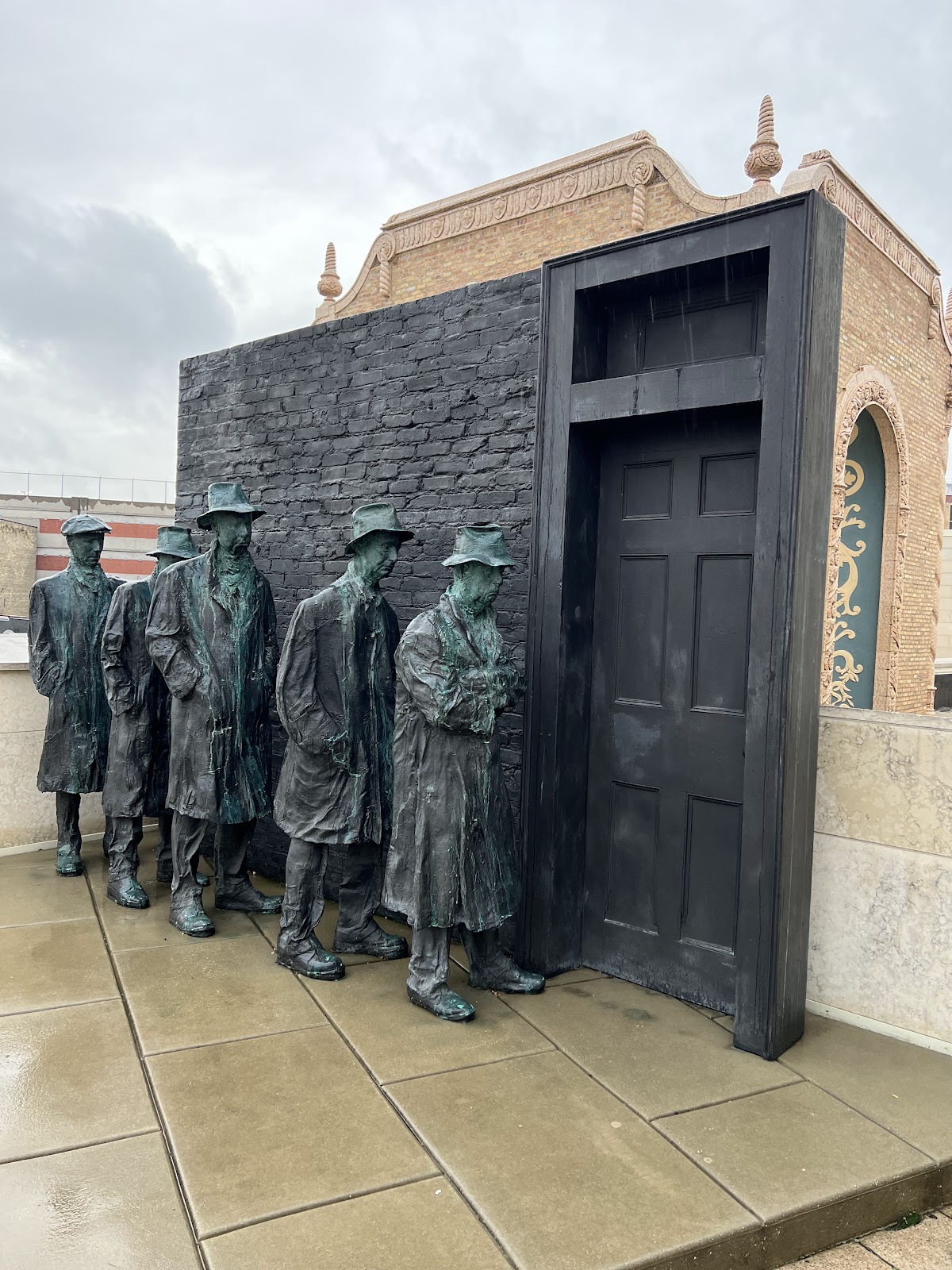
And the sculpture is the third element. Outdoor works on a roof terrace are lit by the sun rather than by a curator, which means their material decides the hour — and they give a subject something substantial to be placed against in a space that is otherwise hard surfaces and sky.
Madison sits at about forty-three degrees north at roughly eight hundred and sixty feet. The June noon sun reaches around seventy and a half degrees, the December noon sun about twenty-three and a half, days run from about eight hours fifty-five to fifteen hours twenty-five, and civil twilight is roughly thirty-three minutes — generous.
We have not photographed a wedding here. Whether the rooftop is bookable, the flash policy in the galleries and the permitted hours are questions for the museum — and the first decides whether this guide applies.
The Madison Museum of Contemporary Art at a glance
| Where | A contemporary art museum in downtown Madison, with a rooftop sculpture garden |
| The geography | The city centre is an isthmus — water on two sides, half a mile apart |
| The frame | The couple on the roof, with the capitol, the downtown and a lake behind |
| The difficulty | The subject is in front and the interest is far behind it |
| Ask first | Whether the rooftop is bookable at all |
Building the frame
Five decisions, and the second is the one that makes or breaks it.
**Choose the direction.** From an isthmus rooftop there are three views and they are lit at different times. Toward the capitol, which is a defined architectural subject with a granite dome. Along the isthmus, which gives the downtown as a receding street. And across to a lake, which gives water and a horizon.
The capitol is the most legible and the most specifically Madison, so it is usually the frame — and because it sits on the isthmus’s high point, it reads clearly from a roof at a lower level rather than being lost among taller buildings.
**Use a longer lens than instinct suggests.** This is the decision people get wrong. A wide lens on a rooftop renders the capitol at its true angular size, which from a few streets away makes it a small pale shape in the middle distance and the frame becomes mostly roof and sky.
A moderate telephoto — something in the eighty-five to a hundred and thirty-five range on full frame — compresses the distance, brings the dome forward, and stacks the intervening buildings into layers behind the couple. That is the frame that works, and it requires standing at the far end of the terrace from the subject rather than beside them.
The consequence is that the couple must be at half or three-quarter length rather than full, because a long lens at that distance cannot contain more. That is fine — it puts faces at a readable size, which is the point.
**Anchor the exposure on the background.** The dome and the downtown are what cannot be recovered if lost, so expose for them and accept that the couple will sit a stop or so under in most light.
The capitol’s dome is worth a specific note: a large pale granite dome is a bright object with a narrow tonal range, and it blows easily. Hold it just below clipping, because a blown dome is a white shape with no ribs or detail in it.
**Fill the couple.** One source, front and slightly off axis, through a modifier, at about half a stop to a stop over the ambient falling on them — enough to separate them from the background without making them look pasted in.
Gel it warm. On a rooftop the light on a subject is entirely sky, and at this latitude a clear sky reads distinctly cool, while the granite and brick behind them read warm in low sun. An ungelled source puts a slightly green face in front of a warm city.
**Time it to the blue hour if you can.** The frame is good in low afternoon sun and better twenty minutes after sunset, when the capitol and the downtown are lit and the sky still holds deep blue. Civil twilight here runs about thirty-three minutes, which is generous enough that the balance point lasts perhaps twelve or fifteen minutes rather than eight.
That is a real working window and it is worth being in position and composed before it starts rather than during it.
One practical warning about a rooftop. It is exposed, and Madison sits between two large lakes which drive their own local breezes — so wind is more likely on a roof than at street level. Never put a modifier on an unweighted stand up there, and expect hair and fabric to be moving.
The sculpture, the galleries and the isthmus below
The rooftop’s other content is the sculpture, and outdoor works need different handling from indoor ones.
The material decides the hour. Polished steel is a mirror and will reflect the sky, the city and the photographer — which at the ends of the day means it carries the colour of the sunset and becomes a subject in itself. Weathered steel is matte and warm and takes raking light beautifully. Painted work reads by shape alone. Stone shows texture only at a low angle.
Walking the terrace once to note which works want which light is worth more than any technique applied on the day.
The composition problem with sculpture is that it competes. A work interesting enough to be in a collection is more arresting than two people standing beside it, so the two solutions are: couple small with the work dominant, giving it scale; or couple close with only a portion of the work behind them, which is a portrait with an unmistakable background. Both mid-size fails, because the eye has nowhere to settle.
On a roof there is a third option that ground-level sculpture parks do not offer: the sky as the background. A work photographed from low against open sky, with nothing else in frame, reads as pure silhouette and form — and a couple placed in that same relationship is a clean graphic frame that the city cannot intrude on.
Inside, the galleries follow museum rules. Conservation lighting is diffuse, indirect, low-level and deliberately directionless, which is difficult for faces because a portrait needs a shadow to describe a shape.
The fix is positional: find the local brightest thing — a skylight, an uplit wall, a lit vitrine, a doorway into a brighter space — and place the subject so it falls on one side of the face. Hold a hundred and twenty-fifth as a shutter floor and pay for it in ISO, because gallery light tempts a photographer to a thirtieth and at that speed a standing subject who breathes is soft.
Settle the flash policy room by room in writing. Contemporary art includes light-sensitive media — photography, works on paper, textiles, some pigments — so prohibitions are common indoors and the rooftop is usually unrestricted.
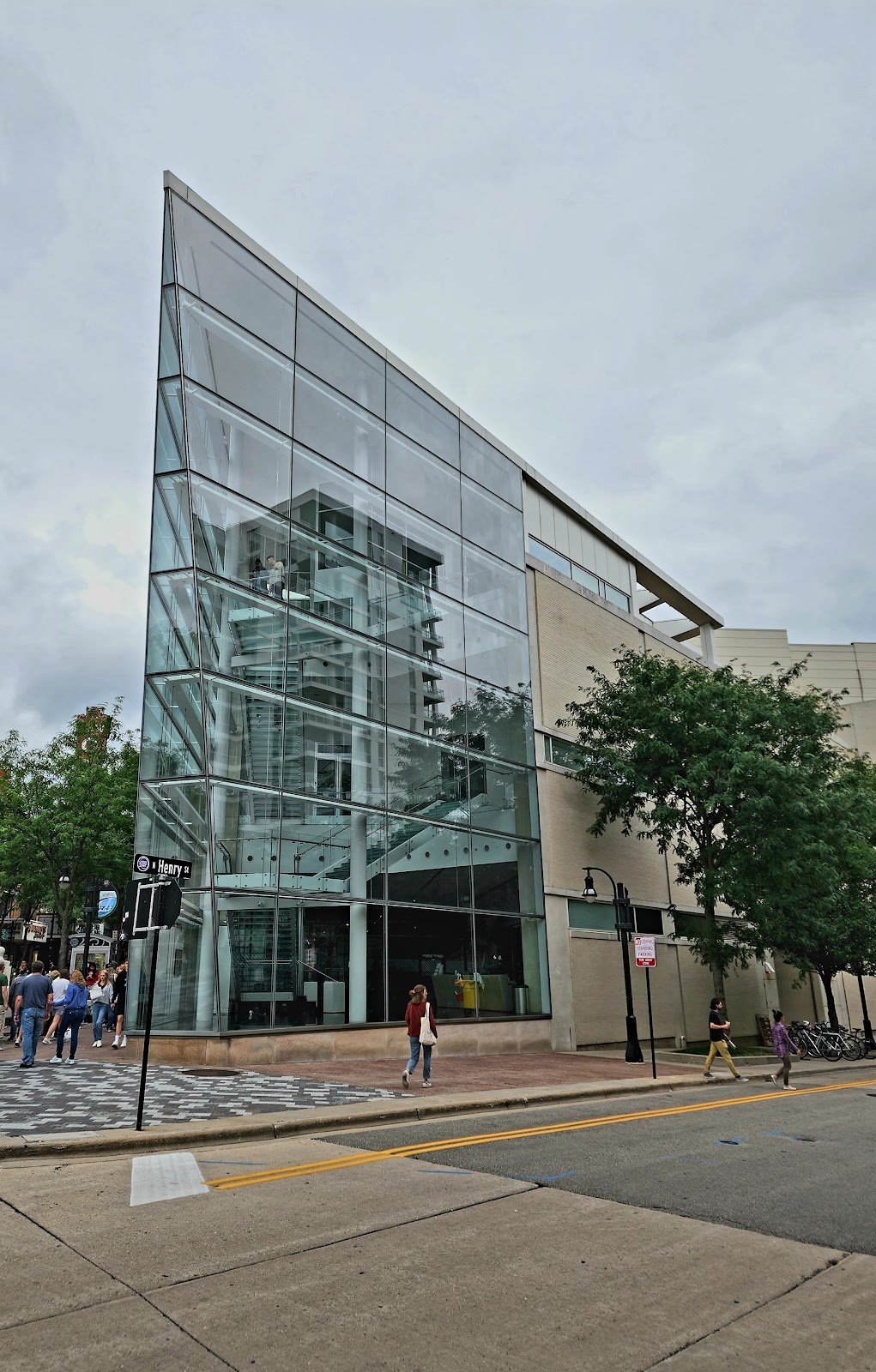
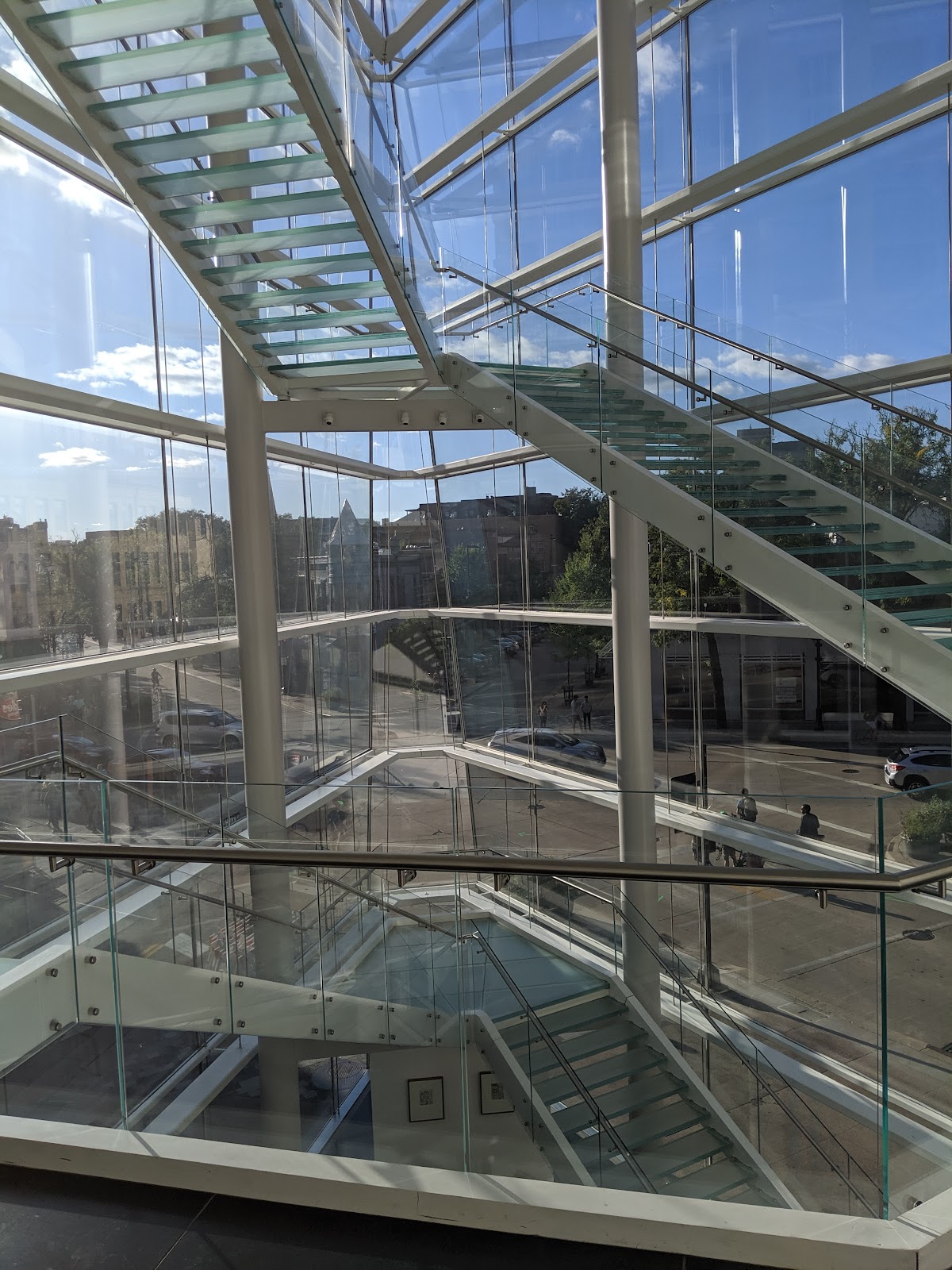
Where the building has a glazed elevation, that is the best unassisted light in it: three or four metres in from the glass gives strong directional light with no top-light problem, and groups arrange parallel to the glazing rather than across the room.
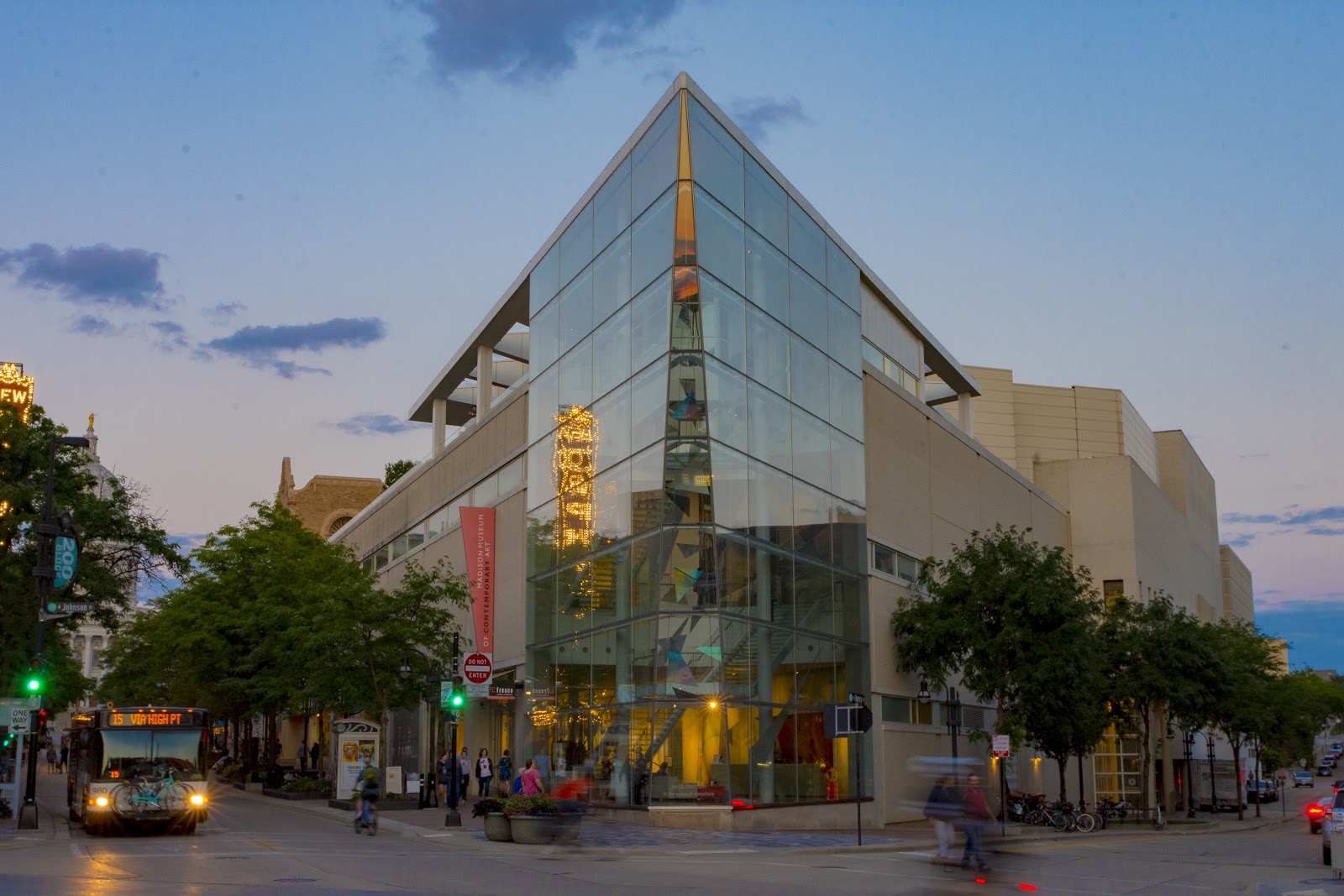
A contemporary museum in a performing arts complex — as this one is — also means large circulation spaces designed for crowds, often glazed to the street. Those are frequently the best-lit interiors in the building and the least used by photographers, because they read as lobbies rather than as venues. A glazed lobby at three metres from the glass is a better portrait position than any gallery.
The isthmus at street level is the last resource and it is worth a short walk. The capitol square is the city’s formal centre, a ring of nineteenth and early twentieth-century commercial buildings around a granite capitol on a rise — and that consistency of scale photographs as a place.
Both lakes are within a few streets. That is the isthmus’s practical gift: a downtown where water is a five-minute walk in either direction, which means a lakeside frame and a city frame are available in the same hour without transport.
Water reflects the sky, which makes it a large low-angle source filling under the chin and lifting eye sockets — strongest at grazing angles, so the last hour. And because the two lakes lie on opposite sides, one of them always has the sun behind it: Mendota to the north-west for sunset, Monona to the south-east for sunrise.
- Use a moderate telephoto from the far end of the terrace, not a wide lens
- Anchor on the capitol dome and hold it below clipping; a blown dome has no detail
- Warm-gel the fill — rooftop light on a face is all sky and reads cool
- Sculpture against open sky is the frame a ground-level park cannot make
- Two lakes, opposite sides: Mendota for sunset, Monona for sunrise
Two lakes, and the Wisconsin year
Madison’s two lakes are large enough to shape the local weather, and knowing how is worth more than a forecast.
They act as thermal masses, which means they lag the seasons in both directions. Spring is late and cool because the water is cold into May; autumn is mild and extended because the water holds summer warmth into November. A lakeside frame in April is considerably colder than the temperature suggests, and in October considerably more pleasant.
They also drive local breezes. On a warm day the temperature difference between water and land produces an onshore flow, and with water on two sides that means a downtown on the isthmus is breezier than a comparable inland city — which matters on a rooftop above all. No unweighted stands, and a fast shutter for hair and fabric.
And they freeze. Both lakes ice over in most winters, substantially and for long enough that people walk and drive on them — and an iced lake is a genuinely distinctive photographic surface: flat, white, featureless, with ice fishing shanties on it and a city skyline beyond.
A frame from the shore across a frozen lake toward the capitol is specifically Madison and rarely photographed at a wedding. The honest caveat is that standing on an exposed lakeshore in a Wisconsin January is brief work.
The seasons rank clearly.
Late September into mid-October is the best window and it is not close. The inland hardwoods turn properly — sugar maple to scarlet and orange, oak to russet, basswood and hickory to yellow — the air reaches its clearest of the year, which restores the long views the summer haze removes, and the lakes are still mild and often calm.
That clarity matters more here than at most venues, because the signature frame is a compressed distant view. A telephoto shot of the capitol across the isthmus reads sharply in October and softly in August, and the difference is entirely atmospheric.
Summer is long-lit, with fifteen hours twenty-five of daylight at the solstice, and humid enough to fill shadows: a sunlit plaza in July carries perhaps a stop and a half less contrast than the same sun angle in a dry climate. It also hazes distance badly, and it is the season when a rooftop is most likely to be uncomfortably hot and breezy.
Spring is the weakest season on this latitude: cold, late, grey, with the lakes at their coldest and the trees not yet leafed. April in Madison is a difficult date and worth saying so.
The one spring asset is the two weeks before the woodland canopy closes in early May, when spring ephemerals appear in any wooded part of the city’s parks — Virginia bluebells, trillium, spring beauty in quantity. That is a fortnight and it is genuinely spectacular.
Winter is cold and short on light — about eight hours fifty-five in December — with long stretches of flat grey overcast that flatters faces and gives architecture nothing, because granite and brick without shadow lose their texture entirely.
Snow is the compensation and it suits a capitol city. White ground reduces a frame to tone and line, which makes a granite dome and a ring of masonry read more clearly than they do against summer green — and a lit capitol above snow at the blue hour is about as good as that frame gets.
Civil twilight here runs about thirty-three minutes, among the longer figures in this library. In December it arrives around five in the afternoon, which puts the rooftop frame comfortably before the reception; in June near nine-thirty, which puts it after dinner and makes it an easier ask of a wedding party who have already relaxed into the day.
More frames from The Madison Museum of Contemporary Art
The Madison Museum of Contemporary Art wedding photography: common questions
What makes Madison's geography unusual?
The city centre sits on an isthmus half a mile wide between two large lakes, with the capitol on the high point. A downtown rooftop has water on two sides.
What lens for the signature frame?
A moderate telephoto from the far end of the terrace. A wide lens renders the capitol at true angular size and it becomes a small pale shape in the middle distance.
What do I expose for?
The capitol dome. Large pale granite blows easily and a blown dome has no ribs or detail in it, so hold it just below clipping and fill the couple.
Why gel the fill warm?
On a rooftop the light on a face is entirely sky, which at this latitude reads distinctly cool, while the granite and brick behind read warm in low sun.
Which lake for sunset?
Mendota, to the north-west. Monona to the south-east gives the sunrise — one of them always has the sun behind it, which is the isthmus’s gift.
Why does October matter so much here?
The signature frame is a compressed distant view, and it reads sharply in October’s clear air and softly in August’s haze.
More Madison, WI venue guides
We are writing a photographer’s guide to every venue we would happily shoot in Madison, WI. Here are three more, plus the full index:
- The Graduate Madison: What It Suits, and What It Does Not
- The Hotel Indigo Madison: What It Suits, and What It Does Not
- The Madison Club, Madison: The Venue’s Own Logic
Planning a wedding at The Madison Museum of Contemporary Art?
A roof above an isthmus, and water both ways. Tell us your date.