 The Hotel Indigo Madison: What It Suits, and What It Does Not
The Madison Club, Madison: The Venue’s Own Logic
Built for members, not guests. The rooms are the proof.
A private city club is a building type with a logic quite unlike a hotel’s, and the difference shows in every room.
A hotel is designed for people passing through. Its public rooms are sized for turnover, its finishes chosen for durability, and its ballroom is a neutral box that can be anything a client wants.
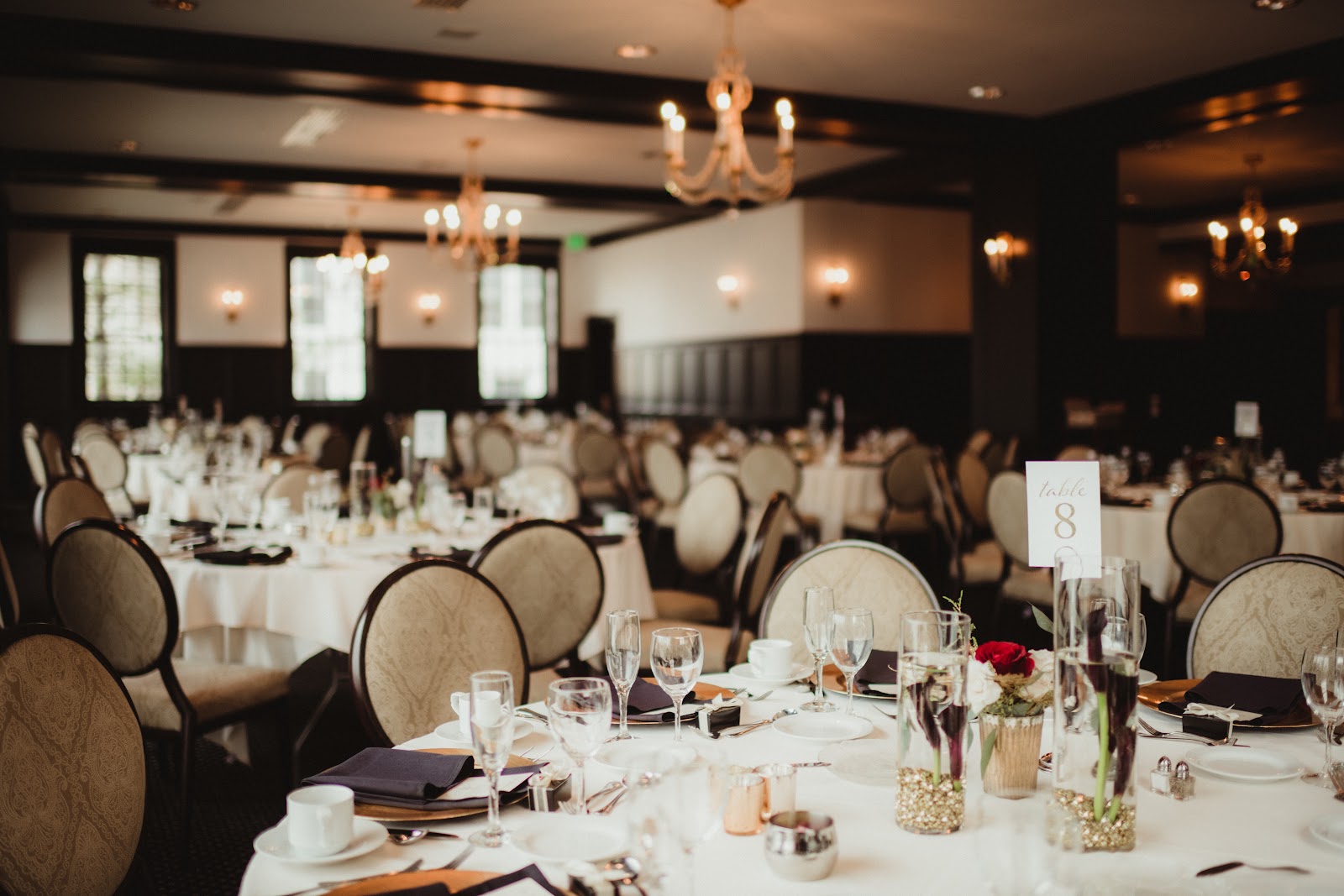
A city club was designed for the same few hundred people using it repeatedly over decades. That produces rooms intended to be inhabited rather than hired: a library with actual books, a dining room with fixed character, lounges with fireplaces, panelling that was specified because members would look at it for years.
The consequence for a photographer is domestic scale inside an institutional building — rooms with generous windows, comfortable proportions, and enough character that a frame taken in one says where it is.
The second consequence is that the rooms are dark. Club interiors of the early twentieth century used heavy stained oak or walnut for panelling and joinery, dark rich colours on walls, and substantial furnishings — and all of those surfaces absorb light rather than returning it. Stained oak reflects perhaps ten percent of what falls on it.
So bounce is largely unavailable, and the rooms are dimmer than their window area suggests.
The third is the windows themselves, and they are the compensation. A building of this date and type has tall sash or casement windows because it was built before air conditioning and needed light and ventilation — and a tall window is much taller than it is wide, which gives strong horizontal direction with gentle vertical falloff. That is the best portrait light there is and this building has it in every principal room.
And the fourth is the site. A club on the shore of Lake Monona has water on one side and the downtown isthmus on the other, which gives two directions and a horizon that an inland building could not.
Madison sits at about forty-three degrees north at roughly eight hundred and sixty feet, on the isthmus between Lake Mendota and Lake Monona. The June noon sun reaches around seventy and a half degrees, the December noon sun about twenty-three and a half, days run from about eight hours fifty-five to fifteen hours twenty-five, and civil twilight is roughly thirty-three minutes.
We have not photographed a wedding here. Which rooms are included, what the member-access arrangements are and the permitted hours are questions for the club — and the middle one is worth asking early.
The Madison Club at a glance
| Where | A private city club on Lake Monona, downtown Madison |
| The logic | Designed for members using it for decades, not guests passing through |
| What that gives | Domestic-scale rooms with character and generous tall windows |
| The constraint | Stained panelling returns about ten percent — bounce is largely unavailable |
| Ask first | Member-access arrangements, included rooms, permitted hours |
Working the windows and the panelling
The windows are the whole interior strategy and they are better than they look.
A tall window in a room of ordinary ceiling height is a source whose height greatly exceeds its width, and that geometry produces a specific and very good light: strong direction horizontally, because the source is narrow side to side; and a gentle gradient vertically, because it is tall.
On a face that means clear modelling from the side with no top-light problem at all — no shadowed eye sockets, no hard nose line, no chin shadow. It is the light a beauty dish approximates and a window supplies free.
The technique is to stand the subject a metre or two in from the glass, turned three-quarters toward it, and expose for the lit cheek. The panelled room behind them falls two or three stops away and the separation needs nothing added.
That falloff is the gift of a dark room. In a pale-walled space the light bounces and the background stays bright; in stained oak it dies immediately, which means a window-lit subject is separated from a near-black background with no effort whatsoever.
Distance from the glass is the control. At the glass the light is bright and flat with a low ratio; two metres in it has ideal direction; five metres in the subject is dim and the frame is about the room.
Interior shutters or heavy curtains, where they exist, are the adjustment nobody uses. Folding one panel partly closed narrows the source, which increases the falloff across a face and deepens the shadow side — a physical snoot built into the architecture. Ten seconds of experiment changes the light substantially.
Where light must be added, the method is direct through a modifier rather than bounced, because the surfaces will not return anything. One source at about forty-five degrees through a softbox, plus a rim from behind at about a stop over the key.
The rim matters more in a panelled room than almost anywhere. A subject lit only from the front against dark oak loses their edges entirely, and a rim restores the separation that a pale room would give for free.
Where there is a pale plaster ceiling — and many club rooms have dark dados and panelling below with lighter plaster above — bounce off that instead. The ceiling is usually the only surface in the room that will return something useful.
Gel warm. A club of this date is lit by tungsten or warm LED in period fixtures at modest levels, and a daylight-balanced flash against that puts a blue-white face in a warm timber room — the commonest error in historic interior coverage. A quarter to a half warm gel with a correspondingly warm white balance resolves it.
And drag the shutter so the fixtures register. Period sconces, table lamps and a chandelier are what make a club room look like a club room, and a frame exposed only for flash renders them dark and the space anonymous. A thirtieth to a sixtieth on a wide lens is the range.
The fireplaces are worth one frame each. An unlit fireplace is a strong architectural element; a lit one is a small very warm practical source that gives a face a low warm key — and it needs the ambient dropped so it reads, plus a gel to match, because firelight is warmer than any tungsten.
The lake, the isthmus and the club's own constraints
Outside, the lake is the site’s main asset and it behaves as open water does.
Lake Monona reflects the sky, which makes it a very large low-angle source — filling under the chin and lifting eye sockets, an effect that strengthens sharply at grazing angles. So a subject at the lakefront in the last hour is lit from below as well as from the side, which flatters faces with no equipment.
The direction matters and it is worth being precise. Monona lies to the south-east of the isthmus, which means a club on its shore looks south-east across the water — so the sun rises over the lake and sets behind the city. Sunrise is the water frame; sunset puts warm light on the building with the lake in shade behind it.
Both are good and they are different pictures, and knowing which one a schedule permits is worth establishing early. It also means the lake is back-lit in the morning and front-lit in the afternoon, which is the opposite of what most people assume.
Whether the surface is still is a matter of wind. Madison sits between two large lakes, which drive their own local breezes on a warm day, so the downtown is breezier than an inland city of the same size. A mirror is luck rather than schedule. Broken water works: a low camera turns a rippled surface into a bright path of speculars running toward the lens, and dropping the camera to knee height lengthens that path considerably.
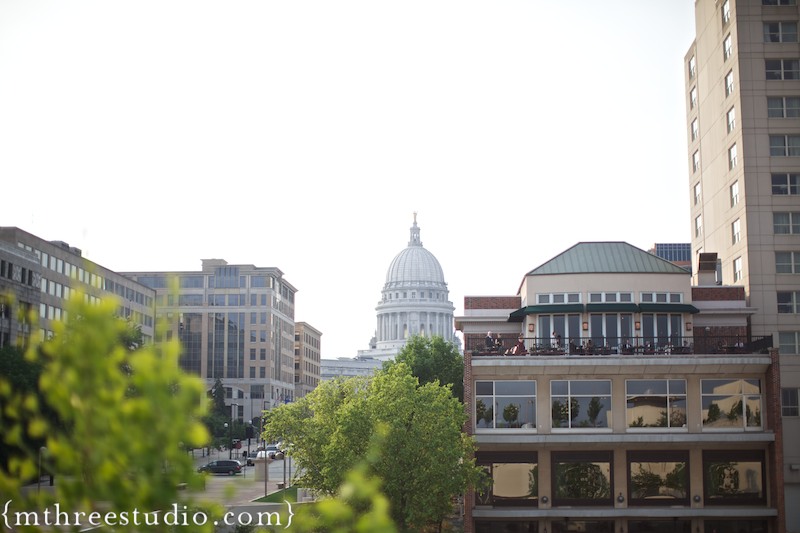
The isthmus is the other direction and it gives the city. The state capitol sits on the high point of the strip a few streets away, with a granite dome that reads from most of the downtown — and the capitol square is a ring of nineteenth and early twentieth-century commercial buildings at consistent scale, which photographs as a place.
A gold or pale granite dome is a specific exposure problem: a bright object with a narrow tonal range that blows easily. Expose for it and let the sky fall where it falls, because a blown dome has no ribs or detail to recover.
The practical gift of the isthmus is that water is a five-minute walk in either direction from anywhere downtown. A lakeside frame and a city frame are available in the same hour without transport, which very few urban venues can offer.
The club’s own constraints are the last thing and they are worth anticipating, because a private members’ building operates differently from a commercial venue.
There will be members using the building, and their expectation of privacy is real. That typically means some rooms are off limits, photography in member areas may be restricted, and a wedding party is a guest in someone else’s club rather than a client in a hired space.
Establishing which rooms are included, and whether members will be present, is the question that shapes the day. A club with the whole building released is a different venue from one where the wedding has the dining room and the members have everything else.
Dress codes are common and they apply to suppliers. A photographer in a club may be expected to meet the house standard, and it is worth asking rather than discovering at the door.
And there may be restrictions on where equipment can be placed, on moving furniture — much of which in a club of this age is original and cared for — and on a firm finish time. Those are reasonable and they are not negotiable, and the person who shows you round will know exactly which chair is original and which is not.
- A metre or two in from a tall window, three-quarters toward it — the best light here
- Fold a shutter partly closed to narrow the source and deepen the shadow side
- Bounce off pale ceilings only; stained oak returns about ten percent
- A rim light is what separates a subject from dark panelling
- Monona faces south-east: sunrise is the water frame, sunset is the building frame
Two lakes, and the Wisconsin year
Madison’s lakes are large enough to shape the local weather and they do it in both directions.
They act as thermal masses, lagging the seasons. Spring is late and cool because the water is cold into May; autumn is mild and extended because the water holds summer warmth into November. A lakefront frame in April is considerably colder than the air temperature suggests, and in October considerably more pleasant.
They also freeze, substantially, in most winters — for long enough that people walk and drive on them. An iced lake is a distinctive photographic surface: flat, white and featureless, with ice fishing shanties on it and the capitol dome beyond. A frame across frozen Monona toward the city is specifically Madison and very rarely photographed at a wedding.
The honest caveat is that an exposed lakeshore in a Wisconsin January is brief work, and that is genuinely why the interior matters here.
The seasons rank clearly.
Late September into mid-October is the best window. The hardwoods turn properly — sugar maple to scarlet and orange, oak to russet, basswood and hickory to yellow — the air reaches its clearest of the year, and the lakes are still mild and often calm. October also gives the most settled water of the year, and a mirror-calm lake doubling the capitol is the best water frame available.
The timing moves with the year: a warm dry autumn delays and dulls the colour while a cool wet one brings it forward and intensifies it. Plan a fortnight either side of the first week of October rather than a specific weekend.
Summer is long-lit, with fifteen hours twenty-five of daylight at the solstice — the most schedule room of any season — and humid enough to fill shadows: a sunlit lakefront in July carries perhaps a stop and a half less contrast than the same sun angle in a dry climate. It hazes distance, so the compressed capitol frame reads soft in August and sharp in October.
Spring is the weakest season at this latitude and it is worth saying so: cold, late, grey, with the lakes at their coldest and the trees not yet leafed. April in Madison is a difficult date, and the one asset is the fortnight before the woodland canopy closes in early May, when spring ephemerals appear in the city’s parks in real quantity.
Winter is cold and short on light — about eight hours fifty-five in December — with long stretches of flat grey overcast. That light is soft and kind to faces and gives masonry nothing, because brick and granite without shadow lose their texture entirely.
For a venue whose best frames are its interior windows and its panelled rooms, that costs almost nothing. This is a building that works in any weather, and a Wisconsin January is exactly the condition it was built for — which makes a winter date here a sensible choice rather than a compromise.
Snow is the exterior compensation, and it suits a masonry club building: white ground reduces a frame to tone and line, which makes substantial architecture read more clearly than it does against summer green.
Civil twilight here runs about thirty-three minutes, among the longer figures in this library, which makes the blue hour a genuine working session. The frame worth scheduling is the club lit from within with the lake in front of it — tall windows glowing warm against a deep blue sky, doubled in the water if the breeze has dropped. In December that lands around five, comfortably before the reception; in June near nine-thirty, after dinner.
More frames from The Madison Club

The Madison Club wedding photography: common questions
How is a club different from a hotel?
It was built for the same few hundred people over decades, not for turnover. That gives domestic-scale rooms with real character rather than neutral function space.
What is the best light in the building?
A tall window. Its height greatly exceeds its width, which gives strong side direction with a gentle vertical gradient and no top-light problem at all.
Why can't I bounce?
Stained oak panelling returns about ten percent. Bounce off a pale plaster ceiling where there is one; otherwise go direct through a modifier and leave the room dark.
What is the shutter trick?
Fold one interior shutter or curtain partly closed. It narrows the source, deepens the shadow side and increases falloff — a snoot built into the architecture.
Which way does the lake face?
South-east. So the sun rises over Monona and sets behind the city — sunrise is the water frame, sunset lights the building.
Does a winter date work here?
Yes, unusually well. The best frames are interior windows and panelled rooms, which do not care that it is nine hours of grey outside.
More Madison, WI venue guides
We are writing a photographer’s guide to every venue we would happily shoot in Madison, WI. Here are three more, plus the full index:
- The Madison Museum of Contemporary Art: One Frame, and How It Is Made
- The Graduate Madison: What It Suits, and What It Does Not
- The Hotel Indigo Madison: What It Suits, and What It Does Not
Planning a wedding at The Madison Club?
Rooms built to be lived in. Tell us your date.