 Roxy’s Downtown: Photographing a Small Stage Room
The Sand Creek Station, Goddard: The One Decision That Governs Everything
One decision: how much of the course the frame admits to.
There is one decision here and it is a compositional rather than a technical one: how much of the golf course a photograph acknowledges.
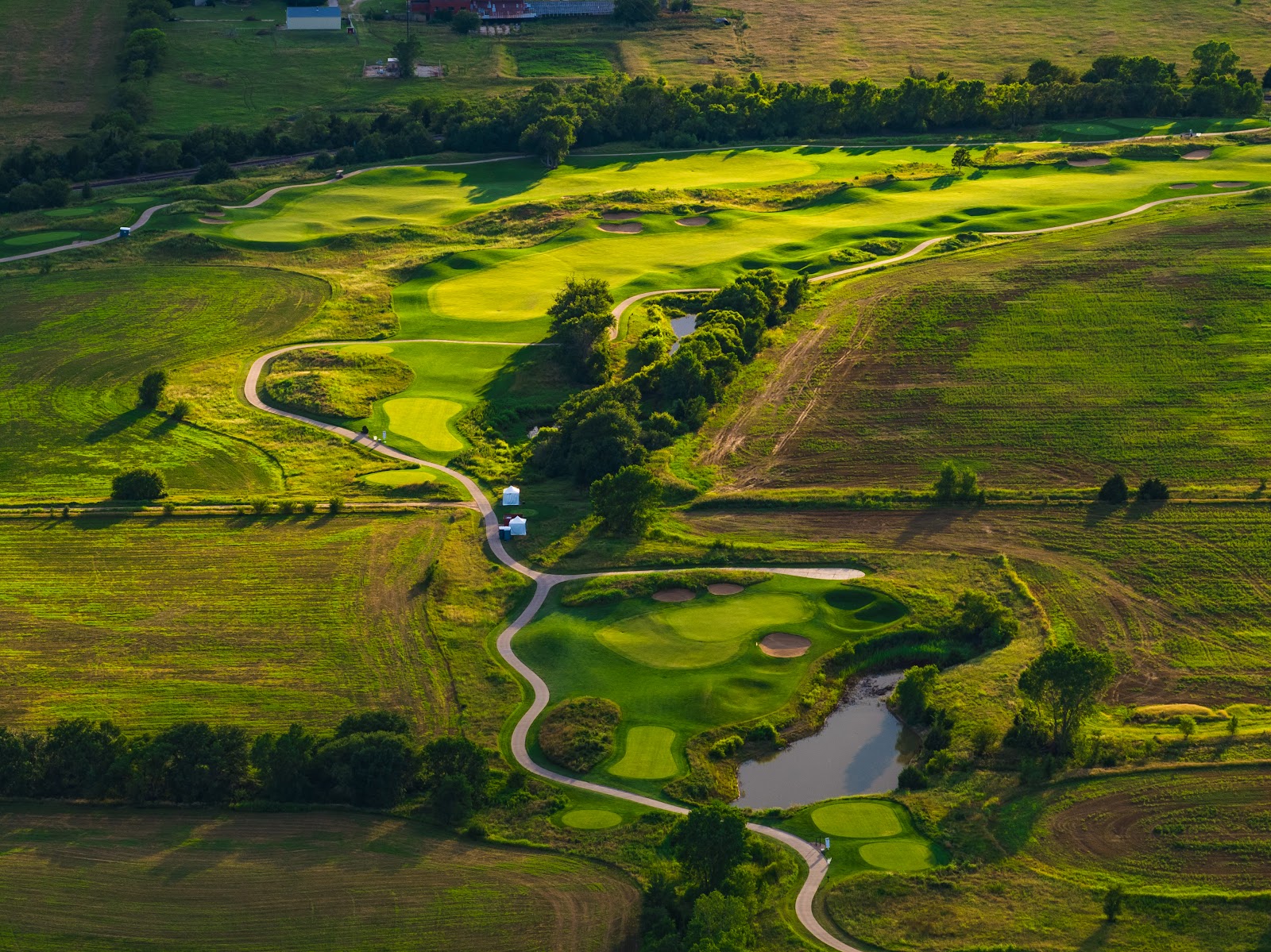
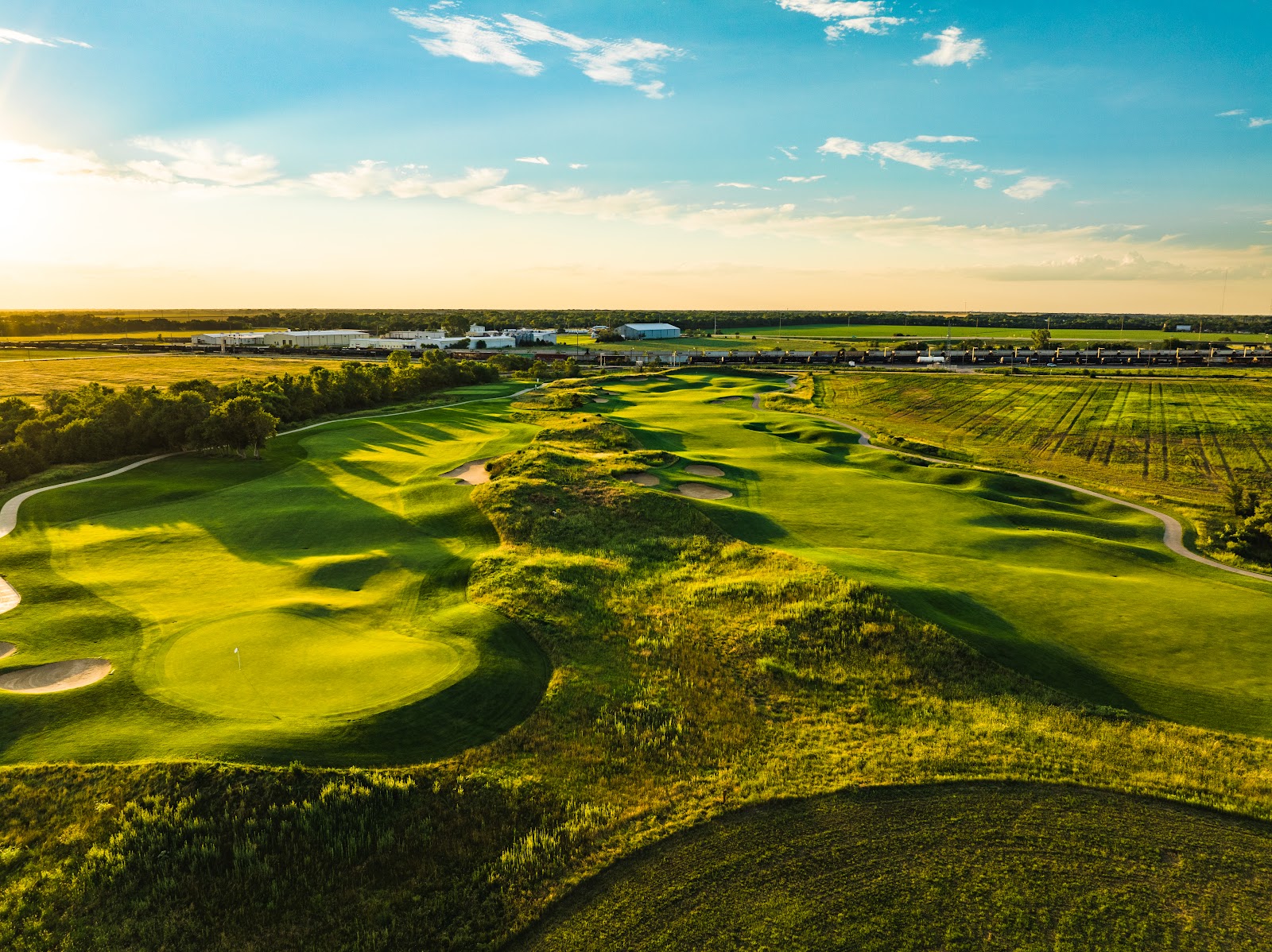
A links-style course on the plains is a particular kind of landscape. Rather than tree-lined fairways cut through woodland, it is open ground shaped by mowing height — close-mown fairway, longer rough, and native prairie grass left standing beyond it — with sand bunkers, subtle contouring and very little vertical structure anywhere.
That produces two completely different pictures from the same place, and the difference is how much of the apparatus is in frame.
Show the apparatus — a flag, a bunker, a green’s edge, a cart path, a mown stripe pattern — and the photograph reads unmistakably as a golf course. That is a legitimate choice, it is honest about where the wedding happened, and for a couple who chose the venue because they play it is exactly right.
Exclude the apparatus and the same ground reads as open grassland with beautifully graded mowing: long sweeping surfaces, bands of different grass height, sand as a pale abstract shape, prairie grass on the horizon. That version is elegant and it does not say golf at all.
The decision matters because the middle fails. A frame with an out-of-focus flagstick at the edge, or half a bunker in the corner, or a cart path running out of the bottom, reads as a photograph that was not paying attention — the apparatus is present enough to be noticed and not enough to be the point.
So it needs deciding in advance, ideally per location, and then executed cleanly.
Goddard sits at about thirty-seven and three-quarter degrees north at roughly fourteen hundred and fifty feet on open ground west of Wichita. The June noon sun reaches around seventy-five and a half degrees, the December noon sun about twenty-nine, days run from about nine hours forty to fourteen hours forty, and civil twilight is roughly twenty-eight minutes.
We have not photographed a wedding here. Which parts of the course are accessible and when, what the clubhouse offers and the permitted hours are questions for their team — and course access during play is the practical constraint.
The Sand Creek Station at a glance
| Where | A links-style course on open plains ground near Goddard, west of Wichita |
| The decision | How much golf apparatus the frame admits — flags, bunkers, paths, stripes |
| Show it | An honest golf-course picture, right for a couple who play |
| Exclude it | Elegant graded grassland with sand as abstract shape |
| The failure | The middle — half a bunker in the corner reads as carelessness |
Showing the course
If the course is the subject, the frames want the things that identify it, composed deliberately rather than admitted accidentally.
The mowing pattern is the most underused of them. Fairways are cut in alternating directions, and the grass lies differently in each pass — which means a fairway viewed along its length shows broad bands of light and dark that a viewer reads as stripes. Those bands are strongest when the sun is low and behind or in front of the camera rather than to the side, because the effect comes from the grass’s specular reflection.
A couple standing on a striped fairway with the bands receding is a strong, clean, unmistakably golf frame that needs nothing but the right angle and a low sun. It is far better than a frame that simply contains a flag.
Bunkers are the second element and they photograph better than expected. Sand is pale, smooth, raked into fine parallel lines, and in raking light those rake marks read as texture while the bunker’s lip casts a hard curved shadow. A bunker’s edge is one of the few genuinely graphic shapes on a course.
It is also a light source. A large sunlit sand surface is an efficient reflector — much more so than grass, which absorbs and tints green — so a subject standing near a bunker on its shaded side receives a bright neutral bounce that opens the eye sockets for free.
That is worth knowing because turf is the opposite. A sunlit fairway fills the lower half of a subject’s surrounding hemisphere with green light, and that green shows under the chin and in the eye sockets as a slightly ill cast that is hard to correct globally. Moving a couple from the middle of a fairway to the edge of a bunker changes the colour of their fill.
The green and the flag are the most obvious identifiers and they are the weakest photographically, because a flagstick is a thin vertical with no mass and a green is simply very short grass. If they are in frame, make them the composition — a couple on a green with the flag as a deliberate vertical anchor — rather than letting them appear at an edge.
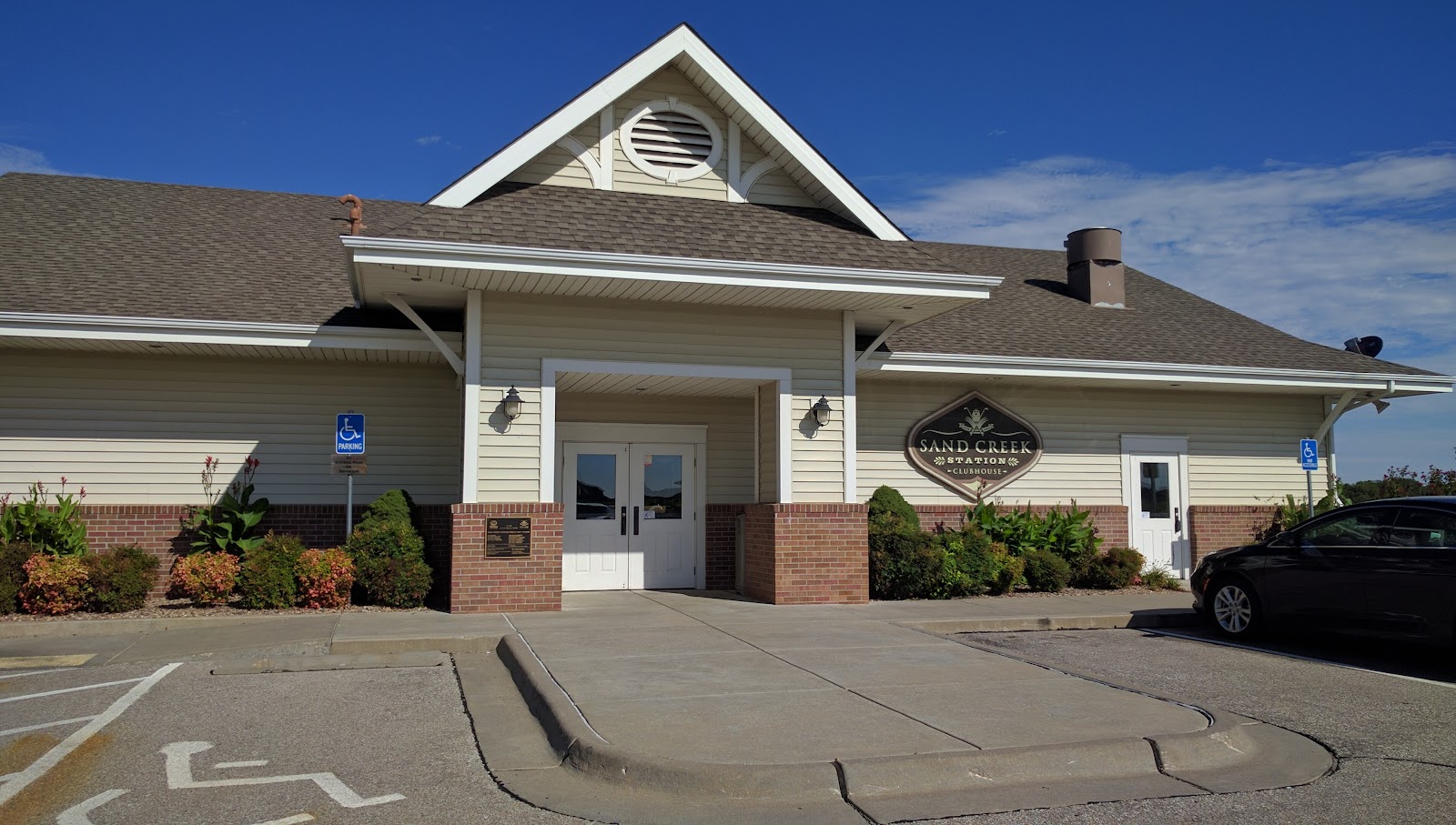
The clubhouse is the built element and it will be the only substantial structure. Whatever it offers — a verandah, a terrace, a covered entrance — is the shade, and shade on a links course is otherwise nonexistent. A verandah is optically a large soft source with a hard mask, and depth back from its open edge controls the ratio exactly as any porch does.
That is worth establishing on arrival, because it will be the midday answer and there is no alternative.
One practical matter that governs everything: course access. A working course has golfers on it, and a wedding party walking a fairway during play is both unwelcome and unsafe. Establish which holes are available and when — often it is the holes nearest the clubhouse, in a window after play has cleared or before it starts.
That window is frequently the end of the day, which happens to coincide with the best light. It is worth confirming rather than assuming, because a course that only releases its fairways at seven in the evening dictates the entire schedule.
Excluding the course
If the golf is out, the ground becomes graded grassland and the frames are landscape photographs — and on the Kansas plains that is a genuinely good thing to have.
The native prairie beyond the rough is the asset, and on a links-style course it is usually left standing deliberately. Tallgrass species — big bluestem, Indian grass, little bluestem — reach six to eight feet by late summer, and they turn copper, bronze and russet from October and hold that colour all winter because the dead growth stands until spring.
That gives a frame with three distinct bands of grass: close-mown in the foreground, longer rough behind it, and tall native grass beyond — all in different heights and, in autumn, different colours. From a low camera those bands read as deliberate landscape design rather than as golf, and they have genuine depth.
Get low and shoot through the tall grass. Prairie grass at six feet is taller than the people in the frame, and a low camera with stems at the lens and the couple beyond solves the emptiness that open country creates — the frame has foreground, middle and distance instead of flat horizontal strips.
Backlight it. Grass stems and seed heads are translucent, and a low sun behind them lights thousands of blades from within, turning a brown field into a glowing mass. That is the single most reliable frame on any prairie ground and it needs nothing but the sun in the right place.
The contouring is the other thing to use. A links-style course is shaped — mounded, hollowed, graded — and that artificial relief is the only elevation available on flat plains ground. From the top of a mound the camera looks down over a subject with the horizon further back; from the bottom, subjects on a rise stand against sky, which is the cleanest background there is.
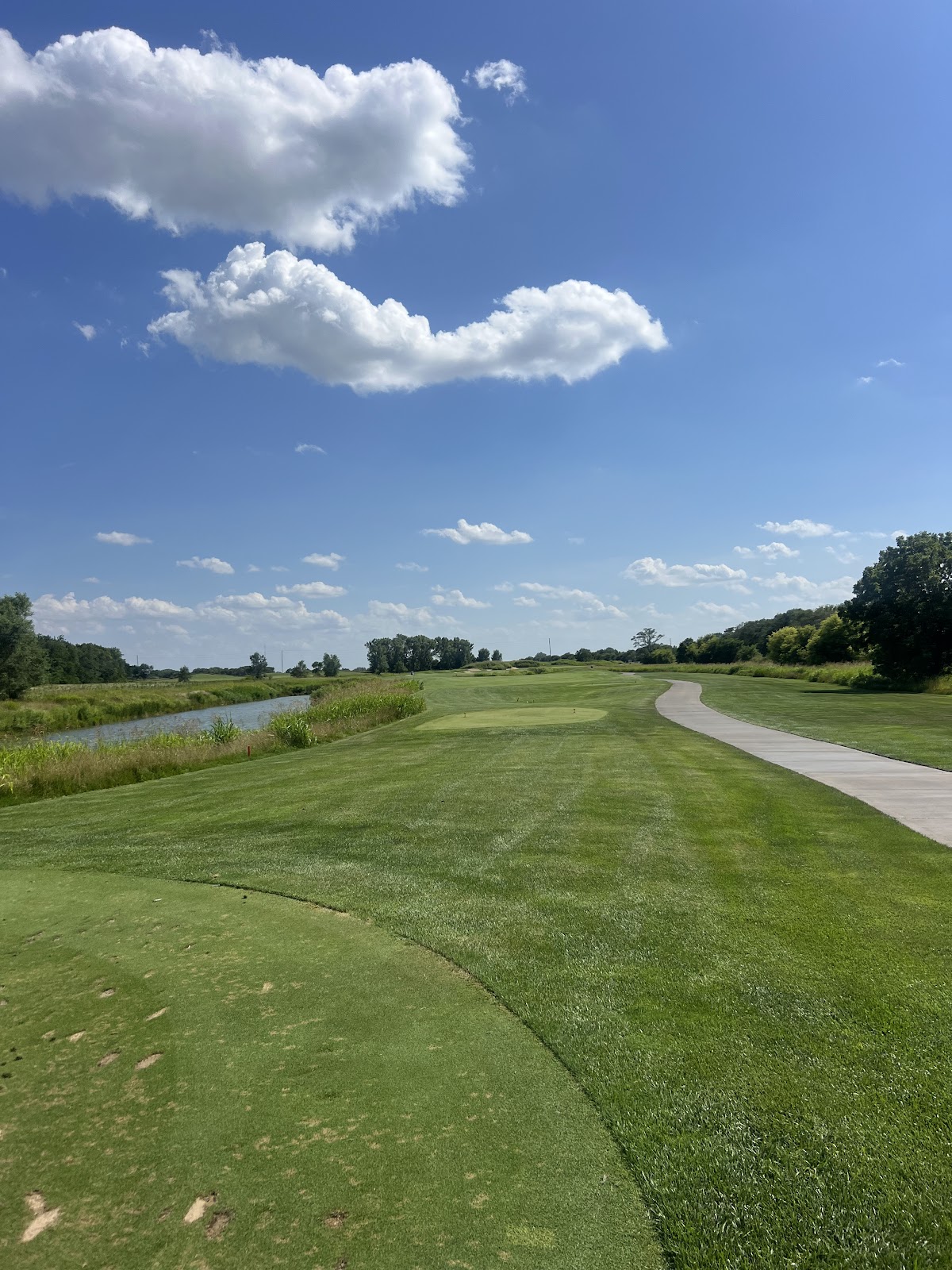
The water, if the course has any, is disproportionately valuable. On open plains a pond or a creek is the only reflective surface, and at dusk it doubles whatever colour the sky is producing — with a reflection sitting about a stop darker than what it reflects, which keeps the frame inside a single exposure.
Whether it is still is a matter of wind, and in Kansas that is a real question. This is among the windiest states, with average speeds well into double figures and almost nothing on open ground to interrupt them — so a mirror is luck rather than schedule. Broken water works too: a low camera turns a rippled surface into a bright path running toward the lens.
The wind governs equipment absolutely. Never put a modifier on an unweighted stand anywhere on this site; hand-held with a braced assistant is the only reliable method; and a five-hundredth of a second is the default for anything with hair or fabric in it.
It also governs the veil, which will be moving. Read the direction and rotate the couple so it carries across or away from the camera rather than toward it — blowing toward you it obscures faces, across it reads as a shape, away it extends into the frame.
And the wind is the best frame here, used deliberately. Tall prairie grass in wind moves as travelling waves, and at a thirtieth of a second on a tripod that blurs into flowing bands while a still subject stays sharp. That is the photograph open grassland makes better than anywhere, and it needs a briefed couple and several attempts.
- Decide per location whether the golf is in or out — the middle reads as carelessness
- Mowing stripes need a low sun in front or behind, not to the side
- A sunlit bunker is a neutral reflector; a sunlit fairway throws green onto skin
- Get low and shoot through the native grass — it solves the emptiness
- Blur the grass at a thirtieth with a still subject on a tripod
The hours, the sky and the year
On open ground with almost no shade, the schedule does more work than any technique, and the day divides sharply.
The middle of a clear summer day is the site’s worst condition and there is no positional fix. At seventy-five and a half degrees of sun elevation with nothing overhead anywhere, an uncovered face has shadowed sockets, a bright forehead and a hard nose shadow. Kansas humidity mitigates it — water vapour scatters light and fills shadows, so contrast runs perhaps a stop and a half below a dry climate at the same angle — but it does not solve it.
The three answers are the clubhouse verandah, a carried diffuser with a braced assistant, or scheduling around it. On a links course the third is the honest one.
The first and last ninety minutes are where the venue works, and they are genuinely excellent. Low light raking across graded turf shows every contour that a high sun flattens, the mowing stripes appear, the sand takes warm light, and the prairie grass beyond glows when backlit.
Dawn is the calmest hour and almost nobody uses it. Overnight the ground cools and the air stabilises, so wind is at its daily minimum at sunrise and builds through the morning — which means the frames that need still air belong at the start of the day and nowhere else.
The evening is windier and better lit, and it is usually when course access is available. That is the practical compromise: the best light and the worst air, with the answer being a fast shutter and a deliberate use of the movement.
Civil twilight here is about twenty-eight minutes, among the shorter figures in this library, so two or three planned setups fit and improvisation does not.
The sky is half of any wide frame on flat ground, and Kansas produces sky worth that proportion. Dust and agricultural haze scatter long wavelengths efficiently, which makes a clear plains sunset unusually saturated — and with an unbroken horizon the colour spreads across the entire western sky rather than being confined to a gap.
From April into June this is Great Plains storm season, and the cloud structure is spectacular: shelf clouds advancing as walls, mammatus beneath an anvil, towering convection visible in its entirety because nothing obstructs the view. A links course under that is remarkable.
It is also the point at which the safety line applies without qualification. This is tornado country, an open course has no shelter at all, and the highest thing on a fairway during a thunderstorm is a person. A wedding in that window needs a genuine plan, someone watching radar, and a willingness to go indoors immediately.
As to the year, late September into October is the best window and it is not close. The heat has broken, storm season has passed, the air is at its clearest of the year, the turf is still green from summer irrigation while the native grass has turned copper — which gives the strongest possible contrast between the mown ground and the prairie beyond.
That combination is specific to this venue type and this region, and it is the single best reason to choose an autumn date here.
May and early June give green everywhere, the longest days, and genuine severe weather risk. Midsummer is hot, humid and difficult in the middle, with the compensation of very long evenings — fourteen hours forty at the solstice puts the good light close to nine o’clock.
And winter gives a nine-hour day, real wind, dormant brown turf and standing copper prairie grass, with excellent low raking light across contoured ground and nothing to obstruct it. A links course in winter is a better photographic proposition than most outdoor venues, because its interest is in shape and grass height rather than in foliage that has gone.
More frames from The Sand Creek Station
The Sand Creek Station wedding photography: common questions
What is the one decision?
How much golf apparatus the frame admits. Show it deliberately or exclude it entirely — half a bunker in the corner reads as carelessness.
What is the best golf-specific frame?
A striped fairway viewed along its length with a low sun in front or behind. Mowing bands are far stronger than simply including a flag.
Why does a bunker help a portrait?
Sand is a pale neutral reflector. A sunlit fairway instead throws green light under the chin and into the eye sockets, which is hard to correct.
How do I make it not look like golf?
Get low and shoot through the standing native prairie grass, using the three bands of mowing height as landscape rather than as course.
When can we actually walk the course?
Ask — a working course has golfers on it, and access is usually the holes near the clubhouse in a window before or after play. It may dictate your schedule.
When is the best time of year?
Late September into October, when the turf is still green from irrigation and the native grass has turned copper. That contrast is specific to this venue type.
More Kansas venue guides
We are writing a photographer’s guide to every venue we would happily shoot in Kansas. Here are three more, plus the full index:
- The Tallgrass Prairie National Preserve: The Problem, and Four Ways Out of It
- The Ambassador Hotel, Wichita: Four Ways Out of the Ornate-Ceiling Problem
- Botanica Gardens: One Decision About Kansas Wind
Planning a wedding at The Sand Creek Station?
Mown ground, standing grass, and a decision to make. Tell us your date.