 Roxy’s Downtown: Photographing a Small Stage Room
The Prairie Rose Chuckwagon Supper, Benton: What It Suits, and What It Does Not
The theming is total. That is the whole question.
A fully themed venue is an unusual proposition and the only honest way to describe it is by what the theming does, because the theming is not a decorative layer — it is the entire building.
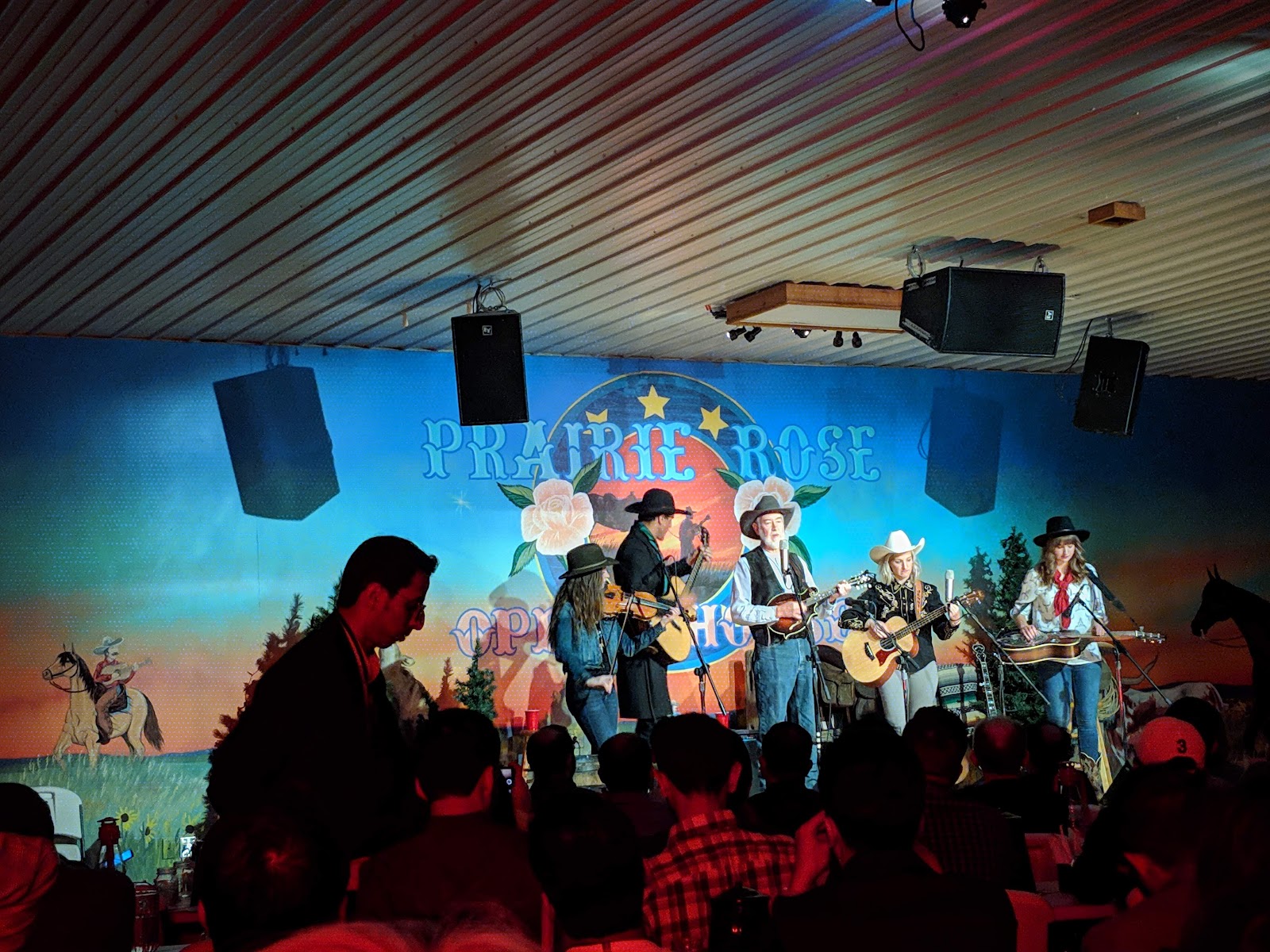
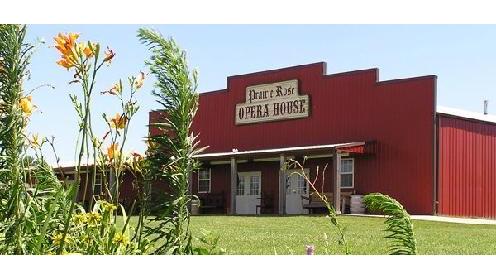
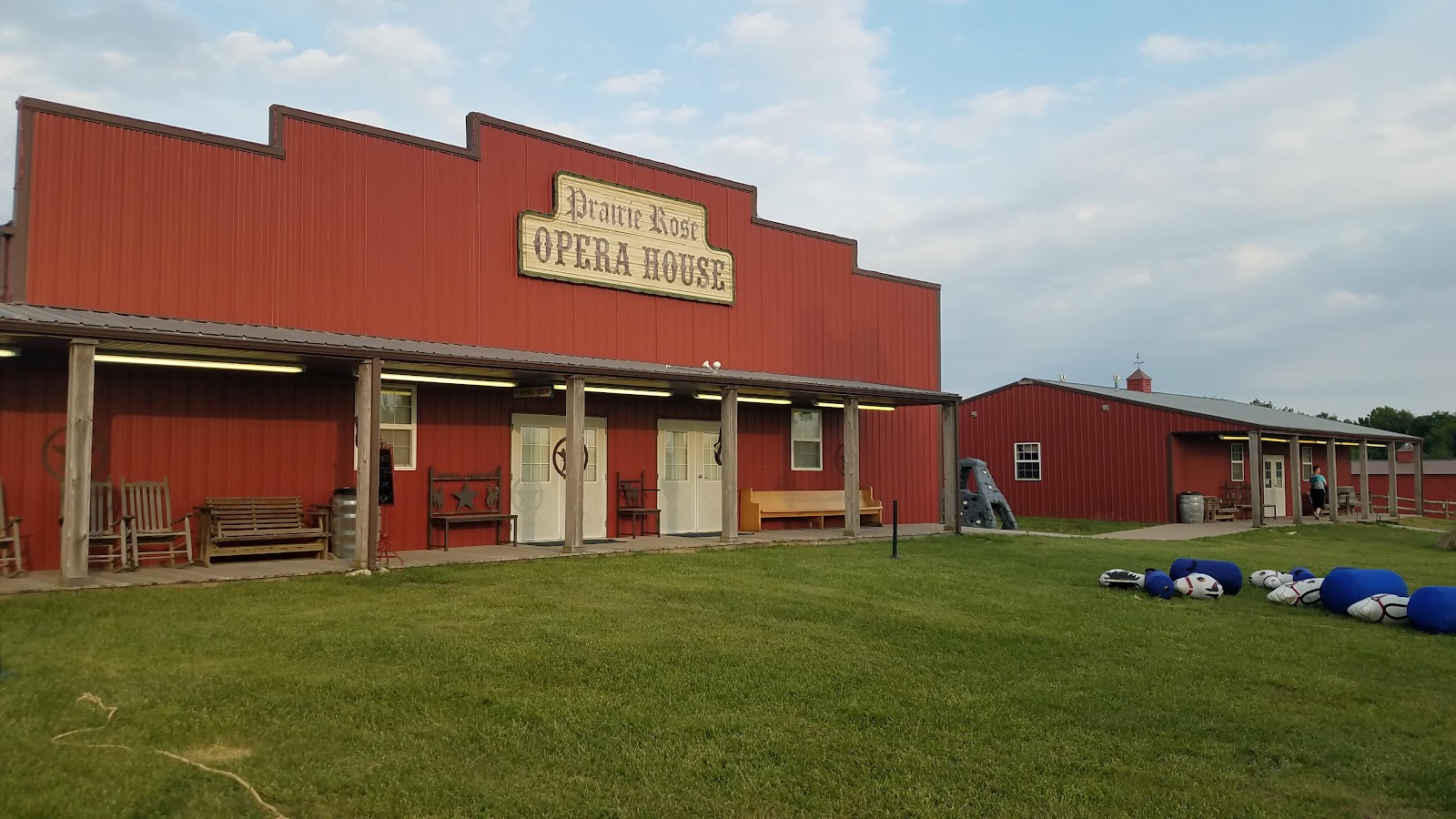
A western chuckwagon operation of this kind is built as a set: a frontier-town street or hall, timber boardwalks, painted signage, period-styled interiors, wagon-wheel and lantern fittings, a stage for a cowboy music revue, and a chuckwagon supper served from cast iron. Everything visible was chosen to support one idea.
That is a genuine commitment and it produces a specific photographic situation. There is no neutral surface anywhere. Every background says western, every fitting is in period, and the light is warm, low and theatrical because that is what the setting wants.
So the question is not how to photograph it well — that is straightforward — but whether the register suits the wedding. A couple who want the theme will get pictures unlike anyone else’s. A couple who want something clean and contemporary will find the building arguing with them in every frame, and no amount of styling overrides a purpose-built set.
The second thing to understand is that this is an entertainment venue before it is a wedding venue. It has a stage, a sound system, stage lighting, a performance schedule and a kitchen built for volume service — which brings real advantages in capability and real constraints in flexibility.
And the third is the location. This is open plains ground near Benton, north-east of Wichita, which means the surroundings are flat to gently rolling farmland with a low horizon, very little natural shade and a great deal of wind.
Benton sits at about thirty-seven and three-quarter degrees north at roughly fourteen hundred and fifty feet. The June noon sun reaches around seventy-five and a half degrees, the December noon sun about twenty-nine, days run from about nine hours forty to fourteen hours forty, and civil twilight is roughly twenty-eight minutes.
We have not photographed a wedding here. What is bookable, whether the stage lighting is available and the permitted hours are questions for their team.
The Prairie Rose Chuckwagon Supper at a glance
| Where | A western-themed supper and entertainment venue near Benton, Kansas |
| Suits | A themed wedding, a large seated group, catering and entertainment under one roof |
| Does not suit | Anyone wanting a neutral backdrop or a contemporary register |
| The register | Total. Every surface and fitting supports one idea |
| Ask first | What is bookable, and whether the stage lighting is available to you |
What it suits
It suits a couple who want the theme, and that is the clearest and most important case. A purpose-built western set produces photographs that look like nowhere else — boardwalks, painted storefronts, lantern light, a stage — and for a couple who chose it deliberately that is the entire point and it will be delivered completely.
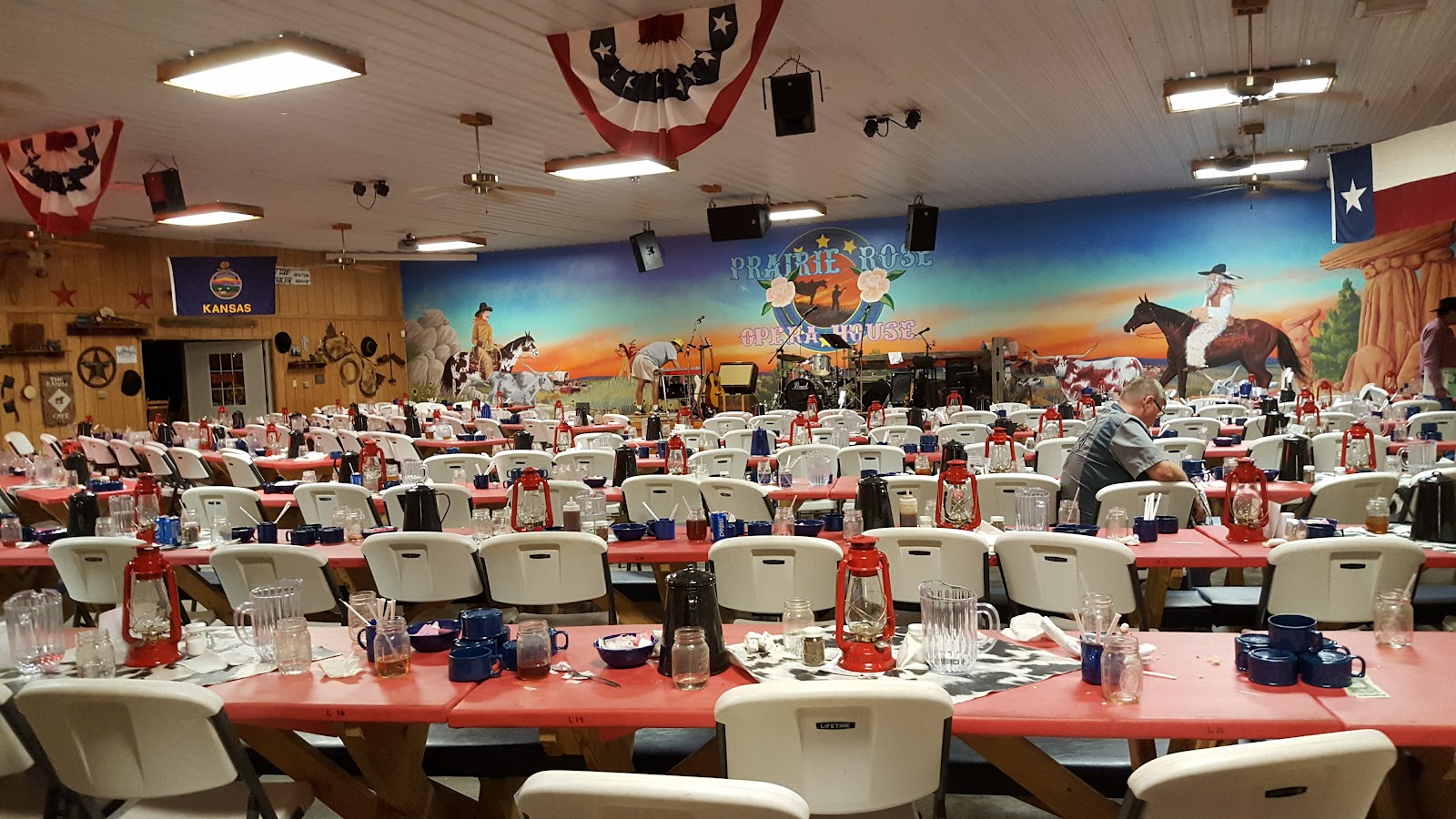
It suits a large seated event with catering built in. A chuckwagon supper operation feeds several hundred people as its ordinary business, which means the kitchen, the service and the timings are professional rather than improvised. For a photographer that matters more than it sounds: a meal that runs to schedule means the light outside is where the plan said it would be when the speeches end.
A venue that runs late costs golden hour, and at this latitude with a twenty-eight-minute twilight that is not recoverable.
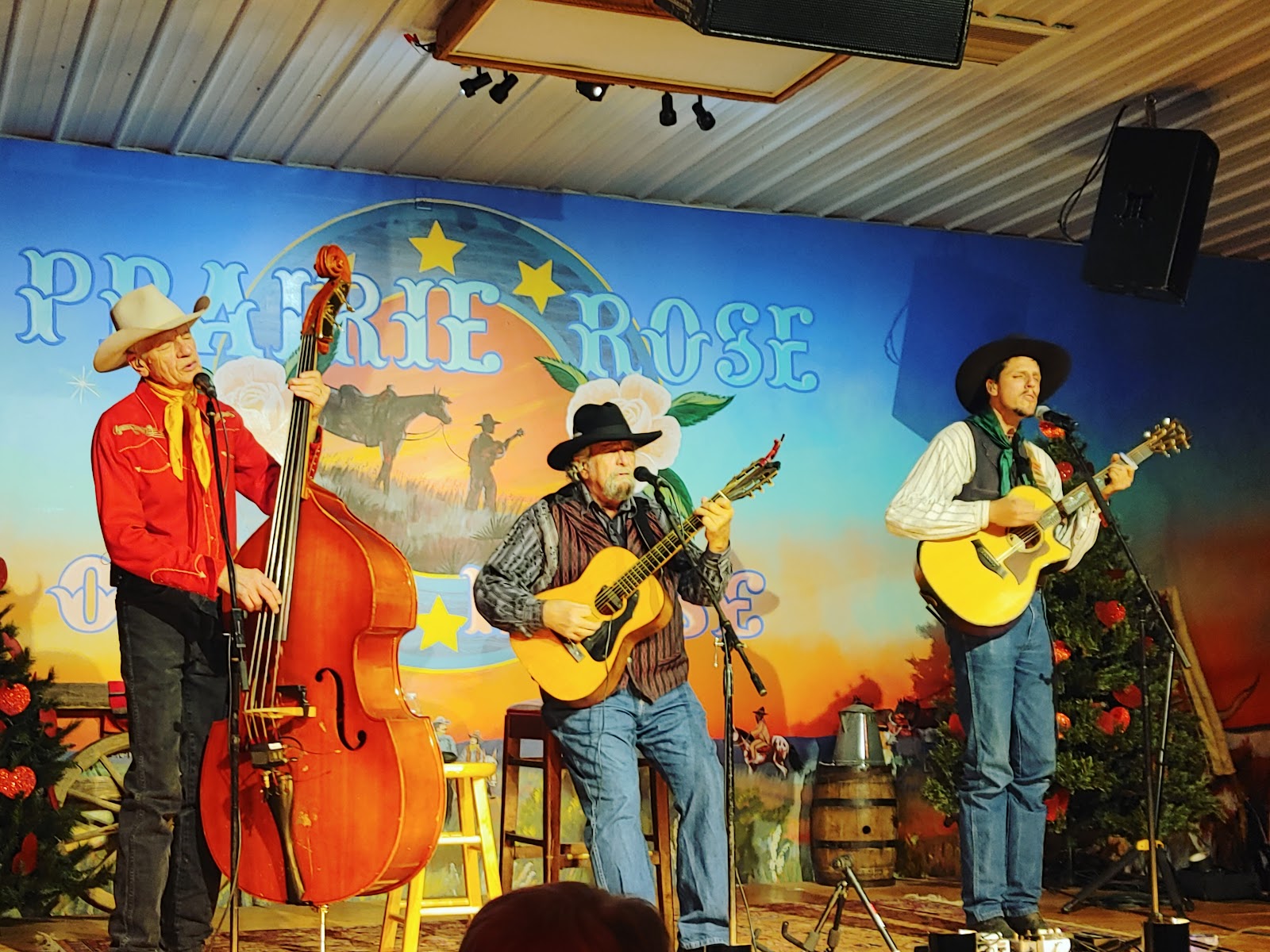
It suits an event wanting entertainment. The venue has a stage, performers and a sound system as standing capability, which means a reception with live music is the building’s normal mode rather than an addition. That produces genuinely good photographic material — performers, a lit stage, an audience reacting — which most wedding venues cannot offer at all.
It suits the theatrical light, once you work with it rather than against it. The interiors are lit warm and low with practical fittings — lanterns, sconces, stage wash — and that produces atmosphere for free. The technique is to expose so the room’s own light reads and add only enough to bring faces up within it, which is the same method any dim characterful interior wants.
It suits bad weather completely, and in this climate that matters. Kansas is genuinely variable: Great Plains storm season from April into June, heat and humidity through midsummer, real wind year-round, and a nine-hour December day. A single indoor venue with catering, entertainment and covered space does not care about any of it, and on flat farmland there is little landscape to miss.
And it suits a photographer willing to use a stage. A raised platform with proper lighting is the best portrait position in any entertainment venue: the subject is above the camera, the background is controllable, and there is real light already aimed at where they will stand. Asking for the stage wash to be set to something neutral for five minutes of portraits is worth doing — staff will usually oblige and almost nobody asks.
What it does not suit
It does not suit a neutral or contemporary wedding. There is no plain wall to fall back on, no undecorated room, no clean modern space — the theming is structural and it appears in every frame. A couple whose florals, stationery and dress are minimal and modern will be photographed against painted frontier signage, and the two registers will fight.
That is worth being blunt about, because it is the single reason this venue would be the wrong choice.
It does not suit a party expecting the photographs to be restrained. Strong theming photographs as strong theming. The pictures will be warm, busy and characterful, and that is the honest product.
It does not suit anyone needing flexibility over the schedule or the layout. An entertainment venue with a stage and fixed seating has a configuration, and a performance operation has a rhythm — which means the timings and the room arrangement are more fixed than at a blank-canvas venue. That is the price of having the capability built in.
It does not suit a photographer unwilling to bring light. Themed interiors are dark by design, because atmosphere requires low levels, and the practical fittings are warm and dim. Every frame indoors is lit, and bounce is likely limited — themed interiors use stained timber, dark paint and patterned surfaces, none of which returns much.
It does not suit a good outdoor ceremony unless one has been specifically built, and this is the thing to ask about most carefully. Open plains farmland offers no natural shade, a low featureless horizon and constant wind — which is the least interesting outdoor condition available. A venue with a purpose-built outdoor space is a different proposition from one with a field, and a website will not distinguish them.
And it does not suit a party that wants variety in the backgrounds. A themed venue is coherent, which is its strength, and coherent means similar — so a long day risks repetition. The answer is to get variety from the light rather than the location: window light, stage light, lantern light, after-dark frames and the exterior at dusk all look different while the set does not.
One further honest note on colour. Themed interiors are frequently lit by incandescent or warm LED practicals at very low levels, and a daylight-balanced flash against that gives blue-white faces in a golden room — which is the most common failure in this kind of venue. Gel the key a quarter to a half warm, set white balance on skin, and let the practicals read as the warm sources they are. Correcting them toward neutral turns a warm atmospheric set into a grey one and loses the whole reason for being there.
- Ask for the stage wash set neutral for five minutes of portraits
- Expose for the room’s own practicals, then lift faces within them
- Gel warm; never neutralise the practicals or you lose the set
- Ask whether the outdoor space is purpose-built or merely a field
- Get variety from the light, not the location — the set does not change
Technique, the plains and the year
Five things govern a day here and none of them is complicated.
The stage is the best position in the building and it should be used deliberately. A raised platform puts the subject above the camera, which flatters, and the existing rig means there is already light aimed where they will stand. For portraits, ask for a neutral wash; for atmosphere, accept whatever colour the rig produces and match your key to it rather than fighting toward neutral.
The rim light matters more in a themed room than almost anywhere, because the backgrounds are busy. A subject lit only frontally against painted signage and patterned surfaces merges into them, and a rim at about a stop over the key on the far shoulder lifts them clear. It is the single biggest improvement available indoors.
Let the room go under. The instinct in a dim atmospheric space is to lift the ambient until everything is legible, which produces a muddy frame full of competing detail. Setting the ambient a stop and a half or two stops under and lighting the subject properly gives clean people in a rich environment — which is also how the place actually feels.
Drag the shutter so the practicals register. Lanterns, sconces, festoon strings and stage wash are what make the interior look like itself, and a frame exposed only for flash renders them dark and the room anonymous. A thirtieth to a sixtieth on a wide lens is the usual range; faster than a hundred and twenty-fifth kills them entirely.
And check the reflective surfaces. A themed interior has glass, polished timber, mirrors behind a bar and metal fittings, all of which will show the photographer and the lighting stand from some angle — easy to miss in a viewfinder, obvious in an edit.
Outside, this is open plains ground and the conditions are the region’s.
There is almost no natural shade. Away from the buildings and any planted shelterbelt, Kansas farmland offers nothing overhead — so the built structures are the answer. A boardwalk, a deep eave, a covered porch on a themed frontage is optically a large soft source with a hard mask, and depth back from its open edge controls the ratio exactly as any porch does.
That is genuinely useful here, because a frontier-town set is largely made of covered boardwalks — which means the venue has more usable outdoor shade than most plains sites, purely as a by-product of its theming.
The wind is the constant. Kansas is among the windiest states, with average speeds well into double figures and very little on open farmland to interrupt them. Never put a modifier on an unweighted stand; hand-held with a braced assistant is the only reliable method; and a five-hundredth of a second is the default for hair and fabric. A veil will be moving, and the fix is positional — rotate the couple so it carries across or away from the camera rather than toward it.
The sky is half of any wide frame on flat ground, and the Plains deliver. Dust and agricultural haze scatter long wavelengths efficiently, so a clear sunset here is unusually saturated, and with an unbroken horizon the colour spreads across the whole western sky. From April into June the storm structure is spectacular — shelf clouds advancing as walls, towering convection visible in its entirety — and it is also the point at which the safety line applies without qualification: this is tornado country, open ground has no shelter, and a wedding in that window needs a genuine plan and someone watching radar.
Civil twilight is about twenty-eight minutes, among the shorter figures in this library, so the end of the day needs its two or three frames known in advance. The best of them is the themed exterior lit from within — warm light spilling from windows and lanterns onto a boardwalk against a deep blue sky, fifteen minutes after sunset. That is the only condition in which the set’s own lighting reads properly from outside, and it takes ten minutes.
As to the year: late September into October is the best window, with the heat broken, storm season passed, the clearest air of the year, and native prairie grass on any unploughed ground turning copper and bronze — a colour that then holds all winter, because dead grass stands until it burns in spring.
May and early June give green ground and real severe-weather risk. Midsummer is hot and humid with a difficult midday. And winter is where an indoor themed venue earns its keep entirely: a nine-hour day, hard wind and possible snow are irrelevant to a building that supplies its own light, its own catering and its own entertainment — and the blue hour arriving around half past five puts the one exterior frame comfortably before the reception rather than in the middle of it.
More frames from The Prairie Rose Chuckwagon Supper
The Prairie Rose Chuckwagon Supper wedding photography: common questions
What is the real question with this venue?
Whether the register suits the wedding. The theming is structural, not decorative — there is no neutral surface anywhere in the building.
What does it do better than most venues?
Entertainment and catering as standing capability, plus a stage. A reception with live music is its normal mode rather than an addition.
What is the best portrait position?
The stage. It puts the subject above the camera and there is already light aimed where they will stand. Ask for a neutral wash for five minutes.
How do I handle the warm practicals?
Gel the key a quarter to a half warm and set white balance on skin. Correcting the practicals toward neutral turns an atmospheric set grey.
What should I ask about outdoors?
Whether there is a purpose-built outdoor space or just a field. Open Kansas farmland has no shade, a featureless horizon and constant wind.
Does the theming give any practical advantage?
Yes — a frontier-town set is largely covered boardwalks, so it has more usable outdoor shade than most plains sites, as a by-product.
More Kansas venue guides
We are writing a photographer’s guide to every venue we would happily shoot in Kansas. Here are three more, plus the full index:
- The Regier Farm, Hillsboro: Field Notes
- The Sand Creek Station, Goddard: The One Decision That Governs Everything
- The Tallgrass Prairie National Preserve: The Problem, and Four Ways Out of It
Planning a wedding at The Prairie Rose Chuckwagon Supper?
A set, committed to completely. Tell us your date.