 The Bierstube: What Changes When the Reception Is in a Bar
Old Faithful Inn, Yellowstone: The Venue’s Own Logic
A seven-storey room built of whole trees. Everything in it absorbs.
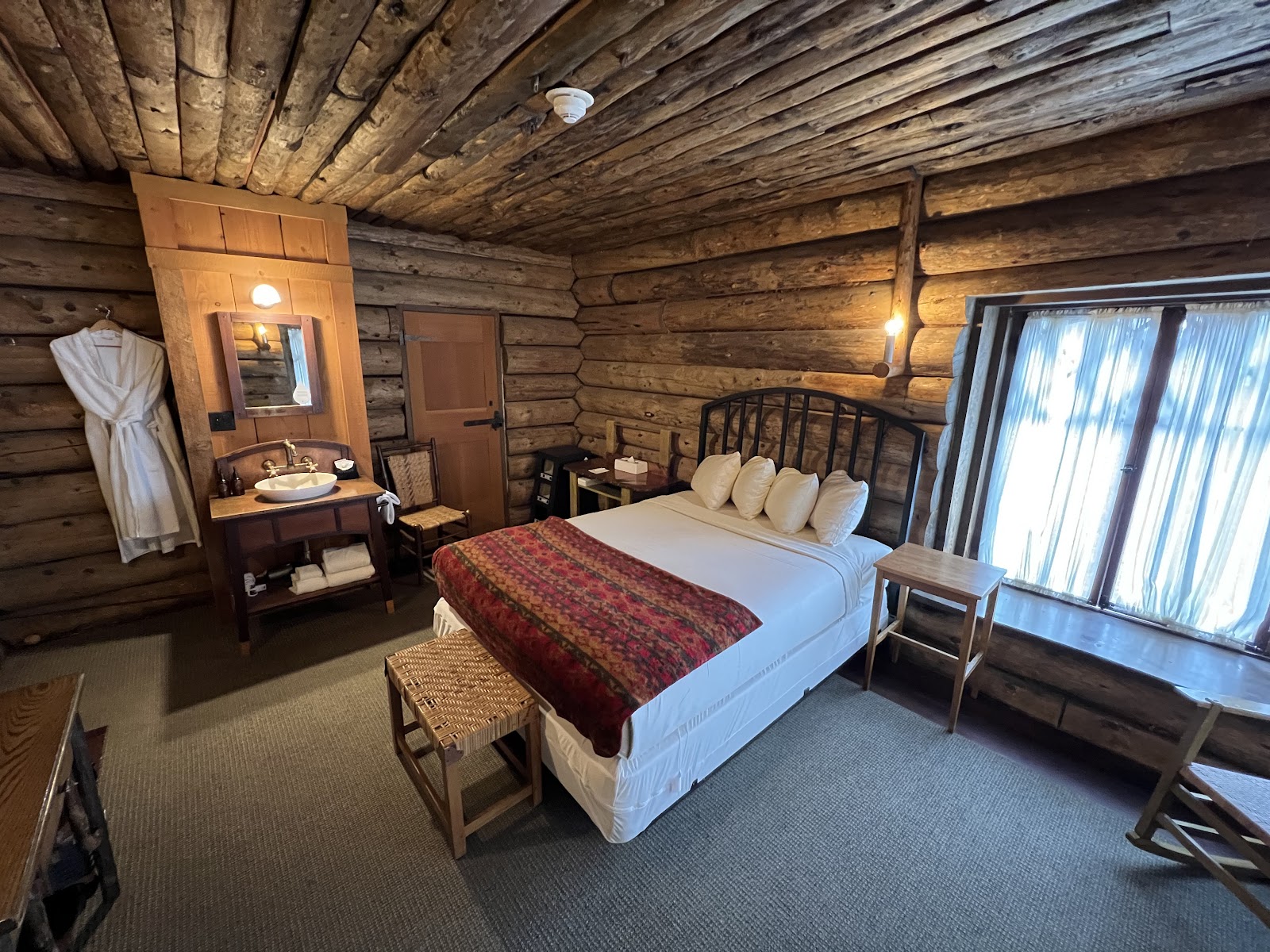
This building has one organising idea and it is a material one: it was made of the trees standing around it.
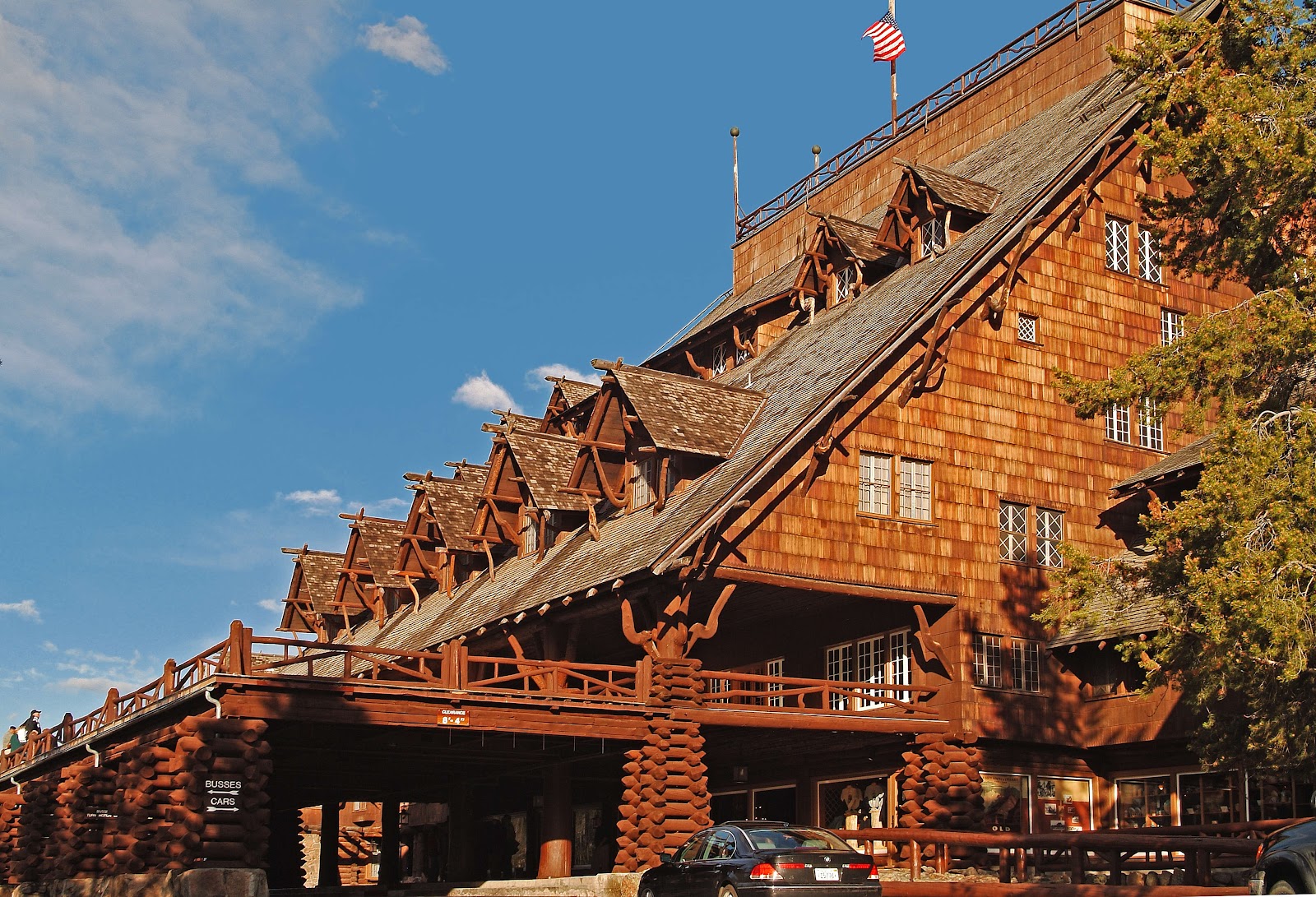
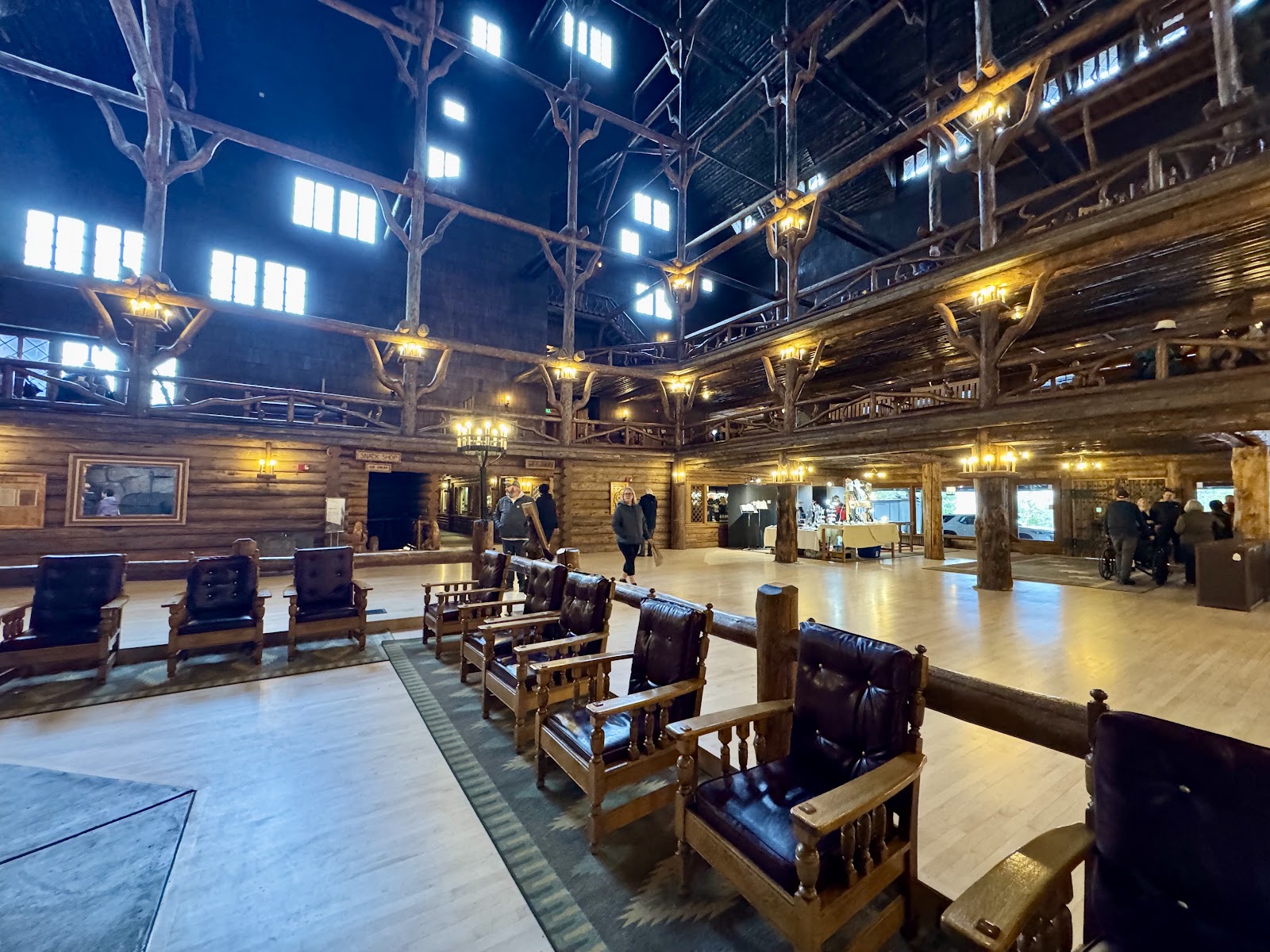
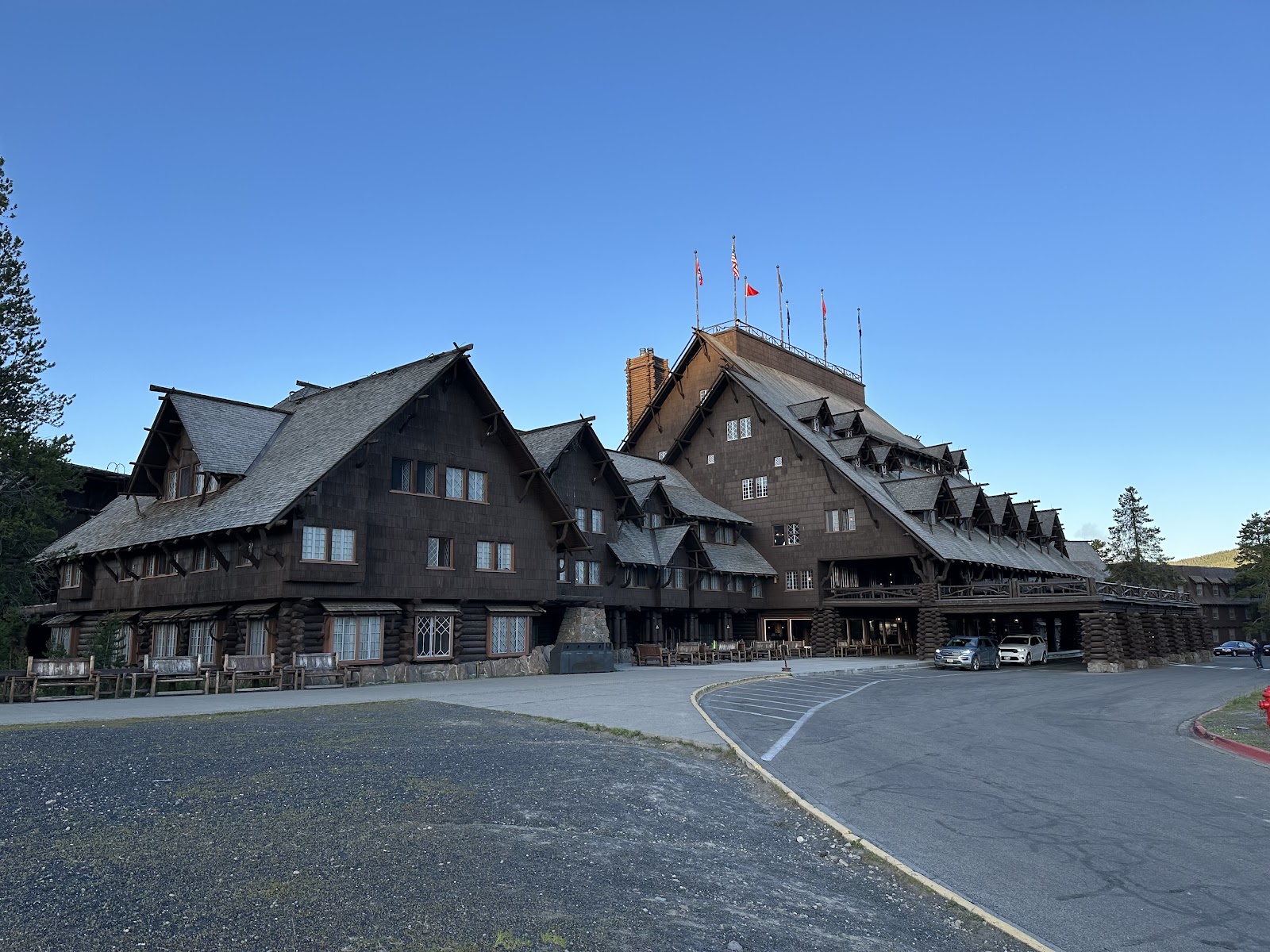
The Old Faithful Inn opened in 1904, built through a Yellowstone winter from lodgepole pine cut nearby and local rhyolite stone, and its central lobby rises the full height of the structure — something like seven storeys of exposed log framing, galleries, staircases and a vast stone chimney.
That is the logic, and it produces a photographic environment unlike anything else in this guide. It is not a room with timber in it; it is a room made of timber, at a scale nobody builds at any more, with the structure entirely visible from floor to roof.
Three consequences follow immediately and they all point the same way. Log and dark timber absorb rather than reflect, which means the ambient in the lobby sits well below what the eye reports — the eye adapts to it and a meter does not. The fall-off from any window is extremely steep, because there is almost nothing to bounce light back: the drop from a face at a window to a surface three metres behind it is routinely four stops or more. And the colour is warm, because every surface in the room is aged wood.
None of that is a difficulty. Steep fall-off is what a portrait wants, and a room this dark supplies a black backdrop for nothing. What it does mean is that the metering method has to change: read the light on the face, set that, and let the enormous volume behind go where it goes.
The fourth consequence is the scale, and it is the one people get wrong. A seven-storey room tempts a wide lens, and a wide lens in a room that size makes two people disappear. The building has to be photographed at two scales deliberately: part of it as the whole, and once as the whole with the people very small.
The setting is a high volcanic plateau at around seven and a half thousand feet, in a geothermal basin. The altitude and the geothermal activity both matter photographically and are dealt with below.
Yellowstone’s Old Faithful area sits at about forty-four and a half degrees north. The June noon sun reaches around sixty-nine degrees, the December noon sun about twenty-two, days run from about eight hours forty to fifteen hours forty-five, and civil twilight is around thirty-six minutes.
We have not photographed a wedding here. Whether ceremonies are permitted, what permit is required, which spaces are available, what group sizes are allowed and what the hours are, are questions for the park and the concessioner — and at a national park those are rules rather than preferences.
Old Faithful Inn at a glance
| Where | A 1904 log hotel in the Old Faithful geyser basin, Yellowstone |
| The logic | Built of local lodgepole pine and rhyolite — a room made of standing trees |
| The consequence | Everything absorbs: a low ambient, steep fall-off, and a warm cast |
| The trap | A seven-storey room makes two people disappear under a wide lens |
| Ask first | Park permits, available spaces, group limits and hours |
Reading the lobby
Meter on skin, always. In a room where the surfaces absorb and the volume is enormous, a camera reading the scene will overexpose everything that matters. That single habit accounts for most of the difference between competent and poor work here.
Then find the windows and treat each one as a studio source. A subject at forty-five degrees to a window, at a distance that sets the ratio, with the log volume falling away behind, gives a lit face against a near-black ground with no equipment. Moving the subject a metre further from the window increases the ratio noticeably, because the timber provides no fill to soften the change.
The galleries are the building’s specific gift and they are worth working properly. Multiple levels of open balcony around a central volume mean a camera can be above, level with, or below a subject without anyone leaving the building — and each of those is a genuinely different photograph.
From a gallery looking down, the lobby becomes a pattern of log framing with figures small in it. From the floor looking up, the structure converges dramatically toward the roof. From one gallery across to another, a subject stands in a frame of horizontal and vertical members with darkness behind them. That vertical freedom is rare and it is the reason to spend time here rather than passing through.
The structure is also the source of separation. Log posts, beams, braces and railings are dark linear elements, which means a subject placed in front of one or between two has separation supplied by the architecture. The hazard is the roof: an exposed log structure overhead is visually dense, and a frame containing a great deal of it has an enormous amount happening above the subjects’ heads.
A lower camera angle or a tighter crop handles it, and the decision is whether the structure belongs in the picture — it is far too strong to be neutral.
The stone chimney is the other major element and the best single position in the room. A very large mass of local rhyolite is dark, textured and low in saturation, which is a better background than any wall, and where a fire is lit it provides a warm low directional source at floor level — an uplight, which fills under the chin and the brow from below and is the opposite of what a window does.
A fire is also very warm and unstable, which means the white balance goes on skin and the shutter has to be fast enough that flicker does not produce differences between frames.
The scale decision is worth stating as a method. Photograph part of the room as though it were the whole: one bay of framing, one gallery corner, one stair, one window with its surrounding logs. That keeps the subjects at a reasonable size and still says what the building is made of.
Then take one frame of the whole volume with the subjects deliberately small in it — a couple occupying a tenth of the frame height in a seven-storey log room reads as a statement about the building, and it works precisely because they are small. Two or three of those in a set, and the rest at human scale, is the right proportion.
The artificial light in the evening is warm, low and mounted high on the structure, which produces a top-heavy pool-and-gap pattern. Balance for the fittings, gel any added source warm, use the pools as key rather than filling them out, and let the roof volume go black. Never bounce off a log ceiling — the light goes into the wood and does not come back.
Outside: the basin, the altitude and the steam
Outside, the building’s exterior is log and stone and it behaves as both materials do: high-frequency textures that come alive under light raking across them and read as flat fields under flat light.
That makes the exterior a first-or-last-hour subject, and a five-minute check of which elevations face which way on arrival is worth more than an hour of walking. A wall rakes for roughly twenty or thirty minutes once a day.
The geyser basin is the setting and it is a genuinely unusual photographic environment. The ground is pale siliceous sinter — a mineral crust deposited by the hot water — which is bright, almost white in places, and which behaves as a large reflector: it fills faces from below and it fools a meter by a stop or more in any frame containing much of it.
The thermal features add steam, and steam is the basin’s great photographic subject. It is backlit brilliantly by a low sun, it makes visible the wind that is otherwise invisible in a still frame, and in cold air it condenses into dense white plumes that can fill a whole landscape. Steam against a dark forest at low sun is the most distinctive frame in this part of the world.
The technical approach to steam is to expose for it rather than through it. A plume is bright and it is the subject; a frame metered on a face with steam behind gives a blown white field. And where a subject is standing in or near steam, the moisture scatters light and lowers contrast, which needs either a position change or acceptance rather than correction.
Thermal features also have a serious practical constraint. The crust around hot springs is thin, the water is at or near boiling, and the boardwalks exist for that reason. Nobody steps off them, ever, and a wedding party near a thermal area is a situation to be managed rather than improvised. What is permitted is a question for the park rather than a judgement to make on the day.
The altitude is the next factor. At around seven and a half thousand feet there is roughly a fifth less atmosphere overhead than at sea level, and the consequences are consistent: direct sun is harder and shadows are deeper than the temperature suggests, the sky is a deeper blue so open shade reads markedly cool, ultraviolet is high, and the air is exceptionally clear — which is why distant ranges hold detail on a long lens.
The practical reading is that the middle of a summer day here is harder than the same hour at sea level, and the low light is cleaner and more saturated.
The forest is lodgepole pine, and that is the single most important species fact in Yellowstone. Lodgepole grows tall, straight and densely, with sparse crowns high on the trunk — which means it holds almost no foliage at eye level and throws a hard, shifting, high-contrast dapple on the ground beneath it.
That dapple is the worst light a face can meet outdoors: a four or five stop range across a head, unrecoverable. A lodgepole forest in direct sun is not a portrait location and no amount of technique fixes it.
What it is instead is a background: a dense field of straight vertical trunks, which is graphically strong and reads well when the subject is lit separately. And under overcast, or after the sun has gone, the same forest becomes soft and entirely usable.
The reliable alternatives are Douglas fir and Engelmann spruce, which grow at these elevations and block far more completely — a subject a metre inside a fir or spruce margin has soft directional light in front and three or four stops of dark behind. Knowing which conifer you are standing under is the practical difference between a good frame and a wasted one.
And the wind: a high open plateau is windy as a baseline, which makes a lightstand a liability and means every source is handheld or weighted.
- Meter on skin; a seven-storey log room will fool the camera every time
- Use the galleries: above, level and below a subject, without leaving the building
- The stone chimney is the best position; a lit fire is an uplight
- Photograph part of the room as the whole, then the whole with people small
- Lodgepole dapples unusably; fir and spruce block. Know which you are under
The Yellowstone plateau year
Four sharply separated seasons on a high plateau, and one of them changes the venue completely.
Winter is the most extraordinary and the most restricted. At seven and a half thousand feet in Montana and Wyoming the snow is deep and the cold is severe, and most of the park’s interior roads are closed to ordinary vehicles — access is by oversnow vehicle or not at all. Whether a winter event is possible here is entirely a question for the park and the concessioner, and it is the first one to ask.
If it is, the photographs are unlike anything else in this guide. Geothermal steam in air well below freezing produces enormous white plumes and frosts every nearby surface — trees, grass and boardwalk railings become rimed white — which is a landscape that exists nowhere else. Bison stand in the warm ground near the springs with frost on their coats.
Snow is also the best natural fill available: it lifts shadows to within a stop and fools a meter by about two, so open up deliberately, and against near-black conifer it gives the widest brightness range in this guide. The December noon sun at around twenty-two degrees means the whole short eight-hour-forty day rakes rather than floods.
Spring at this altitude is late and it is the weak window. Snow lies into May and often June, the ground is saturated with meltwater, and the landscape is brown and grey where it is not white. Roads open progressively rather than on a date.
Late June brings green, wildflowers on the meadows, and very long days.
Summer is the short high season and the days are remarkable: over fifteen and three-quarter hours of daylight at the solstice with about thirty-six minutes of civil twilight, which means the low light arrives after nine and lasts, and the working day is longer than anywhere in the southern half of this guide.
The costs are the middle of the day at sixty-nine degrees of elevation, afternoon convection — these mountains make their own weather and a clear morning frequently becomes a wet afternoon — and crowds, which at Old Faithful in July are very substantial indeed. A frame that reads as uncrowded requires early morning or late evening.
The honest late-summer note is wildfire smoke. The northern Rockies’ fire season runs from roughly July into September, and smoke from fires anywhere in the region can fill the plateau for days — turning the sun orange, flattening contrast, removing distant ranges entirely, and shifting everything warm in a way no white balance resolves.
That removes the wide frames while leaving the interiors and the close frames intact, which is a real argument for weighting a late-summer day toward the lobby and the basin at close range. It cannot be planned for, only acknowledged.
Late September into early October is the best window of the year. The aspen turn — and because a grove is clonal, genetically a single organism, a whole stand goes gold at once rather than tree by tree, which gives blocks of uniform colour against near-black conifer. The cottonwoods along the rivers turn gold too, the first snow returns to the peaks, the smoke risk has usually passed, the crowds thin, and the air is at its clearest of the year.
Gold aspen against dark lodgepole under a fresh-snowed ridge, with steam rising somewhere in the frame, is the strongest thing this landscape produces. The window is about two weeks.
By late October the plateau is turning toward winter and the roads begin to close.
More frames from Old Faithful Inn
Old Faithful Inn wedding photography: common questions
What is the building's logic?
It was built in 1904 from lodgepole pine cut nearby, with its structure fully exposed in a lobby rising something like seven storeys.
How should I meter inside?
On skin, always. Log and dark timber absorb, so the ambient is well below what the eye reports and a scene reading will overexpose the faces.
What is the lobby's specific advantage?
The galleries. A camera can be above, level with or below a subject without leaving the building, and each is a genuinely different photograph.
How do I handle the scale?
Photograph one bay or one stair as though it were the whole room, then take one frame of the whole volume with the subjects deliberately small.
Can I photograph in the geyser basin?
On the boardwalks, and only there — the crust is thin and the water is near boiling. What is permitted is a question for the park, not a judgement for the day.
When is the plateau at its best?
Late September into early October: clonal aspen turning gold all at once, fresh snow on the peaks, thin crowds, and the clearest air of the year.
More Montana venue guides
We are writing a photographer’s guide to every venue we would happily shoot in Montana. Here are three more, plus the full index:
- Paradise Ranch, Emigrant: A Walk Through the Site
- The Ranch at Rock Creek, Philipsburg: What It Suits and What It Does Not
- The Resort at Paws Up, Greenough: A Walk Through the Site
Planning a wedding at Old Faithful Inn?
A room built of whole trees. Tell us your date and we will meter on the faces.