 The Bierstube: What Changes When the Reception Is in a Bar
Many Glacier Hotel, Glacier: One Frame and How It Is Made
A mountain across the water from the front door, and one hour when it doubles.
There is one frame in the Many Glacier valley that is worth planning the whole day around, and it depends on two things being true at the same time.
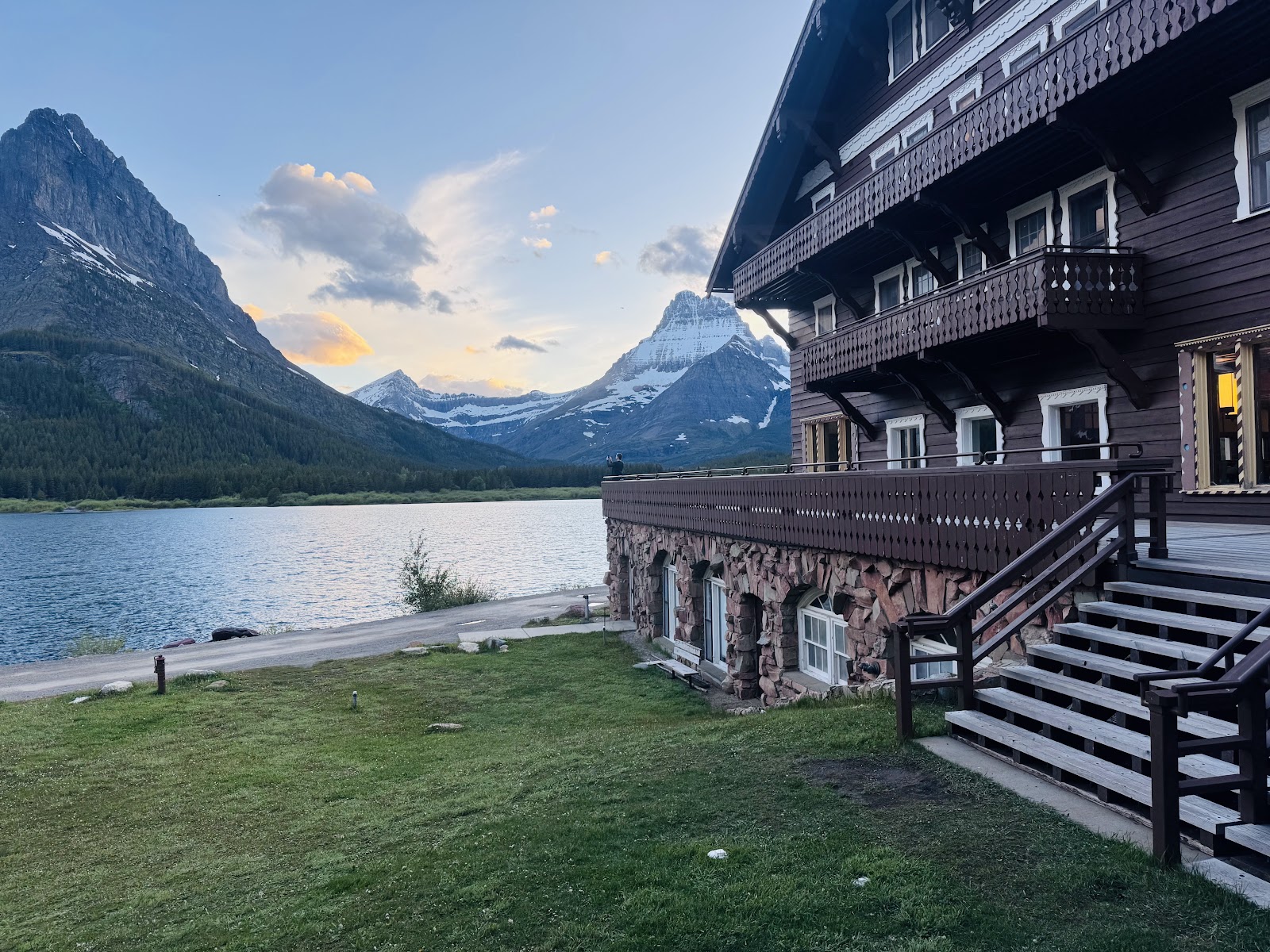
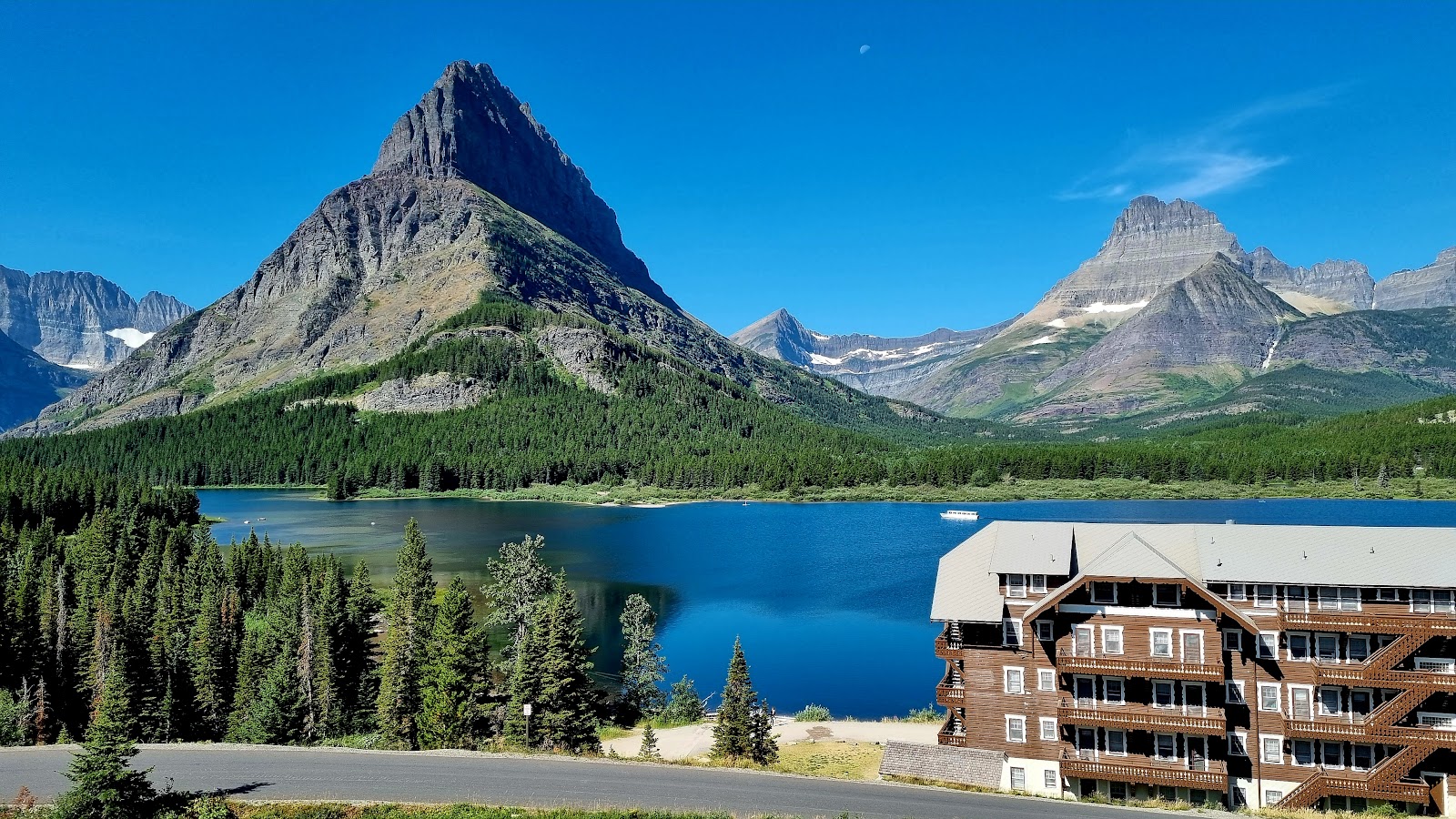
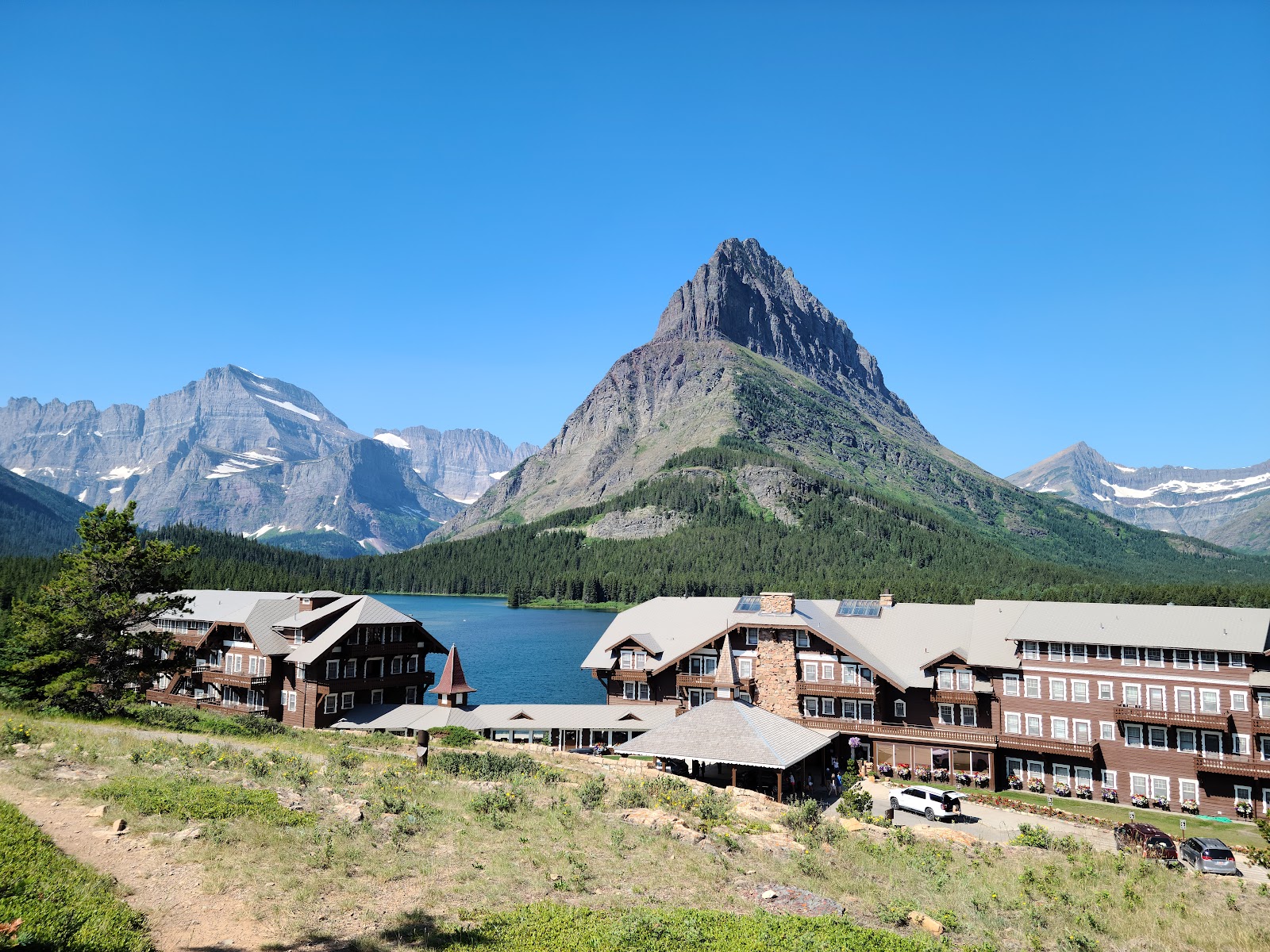
The frame is a reflection: a mountain rising directly across a glacial lake from the hotel, doubled in the water, with the subjects placed at the shore. The valley is arranged so that this is available from the property itself rather than from a trailhead — which is rare, because a mountain reflection usually requires walking.
The two conditions are stillness and light, and they do not always coincide.
Stillness first. A reflection requires an unbroken surface, and a mountain valley develops a wind as the day heats — cold air pools overnight, the sun warms the slopes, and by mid-morning there is usually a working breeze along the valley. Which means the mirror belongs to the first hour after sunrise and, less reliably, to the last hour as the air settles again.
Light second, and here the valley’s orientation is decisive. Whether the mountain opposite is lit at the hour the water is still decides whether the frame is a reflection of a lit peak or a reflection of a dark one — and those are completely different photographs. A lit peak doubled in still water is the picture people imagine; a dark peak doubled in still water is quieter, cooler and often better, because the tonal range is manageable.
Establishing which you will get requires knowing which way the valley faces, and that is a five-minute job on arrival that determines the entire plan.
The water itself is the third element and it is not ordinary water. Glacier’s lakes are fed by meltwater carrying rock flour — silt ground so fine by moving ice that it stays suspended — which scatters light and gives the water a distinctive milky turquoise or jade colour rather than the blue-black of a clear mountain lake.
That colour is at its strongest in the middle of the day when the sun penetrates, and it drains toward evening. Anyone who wants the turquoise has to take it at an hour when the light on people is otherwise difficult — a conscious trade.
The Many Glacier area sits at about forty-eight and three-quarter degrees north, at around forty-nine hundred feet. The June noon sun reaches only about sixty-four and a half degrees, the December noon sun about seventeen and a half, days run from about eight hours ten to sixteen hours fifteen, and civil twilight is around forty-three minutes — the longest in this guide.
We have not photographed a wedding here. Whether ceremonies are permitted, what permit is required, which spaces are available, what group sizes are allowed and what the hours are, are questions for the park and the concessioner.
Many Glacier Hotel at a glance
| Where | A lakeside hotel in the Many Glacier valley of Glacier National Park |
| The frame | A mountain across the lake, doubled in still water, with subjects at the shore |
| Two conditions | Stillness, which means the first hour; and whether the peak is lit then |
| The water | Milky turquoise from glacial rock flour — strongest at midday |
| Ask first | Park permits, available spaces, group limits and hours |
Building the frame
Scout the shoreline the day before and find the position, because at first light there is no time to look for it. The requirements are narrow: a stretch of shore with a clean foreground, a clear line of sight to the mountain, and room to place two people without them standing in the water.
Decide the camera height at the same time. A reflection reads best from low down, because a low camera sees more of the water surface and less of the near shore — and at eye height the reflection compresses into a thin band while the bank fills the bottom of the frame. Kneeling or lying is the difference between a mirror and a stripe.
Arrive before sunrise, not at it. At this latitude civil twilight runs about forty-three minutes, which is the longest in this guide, and the light in that window is worth having on its own terms: soft, cool and shadowless, with the peaks holding a pale glow before the sun reaches them and the water at its absolute stillest.
That pre-sunrise period is the most reliable part of the whole sequence, because it does not depend on the sun clearing anything.
Then the exposure, and reflections have a consistent property worth stating precisely: a reflection is about a stop to a stop and a half darker than the thing it reflects, because a water surface returns only part of what strikes it. A frame exposed for a lit peak therefore has a reflection that reads flat and dark; a frame exposed for the reflection blows the peak.
There are two answers. Choose a moment when the peak is not brightly lit — before the sun reaches it, or with cloud on it — which brings the two within a stop of each other and needs nothing at all. Or expose for the peak and lift the reflection selectively afterwards, accepting that the water will be the darker half.
The first is the better answer and it is available every morning.
The subjects are the third exposure and they need their own light, because at shoreline distance neither the sky nor the peak will do anything useful for faces. A source close to them, at about a stop over the ambient falling on them, does the whole job — close, because fall-off is the only way to light two people without also lighting the twenty metres of shore around them.
Gel it to match. Before sunrise the ambient is cool and blue; after the sun clears the ridge it is strongly warm. An ungelled daylight source is wrong in both cases and in opposite directions, so the gel decision has to be made rather than defaulted.
And hold it by hand. A mountain valley is windy as a baseline and a lightstand at a lake shore is a liability.
Then make the frame more than once: a wide version with the whole mountain and its reflection and the subjects small — the picture of the place; a closer version with the reflection as a background element behind two faces; one with no people at all, because a mountain doubled in still glacial water deserves it; and one of the water alone, close, because rock flour under low light is a colour worth a frame on its own.
The valley, the rock and the rest of the day
The valley is the second environment and it is a glacial trough — a U-shaped valley carved by ice, with steep walls, a flat floor and lakes strung along it. That shape has a specific consequence: the walls take the first and last hours of direct sun, so the floor is in shade while the peaks above are lit.
That is the valley’s twice-daily gift and it is the easiest good frame here. A subject standing in even shade on the valley floor with a brightly lit peak or wall behind them has the separation of a studio setup with a mountain as the backdrop, and it needs no equipment at all.
It also means the light on the floor for much of the day is a large soft source from the strip of sky overhead and along the valley, with dark absorbing walls to the sides. The way to use that is to orient subjects along the valley rather than across it: facing up or down the trough puts the bright sky band in front of them and the dark wall behind. Facing across puts a wall in front of the subject and is the one orientation that does not work.
The colour under that condition is both cool and green — a strip of blue sky filtered along a green corridor — which on skin reads as unhealthy. A custom white balance on a face in position fixes most of it, and a warm-gelled source at a stop over the ambient fixes the rest.
The rock is Glacier’s distinguishing feature and it is worth composing for. The mountains here are built of very old sedimentary rock thrust eastward over much younger rock, and a great deal of it is coloured: red and green argillites — mudstones — which give the cliffs and slopes genuine colour rather than the grey of most mountain ranges.
Red rock above jade water under a deep blue sky is a Glacier-specific palette and it exists almost nowhere else. It also means a long-lens frame of a cliff face is a colour photograph rather than a tonal one, which changes how it should be composed.
The altitude matters. At around forty-nine hundred feet there is roughly a seventh less atmosphere overhead than at sea level, which means direct sun is harder and shadows deeper than the temperature suggests, the sky is a deeper blue so open shade reads markedly cool, ultraviolet is high, and the air is exceptionally clear — which is why the peaks hold detail on a long lens.
The forest is the standard northern Rockies mix and the species distinction decides where a portrait can be made. Lodgepole pine grows tall and straight with sparse high crowns, which throws a hard shifting dapple — the worst light a face can meet outdoors, and background material only. Engelmann spruce, subalpine fir and Douglas fir block almost all direct light, which makes their margin the best free separation available: a metre inside gives soft directional light in front and three or four stops of dark behind.
Quaking aspen and cottonwood are the deciduous element, and aspen matters for autumn because a grove is clonal — genetically one organism — so a whole stand turns gold at once.
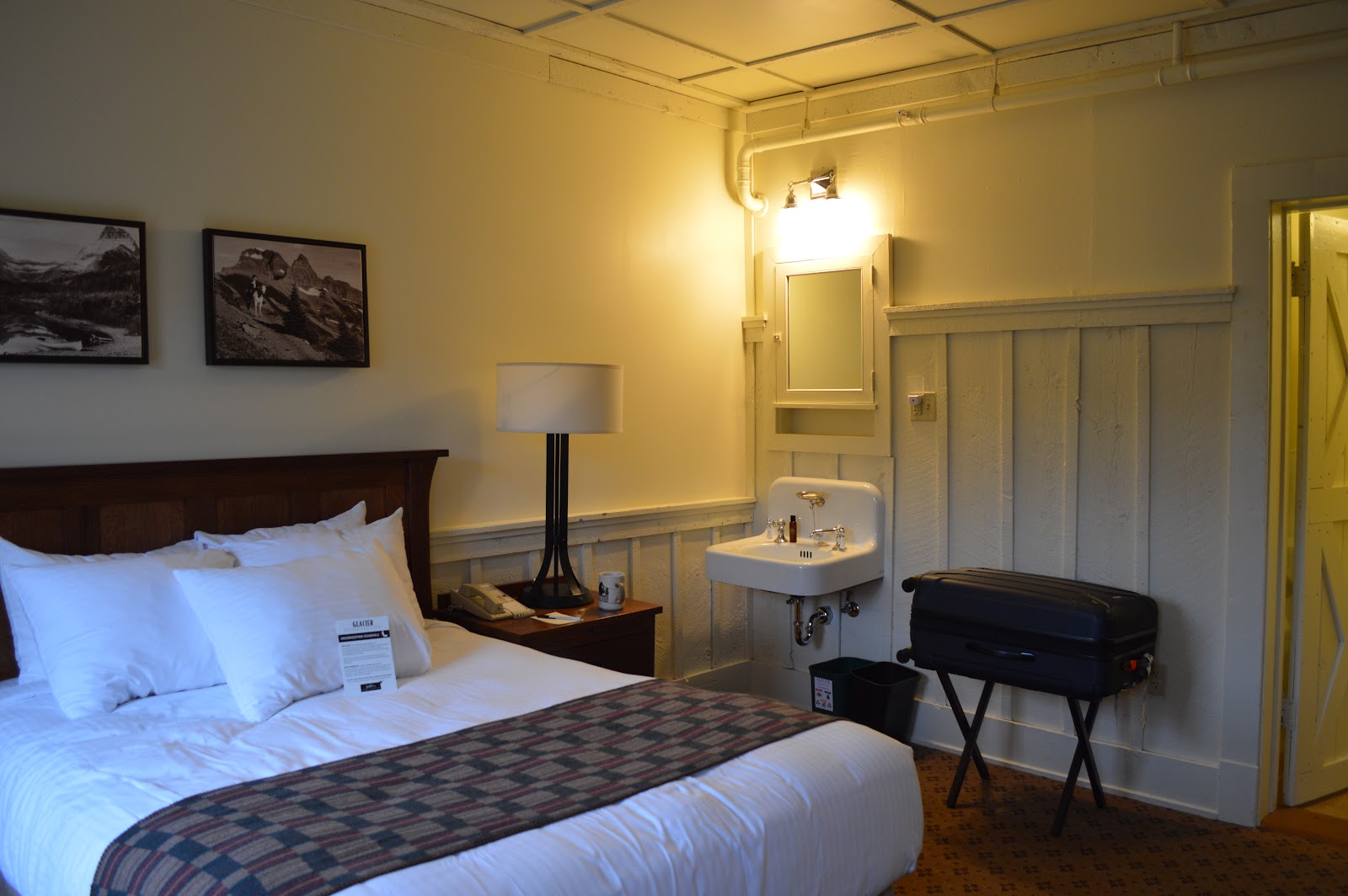
The hotel itself is a railway-era Swiss-styled timber building, which means the interiors behave as every timber interior does: dark finishes absorb rather than reflect, the ambient sits a stop or two below what the eye reports, and the fall-off from a window is steep. Meter on skin, use each window at forty-five degrees, and let the room go dark.
Two practical matters. Wildlife in this valley is genuinely present rather than theoretical — bears in particular — which is a matter for the park’s guidance rather than for improvisation, and it affects where a party may go and how. And wind along a glacial trough is the baseline condition, which makes a lightstand a liability and hair and veils unpredictable.
- Scout the shoreline the day before; kneel or lie for the reflection
- Arrive before sunrise — forty-three minutes of twilight is worth having
- Choose a moment when the peak is unlit and the reflection exposes itself
- Orient subjects along the valley, never across it
- Lodgepole dapples unusably; spruce and fir block. Know which you are under
The Glacier year
This is the highest latitude and one of the highest venues in this guide, and its season is genuinely short.
The first thing to establish is whether the property operates at all on the date in question. Railway-era park hotels at this altitude and latitude are seasonal by necessity, and the access road into a valley like this is a snow road for a substantial part of the year. That is the question to ask before any other.
Summer is the season and the light is extraordinary. At forty-eight and three-quarter degrees north the solstice day runs over sixteen hours, with about forty-three minutes of civil twilight at each end — which means the low light arrives after nine in the evening and lingers, and the morning window opens before four. There is more usable light here than anywhere else in these guides.
The trade is that the noon sun only reaches about sixty-four and a half degrees, which makes the middle of a summer day less punishing than further south, though at this altitude it is still hard enough to need the fir margins.
Early summer has a specific advantage: the peaks hold snow while the valley greens, which stacks white summit, dark conifer and green floor into one frame — and the lakes are at their most turquoise because the meltwater is carrying the most rock flour. Late June and early July are the strongest weeks for the colour of the water.
The costs are afternoon convection, because these mountains make their own weather and a clear morning frequently becomes a wet afternoon, mosquitoes in the wetter valley bottoms in early summer, and crowds — this is one of the more visited valleys in the park.
The honest late-summer note is wildfire smoke. The northern Rockies’ fire season runs from roughly July into September, and smoke from fires anywhere in the region can fill a valley like this for days — turning the sun orange, flattening contrast, removing the peaks entirely and shifting everything warm in a way no white balance resolves.
For a venue whose central frame is a mountain reflected in water, smoke is the one condition that removes it completely. It cannot be planned for, only acknowledged — and the interiors and the close water frames survive it.
Late September into early October is the best window of the year and the shortest. The aspen turn, and because a grove is clonal a whole stand goes gold at once, giving blocks of uniform colour against near-black conifer. The cottonwoods along the creeks turn gold too, the first snow returns to the peaks, the smoke risk has usually passed, the crowds have gone, the air is at its clearest, and the mornings are cold enough that the lake is at its stillest.
Gold aspen below fresh-snowed red argillite peaks, doubled in jade water at first light, is the strongest photograph this landscape produces. The window is perhaps two weeks and the property may close inside it.
Winter here is long, deep and largely inaccessible: the solstice day is about eight hours ten, the noon sun reaches only seventeen and a half degrees, and the snow is measured in metres. On the light alone a clear winter day would be superb — a sun that low rakes all day — but whether anyone can reach the valley, let alone be married in it, is entirely a question for the park.
Spring is late and long. Snow lies into June at this elevation, the access is conditional, and the landscape is brown and white rather than green. There is no good version of April or May here.
More frames from Many Glacier Hotel
Many Glacier Hotel wedding photography: common questions
What is the frame?
A mountain rising across a glacial lake, doubled in still water, with the subjects at the shore — available from the property rather than from a trailhead.
When is the water still?
The first hour after sunrise, and less reliably the last. A mountain valley develops a breeze as the slopes warm through the day.
How do I expose a reflection?
Choose a moment when the peak is not brightly lit — before the sun reaches it, or with cloud on it — which brings the two within a stop and needs nothing.
Why is the water turquoise?
Glacial meltwater carries rock flour, silt ground so fine by moving ice that it stays suspended and scatters light. It is strongest at midday.
What is unusual about the rock here?
Much of it is red and green argillite rather than grey, which makes a cliff frame a colour photograph rather than a tonal one.
When is the valley at its best?
Late September into early October: clonal aspen gold below fresh-snowed peaks, cold still mornings, thin crowds and the clearest air — a two-week window.
More Montana venue guides
We are writing a photographer’s guide to every venue we would happily shoot in Montana. Here are three more, plus the full index:
- Old Faithful Inn, Yellowstone: The Venue’s Own Logic
- Paradise Ranch, Emigrant: A Walk Through the Site
- The Ranch at Rock Creek, Philipsburg: What It Suits and What It Does Not
Planning a wedding at Many Glacier Hotel?
One mountain, one mirror, one hour. Tell us your date and we will be there for it.