 The Bierstube: What Changes When the Reception Is in a Bar
Glacier Park Lodge, East Glacier Park: The Venue’s Own Logic
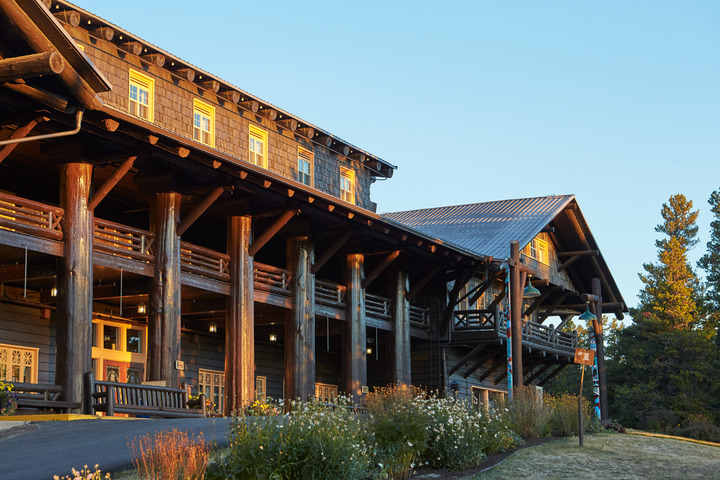
A colonnade of whole trees, at the point where plains meet mountains.
This building has one organising idea and it is unusually literal: it is a hall held up by whole trees.
It was built in the second decade of the twentieth century as a railway hotel, at the eastern gateway to Glacier, in the era when the railroads built grand lodges to give passengers a reason to travel. Its central hall rises several storeys and is supported on rows of enormous Douglas fir trunks, used entire, with the bark left on in places.
That produces a photographic environment with a specific and unusual character. A colonnade is a rhythm of verticals, which is the strongest compositional structure architecture offers — and a colonnade made of trees of that diameter, at that spacing, in a hall of that height, is a rhythm at a scale no masonry building achieves.
Three consequences follow. Dark timber absorbs rather than reflects, which means the ambient in the hall sits well below what the eye reports and the fall-off from any window is extremely steep — four stops or more from a face at a window to a surface three metres behind it. That is the building’s gift, because it supplies a black backdrop for nothing.
The colonnade gives free separation and free framing: a subject placed against a trunk, or between two, is separated by the architecture and framed by it at the same time. And because the trunks are round rather than flat, the light falls off around them continuously — which means each one has a lit side and a dark side and a subject placed relative to that has modelling supplied by the building.
The third consequence is the setting, and it is the other half of the venue’s logic. East Glacier sits where the Rocky Mountain Front meets the Great Plains — an abrupt boundary rather than a gradual one, with the mountains rising directly from flat grassland. That means the property has both a dramatic mountain backdrop and an unobstructed eastern and southern horizon, which is a combination almost nothing else in this guide offers.
East Glacier Park sits at about forty-eight and a half degrees north — the highest latitude in these guides. The June noon sun reaches only around sixty-five degrees, the December noon sun about eighteen, days run from about eight hours fifteen to sixteen hours ten, and civil twilight is around forty-two minutes, which is the longest dusk in this guide by a wide margin.
We have not photographed a wedding at this lodge. Which spaces and grounds are included, what access there is to the surrounding land and what the permitted hours are, are questions for their team.
Glacier Park Lodge at a glance
| Where | A railway-era lodge at the eastern gateway to Glacier, on the plains edge |
| The logic | A great hall held up by rows of enormous whole Douglas fir trunks |
| The gift | Four stops of fall-off, plus free framing and free modelling from round columns |
| The setting | Where the Rocky Mountain Front meets the plains — mountains and an open horizon |
| The latitude | 48.5°N: a sixteen-hour midsummer day and a forty-two-minute twilight |
Reading the hall
Meter on skin, always, and never on the scene. A camera reading a dark timber hall with bright windows in it will settle on an exposure that is wrong for both, and the correction is a change of method rather than a compensation value.
Then use the colonnade, which is the building’s whole proposition, and use it in three distinct ways.
Along the rhythm: a camera positioned so the trunks recede in a line gives a diminishing series of verticals with light and shade alternating between them, which is a strong graphic structure and more dynamic than a symmetrical frame. One couple per bay, or the pair centred in a single gap with the rhythm receding behind them.
Against a trunk: a subject standing with their back to or beside a single column gets a dark, textured, curved background at close range — and because the trunk is round, its own tonal gradient from lit side to dark side gives the frame a built-in falloff. Placing a subject so their lit side is against the trunk’s dark side, and their shadow side against its lit side, produces a frame that separates twice over.
And on the axis: a formally planned hall photographed on its exact centre line, absolutely level, with the couple centred and the trunks receding evenly on both sides, is a composed and still photograph that very few venues can produce. The requirements are exact — on the axis, level, and at about the subjects’ chest height so the verticals do not converge. A minute with a level is worth it; approximately right is visibly worse than not attempting it.
The windows are the light and each one is a studio source. Subject at forty-five degrees, at a distance that sets the ratio, with the hall falling away behind. Because the timber absorbs and gives no fill back, moving a subject a metre further from a window changes the ratio noticeably, which makes precision worthwhile.
Where the hall has a skylight or clerestory — and railway-era lodges of this kind frequently do, because a hall that tall needed daylight from above — the light is top-heavy and needs handling. Soft light from directly overhead still leaves the eye sockets dark, and the answer is positional: move the subject close to a trunk or a wall, which converts part of the overhead light into side light, or find a lower opening and use that instead.
The scale decision is the same as at any very large room. Photograph part of the hall as though it were the whole — two trunks and the space between them, one window with its surrounding timber, one section of gallery — which keeps the subjects at a reasonable size. Then take one frame of the whole volume with them deliberately small in it, because a couple occupying a tenth of the frame height beneath columns of that diameter reads as a statement about the building.
Evening light in a hall like this is warm, low and mounted high, producing a top-heavy pool-and-gap pattern. Balance for the fittings, gel any added source warm so the subjects belong to the room, use the pools as key rather than filling them out, and let the roof volume go black. Never bounce off a timber ceiling — the light goes into the wood and does not come back.
Outside: the Front, the plains and the rock
The setting here is geologically unusual and it shows in every photograph, so it is worth understanding.
The Rocky Mountain Front at this point is an abrupt wall: ancient rock was thrust eastward over much younger rock along a great fault, which is why the mountains rise directly from flat prairie with almost no foothills. For a camera that means two things simultaneously available — a dramatic mountain backdrop to the west, and an unobstructed horizon to the east and south.
The unobstructed horizon is the underrated half. It means the sun rises into the site rather than over a ridge, that the whole of a forty-two-minute civil twilight is usable, and that the eastern sky at sunset — the anti-solar side, always deeper in colour — is available as a background with nothing in the way.
The mountain backdrop needs a lens decision. A wide lens renders distant mountains at their true angular size, which is modest, so a wide frame of two people with the Front behind them shows a lot of foreground and hills. A moderate telephoto compresses, bringing the wall of rock forward so it reads at something closer to the scale the eye perceives — and that requires the camera a long way back from the subjects, with clean ground between.
The exposure follows: expose for the mountains, because that is what the frame is about, and lift the subjects with a close source, warm-gelled to match a low sun, at about a stop over the ambient on them. Metering on faces gives a white sky and a washed-out range.
The rock itself is worth knowing because Glacier’s is unusual. The thrust sheet here is made of very old sedimentary rock, and much of it is coloured: red and green argillites — mudstones — which give slopes and cliffs genuine colour rather than the grey of most mountain ranges. Red rock above a green meadow under a blue sky is a Glacier-specific palette and it is worth composing for.
The prairie side is the other exterior environment and it is nothing like the mountains. Open grassland is level, vast, and windy, with a low horizon and an enormous sky — which means a low camera with grass across the bottom of the frame puts the subjects entirely against sky, and that is the cleanest background available anywhere in any weather.
What the sky is doing matters more here than at almost any venue in this guide, because there is so much of it. A clear blue high-plains sky is even and deeply saturated at this altitude and latitude; a convective sky with towering cloud over the Front is the best background this landscape ever has.
The wind on the Rocky Mountain Front is not occasional. This is one of the windiest places in the interior United States — downslope winds off the mountains are a defining feature of the local climate, and chinooks in winter can be violent. Every light is handheld or weighted, hair and veils do what they will, and a lightstand on open prairie is not a proposition.
The trees are the standard northern Rockies mix and the species distinction is decisive. Lodgepole pine grows tall and straight with sparse high crowns, which means it throws a hard shifting dapple that is the worst light a face can meet outdoors — background only. Douglas fir, Engelmann spruce and subalpine fir block almost all direct light, which makes their margin the best free separation on any property: a metre inside gives soft directional light in front and three or four stops of dark behind.
Quaking aspen is the third and it matters for autumn: a grove is clonal, genetically one organism, so a whole stand turns gold at once rather than tree by tree.
And the altitude: East Glacier sits at around four and a half thousand feet, which means roughly a seventh less atmosphere overhead than at sea level — harder direct sun, deeper shadows, markedly cool open shade under a deep blue sky, high ultraviolet, and exceptional clarity at distance.
- Meter on skin; a dark timber hall will fool the camera every time
- Place a subject so their lit side meets a trunk’s dark side and vice versa
- On the axis, level, at chest height — or deliberately off it
- Compress the mountains with a telephoto; a wide lens makes them hills
- Handhold every light: the Rocky Mountain Front is genuinely windy
The Rocky Mountain Front year
Four sharply separated seasons at the highest latitude in this guide, where the day length swings further than anywhere else here.
Summer is short and the light is extraordinary. At forty-eight and a half degrees north the solstice day runs over sixteen hours, and civil twilight lasts about forty-two minutes at each end — which means the low light arrives after nine in the evening and lingers, and there is genuinely usable light for longer than at any other venue in these guides.
The trade is a sun that reaches sixty-five degrees at noon — lower than anywhere further south, which makes the middle of a summer day here less punishing than at a southern venue, though still high enough to need the fir margins and the building.
The costs are afternoon convection, because these mountains make their own weather and a clear morning frequently becomes a wet afternoon, and the crowds on the Glacier side in July and August.
The honest late-summer note is wildfire smoke. The northern Rockies’ fire season runs from roughly July into September, and smoke from fires anywhere in the region can fill this valley for days — turning the sun orange, flattening contrast, removing the Front entirely and shifting everything warm in a way no white balance resolves. That removes the mountain frames while leaving the hall and the close frames intact.
Late September into early October is the best window of the year. The aspen turn, and because a grove is clonal a whole stand goes gold at once, giving blocks of uniform colour against near-black conifer. The cottonwoods along the creeks turn gold too, the first snow returns to the peaks, the smoke risk has usually passed, the crowds thin, and the air is at its clearest of the year — which is precisely when a long-lens mountain frame needs it.
Gold aspen below fresh-snowed red argillite peaks, with dark fir between, is the strongest frame this landscape produces, and the window is about two weeks.
Winter is long, cold and severe, and at this latitude it is dark: the solstice day is only about eight and a quarter hours, with the noon sun at eighteen degrees. That low sun is the season’s gift — the whole short day rakes rather than floods, which is exactly what timber, rock and snow want, and there is no bad hour at all.
Snow is the best natural fill available: it lifts shadows to within a stop and fools a meter by about two, so open up deliberately, and against near-black conifer it gives the widest brightness range in this guide. A snow-covered prairie below a white Front in raking light is austere and superb.
The costs are severe: cold, an eight-hour day, chinook winds that can be violent, roads and access dependent on conditions, and glass that fogs on the way into a heated hall. Whether the lodge operates in winter at all is the first question to ask, because railway-era park hotels frequently do not.
Spring on the Front is late and it is the weak window. Snow lies into May at this latitude and elevation, the ground is saturated, the grass is brown before it is green, and the peaks stay white while the prairie is dun. There is no good version of April here.
Late May and June bring green prairie, wildflowers, and very long days — and the peaks still hold snow while the grassland is at its greenest, which stacks white, green and dark conifer into one frame for a few weeks. That is a genuinely fine and much less visited window than autumn.
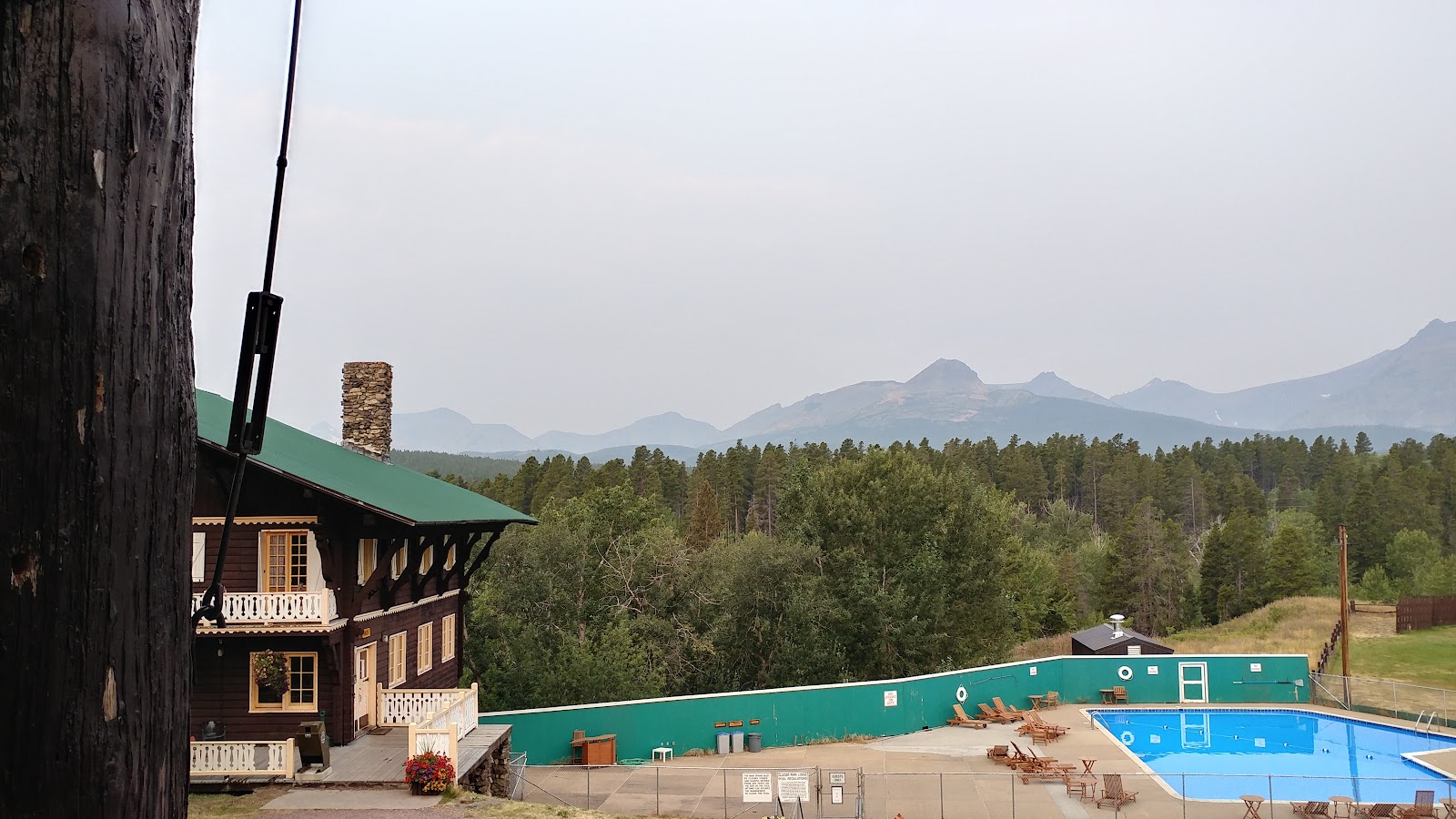
More frames from Glacier Park Lodge
Glacier Park Lodge wedding photography: common questions
What is the building's logic?
A great hall held up by rows of enormous whole Douglas fir trunks — a colonnade at a scale no masonry building achieves.
How do I use round columns?
Place the subject so their lit side is against the trunk’s dark side and their shadow side against its lit side. The frame then separates twice over.
What lens for the mountains?
A moderate telephoto. A wide lens renders the Rocky Mountain Front at its true angular size, which makes a wall of rock look like hills.
What is unusual about Glacier's rock?
Much of it is coloured — red and green argillites rather than grey — which gives a palette no other mountain range in this guide offers.
How long is the light here?
The longest in this guide: a sixteen-hour midsummer day and about forty-two minutes of civil twilight, at forty-eight and a half degrees north.
When is the site at its best?
Late September into early October for clonal aspen gold below fresh-snowed peaks in the clearest air — and late May to June for snow above a green prairie.
More Montana venue guides
We are writing a photographer’s guide to every venue we would happily shoot in Montana. Here are three more, plus the full index:
- Lake Yellowstone Hotel: How the Light Moves on a High Lake
- Mammoth Hot Springs Hotel, Yellowstone: One Frame and How It Is Made
- Many Glacier Hotel, Glacier: One Frame and How It Is Made
Planning a wedding at Glacier Park Lodge?
A hall of whole trees where the plains meet the mountains. Tell us your date.