 Venue at Willow Creek, Huntsville: The Problem, and Four Ways Out
Lodge at Gulf State Park, Gulf Shores: Field Notes
This sand is nearly pure quartz. It is the brightest surface in this guide and it lies to every meter.
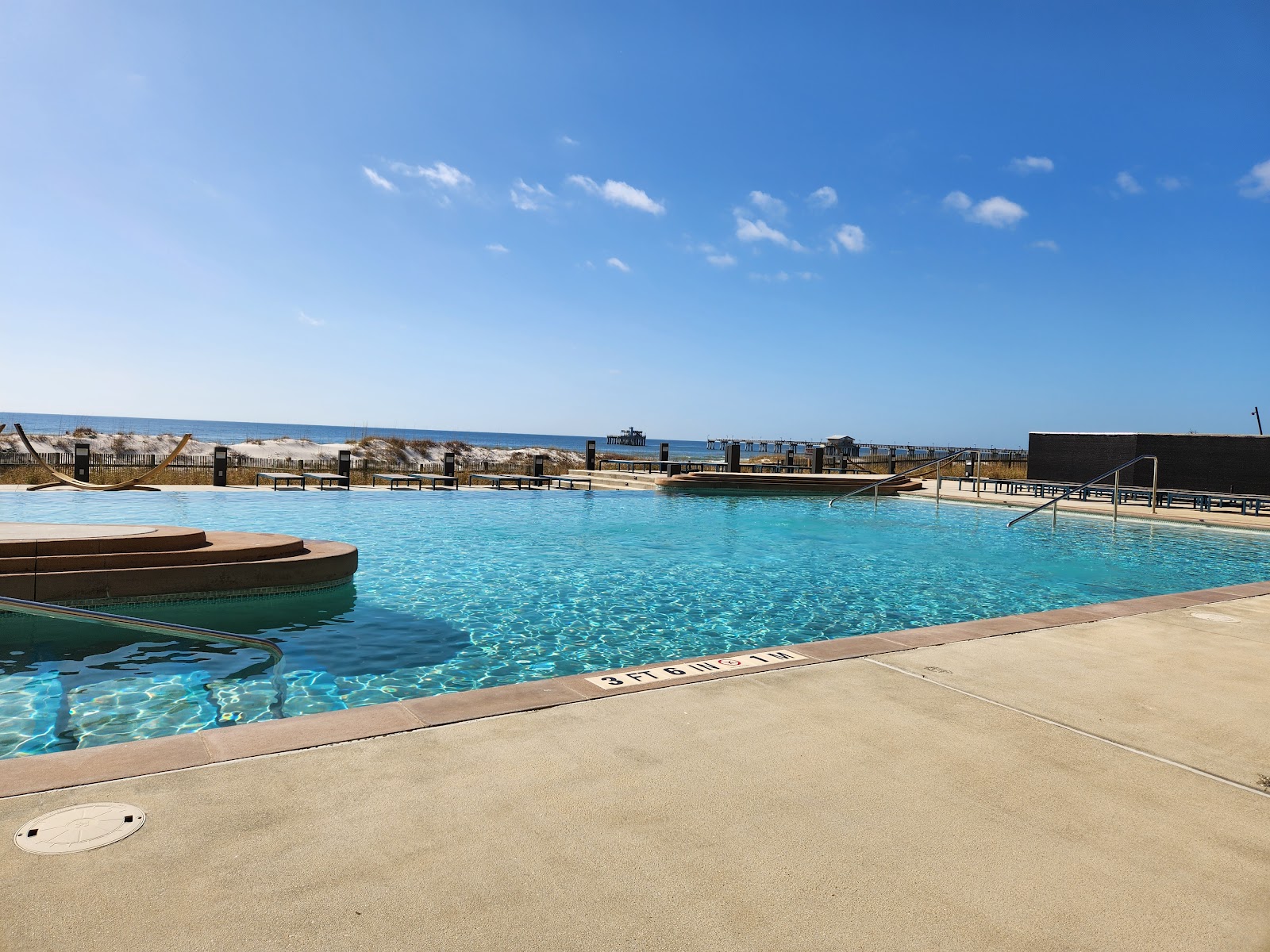
These are field notes on a beachfront lodge on the Alabama Gulf coast, and the first note is about the sand, because it is unlike the sand at most beaches in this guide.
The beaches here are exceptionally white and fine, and the reason is geological: the sand is almost pure quartz, eroded from the southern Appalachians and carried down by rivers over a very long period, with the softer minerals worn away and only the hard quartz grains surviving. The result is a beach that is brilliant white rather than tan or grey, and fine enough to squeak underfoot.
That has three photographic consequences and they run through every frame on the beach.
It is the brightest natural surface in this guide. A white quartz beach in Gulf Coast sun is as bright as snow, which means a meter looking at it pulls the exposure down hard — giving grey sand and dark faces, which is the single commonest failure at a beach like this. The correction is deliberate: meter on skin, work in manual, and expose brighter than the camera suggests, frequently by a full stop or more.
It bounces enormously. White sand throws a great deal of light upward, which fills the shadows a high sun carves under eyes and chins — genuinely useful at midday — at the cost of lighting the underside of the chin and the brow. The diagnosis is to look at the chin in the first frame, and something solid on one side corrects it.
And it is neutral in colour, which is an advantage over most reflective surfaces. Unlike red rock or brick or warm stone, white quartz sand bounces light that needs no correction — so the fill it gives is clean rather than tinted.
The second note is the water. The Gulf here is shallow, warm and usually calm by ocean standards, which means it reads green-blue to turquoise rather than the grey-green of colder water — and it goes flat enough to mirror far more often than an open Atlantic or Pacific coast.
We have not photographed a wedding at the Lodge at Gulf State Park; Gulf Coast beachfront lodges behave consistently. Which spaces and beach areas are included, what permits apply to the beach, the covered alternative, whether there are any dune protection rules about where anyone may walk, and what the function-room lighting can do are questions for their team — and the dune rules matter, because dune vegetation here is protected and fragile.
Lodge at Gulf State Park at a glance
| Where | A beachfront lodge at Gulf Shores on the Alabama Gulf coast |
| The sand | Nearly pure white quartz — as bright as snow, and neutral in colour |
| The correction | Meter on skin and expose brighter, often by a full stop or more |
| The water | Shallow and warm, so it is turquoise and it mirrors more than most coasts |
| Ask first | Beach areas and permits, dune rules, covered alternative, lighting control |
The beach: the problems, and the solutions
The exposure problem is the one to solve first because it affects every frame. The habit that makes it reliable is to set an exposure once, on skin, in each lighting condition, and then work in manual rather than letting the camera re-decide every time the framing changes — because on a beach the framing changes constantly and an automatic exposure will chase the sand.
The check is the highlights: white sand should read white with the texture of the surface visible in it, not grey and not a featureless blank. Get that right and the rest of the frame follows.
The uplight problem takes ten seconds to diagnose and a metre to solve, as above — and used deliberately it is one of the best things about a white beach. A subject standing in the shade of a building or a structure, on open white sand, is lit from the front by whatever sky is visible and from below by the ground, which is close to a two-source arrangement arriving for nothing.
Midday sun on an open beach is the condition with no technique for it. High Gulf Coast sun gives vertical shadows, dark eye sockets and squinting, with the sand’s bounce only partly compensating — and there is no shade on a beach. That makes the middle of the day a matter of not scheduling portraits there rather than solving it.
The solution to the whole beach problem is timing, and on this coast it has a specific geometry worth understanding. The Alabama Gulf coast faces roughly south, which means the sun crosses the water through the day rather than setting into it — so there is no straightforward backlit sunset over the sea of the kind a west-facing coast gives.
What there is instead is side light across the water for most of the day, which puts texture on the surface rather than glare, and an evening sun off to the west along the beach rather than ahead of it. That means a subject can be front-lit, side-lit or rim-lit simply by being turned, and the colour frame at the end of the day looks along the beach to the west rather than straight out to sea.
Finding that position is ten minutes of walking beforehand, and it is the single most useful piece of preparation at a south-facing beach.
The practical advantage of that geometry is that a frame at the end of the day frequently does not need to be exposed for a bright sky at all, which means a single exposure holds the whole scene and no added light is necessary. That is a genuine simplification.
Wet sand is the other surface and it is worth walking to. It is darker than dry sand, so it bounces less — and it is specular rather than diffuse, so it mirrors the sky and the figures standing on it. A couple on wet sand at the end of the day has a reflection beneath them, which is the strongest beach frame available here.
Wind is the constant practical fact. A lightstand in sand in onshore wind is a liability twice over — unstable footing and a sail above it — so a source in a hand or on a bracket is the configuration, planned from the start. A veil on a beach is unpredictable, which means shooting many more frames than usual.
And salt and fine sand are the maintenance note, and fine quartz sand gets everywhere. Lens changes away from the beach, a cloth in a pocket, and nothing set down on the ground.
The dunes are the last element and they are both a resource and a restriction. Dune vegetation on this coast — sea oats and low grasses — is protected and fragile, which means walking on the dunes is frequently prohibited and always damaging. Photographed from the beach or a boardwalk, sea oats backlit in low sun are the most characteristic foreground this coast offers: thin blades that transmit light and glow. That is the frame, and it is made from where the party is allowed to be.
The lodge, the maritime forest, and the humidity
Behind the beach the site has two other environments and both are more useful than they look.
The maritime forest is the first: live oak, slash and longleaf pine, magnolia and palmetto on the stabilised ground behind the dunes. Live oak is the best shade tree in this guide — dense, broad, low-spreading and evergreen, with limbs running horizontally rather than upward — which means a mature specimen gives genuinely full shade over a wide area at any hour of any month.
The canopy edge is the reliable position: a few metres in on the side facing open sky gives soft directional light in front and a dark canopy behind, three or four stops of free separation and no equipment. The metering correction reverses from the beach’s: dark canopy makes a meter overexpose a face by a couple of stops where white sand makes it underexpose, and those positions can be a hundred metres apart on the same afternoon.
That reversal is the discipline of working this kind of site: manual, metered on skin, reset at every transition.
Spanish moss occurs on the oaks here and it is worth using. It is an epiphyte rather than a moss, taking moisture from the humid air, and because the strands are fine and translucent it transmits light — so a backlit curtain of it glows, and a moss-hung canopy diffuses whatever sun gets past the leaves into something softer than a clean canopy gives.
A custom white balance set on a face under the canopy is worth the thirty seconds, because filtered light through evergreen oak picks up green while the beach a short walk away is neutral.
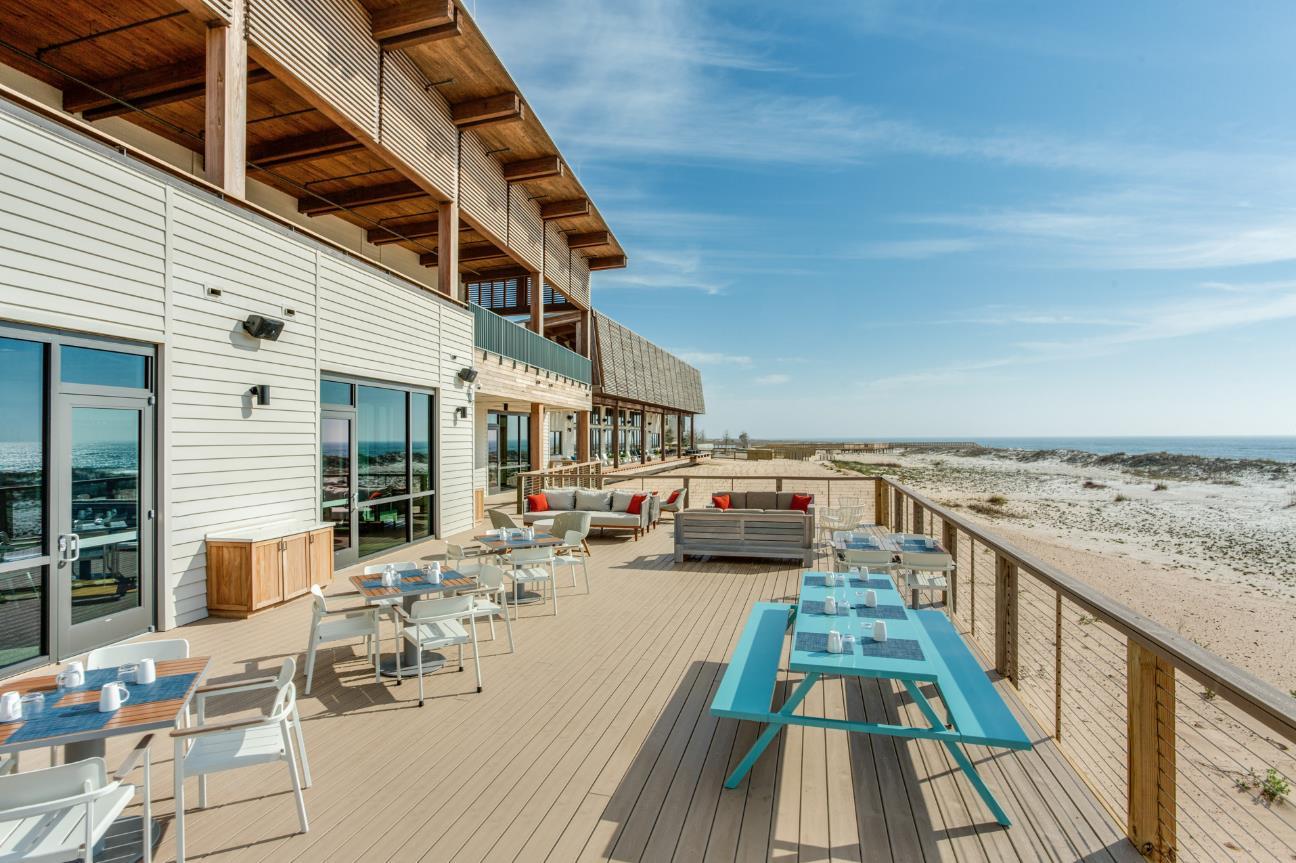
The lodge is the second environment and a modern coastal building is glazed toward the water, which gives abundant soft light — and one specific problem. A subject a metre from that glazing turned about forty-five degrees to it gets real modelling because the window is still much brighter than anything bouncing around; but the room behind them is likely pale, which means the background does not fall away and the frames read flat.
The fixes are the standard ones: find something genuinely dark to put behind the subject, use the glazing as a directional source rather than a background, or add a source at a stop above the ambient to create the shadow side the room’s own bounce has filled in.
Light off white sand and turquoise water is bright and slightly cool, and it is mobile — the water’s brightness changes with the surface state — so metering rather than assuming is the habit, and a custom white balance set on a face handles the colour.
Large glazing also reflects, and by the evening it becomes a mirror as the exterior darkens — which means every frame pointed that way contains the lit room twice. A few degrees off perpendicular removes it.
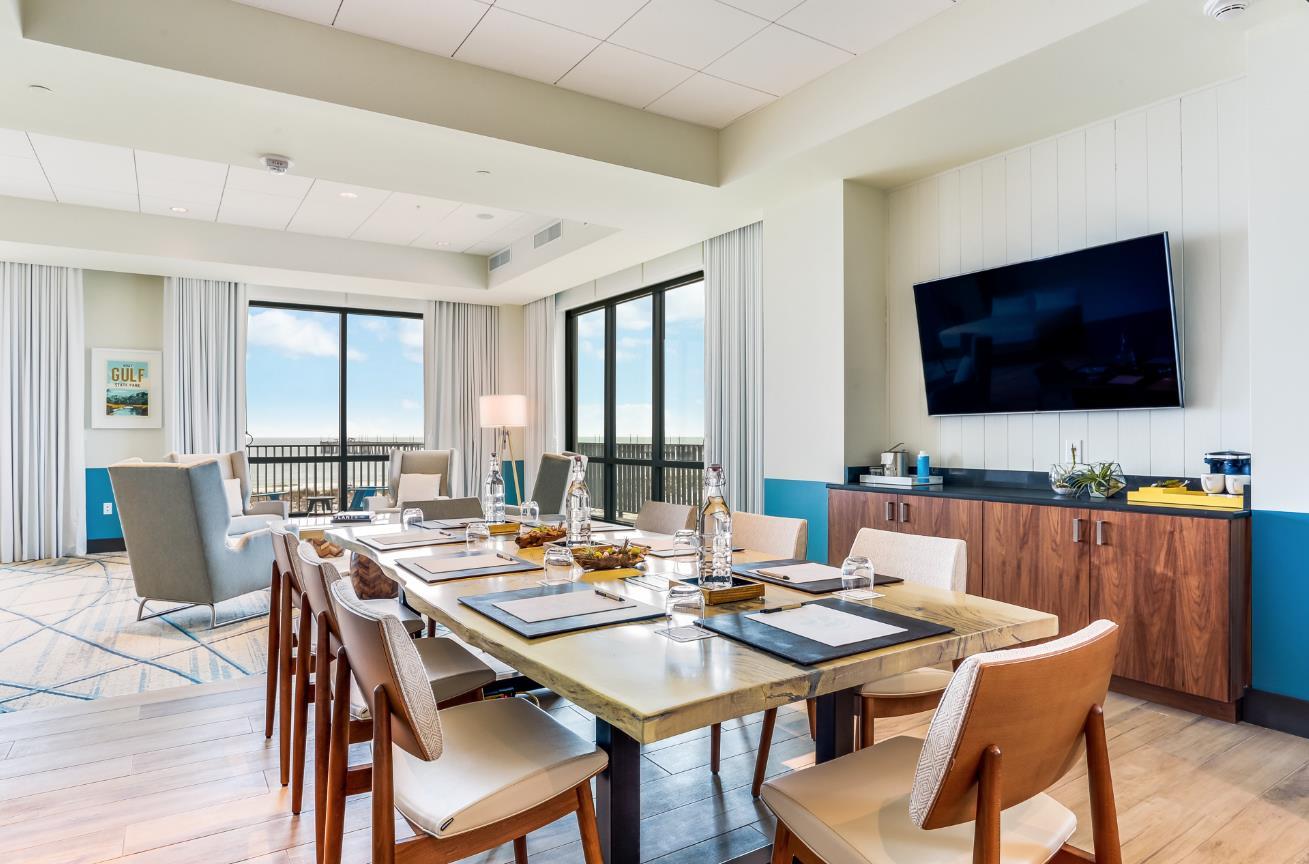
For the function rooms: expose the ambient about a stop under what faces need so the room keeps depth, then add one warm-gelled source just above skin level with the white balance set to the gel. A lower ceiling is a usable bounce surface.
The humidity is the condition running under all of it and on this coast it is high for most of the year. It softens contrast, which makes the beach’s extreme range slightly more manageable than it would be in dry air. It reduces clarity at distance, which means any long view along the coast is hazier than it looks. And it warms and diffuses the light at the ends of the day, which flatters skin and gives a long soft golden period.
It also produces heavy dew and morning fog in the cooler months, which on a moss-hung oak or over still water is the most atmospheric condition the site offers — and a sea fog on a Gulf beach is a genuinely unusual and beautiful frame.
The practical Gulf Coast notes are heat and weather. Summer here is hot and humid enough that an outdoor ceremony between June and September is a welfare matter first — shade, water and an early or late hour do more than any camera decision. Afternoon thunderstorms are near-daily in July and August. And the hurricane season runs from roughly June through November with a peak from August into October: direct hits are uncommon, the effects of a passing system are not, and it cannot be planned for, only acknowledged.
- Meter on skin and expose brighter — white quartz sand is as bright as snow
- Check the chin; the sand lights it from below in every position
- This coast faces south, so the colour frame looks west along the beach
- Wet sand mirrors: a couple reflected on it is the strongest beach frame
- Live oak canopy is the shade, and the metering correction reverses there
The Gulf Coast year
Coastal Alabama has a humid subtropical climate with mild winters and a long hot summer, which makes almost any date workable and turns the calendar into a question of comfort rather than possibility.
Winter is mild and genuinely good. Frost is occasional rather than reliable, the live oaks are evergreen so the shade is unchanged, the beach is empty, and the humidity drops — which means the air is at its clearest of the year and the long coastal views work better in January than in July.
The December sun at this latitude reaches about thirty-eight degrees above the horizon, which is low enough that the whole short day rakes rather than floods. On a white sand beach that is decisive: the midday problem largely disappears, because the sun is never high enough to produce the vertical shadows that ruin a summer noon. Winter is the easiest season here on the light alone.
It also produces the best water: winter seas on this coast are frequently calm and the light is low all day, which gives long broken reflections across turquoise water rather than glare.
The costs are cooler water, short days, and the possibility of a cold snap — and sea fog, which is frequent in the cooler months and which is either the most atmospheric frame of the year or the removal of every view, depending on its thickness.
Spring is the most comfortable season and the busiest. The water warms, the beach greens at the dune line, and the maritime forest fills in — and the light is long without being punishing.
The honest spring caveat for Alabama is severe weather. This state sits in one of the most tornado-prone regions in the country, with a pronounced spring peak, and severe thunderstorms are a real feature from March through May. On a coastal site the risk is somewhat lower than inland but the storms are real, and a named covered alternative with real capacity is a requirement rather than a courtesy.
Summer is hot and humid and it is the season the beach is most crowded. Temperatures in the low nineties Fahrenheit with high humidity make the heat index considerably higher, and a party in formal clothes on white sand at two in the afternoon is uncomfortable in a way that shows in the photographs.
The answers are scheduling and shade: early morning and the last two hours, with the maritime forest and the building’s covered spaces for the middle. Afternoon thunderstorms are near-daily in July and August and they build fast over a warm Gulf, which is useful warning and a dramatic subject in its own right — a storm cloudbase over turquoise water is the most striking sky this coast produces.
The Gulf hurricane season is the honest planning note for the second half of the year. It runs from roughly June through November with a peak from August into October, and while direct hits are uncommon, the effects of a passing system — heavy rain, strong onshore wind, rough water and beach erosion — are not. It cannot be planned for, only acknowledged, and it is a reason a real covered alternative matters for a September date.
Autumn is the best season overall. The heat breaks in October, the humidity drops, the air clears, the crowds thin, the water is still warm, and the light is long and low. Autumn colour is not a feature on a largely evergreen coast, and what deciduous colour there is arrives in November — later than almost anywhere else in this guide.
Late October and early November are the easiest dates of the year here on every count, with the caveat that November is the second severe-weather peak in this state.
More frames from Lodge at Gulf State Park
Lodge at Gulf State Park wedding photography: common questions
Why is the sand so white?
It is almost pure quartz, eroded from the southern Appalachians with the softer minerals worn away — which makes it brilliant white and very fine.
What does that do to the exposure?
It behaves like snow. A meter pulls it toward mid-grey, so meter on skin and expose brighter than the camera suggests, often by a full stop.
Is the bounce useful?
Very. White quartz is neutral in colour, so the light it throws upward is clean fill rather than a tinted cast — at the cost of uplight under the chin.
Where is the sunset?
To the west along the beach, not out to sea. This coast faces south, so the sun crosses the water rather than setting into it.
Where is the shade?
In the maritime forest behind the dunes — live oak above all, which is dense, broad and evergreen. There is none on the beach.
Which season is easiest?
Late October and early November for comfort, and December and January for the light, because a low sun removes the midday problem entirely.
More Alabama venue guides
We are writing a photographer’s guide to every venue we would happily shoot in Alabama. Here are three more, plus the full index:
- Pines at Lake Martin, Dadeville: The Problem, and Four Ways Out
- Retreat at Yellowhammer, Athens: What It Suits and What It Does Not
- Riverchase Golf Club, Hoover: What It Suits and What It Does Not
Planning a wedding at Lodge at Gulf State Park?
White sand and a south-facing coast. Tell us your date and we will walk it west.