 The Venetian, Garfield: The Building’s Own Logic
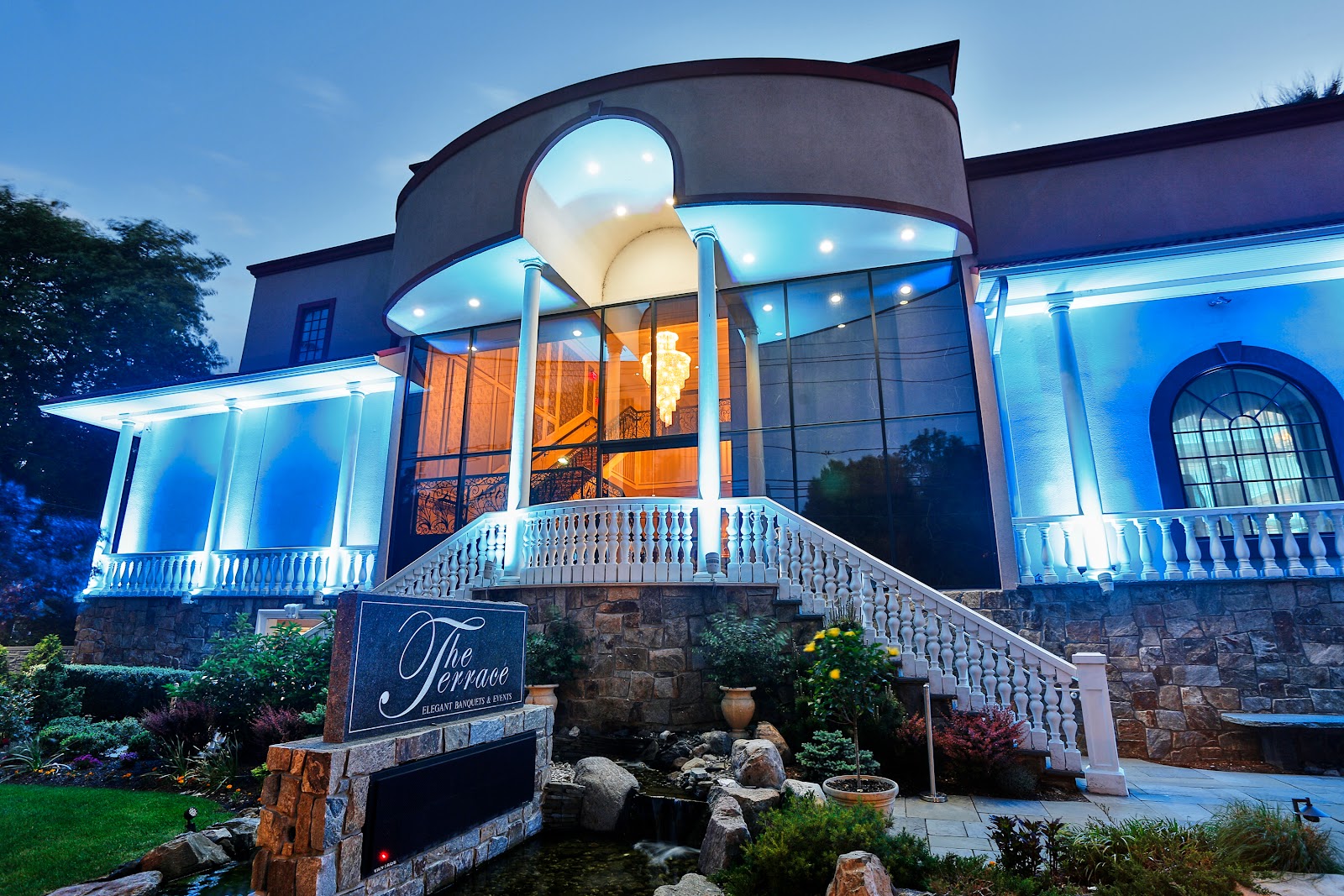
The Terrace, Paramus: Field Notes
A paved terrace is a mirror at your feet. It fills every shadow and lights every chin.
These are field notes on a venue whose principal outdoor space is a paved terrace, and the first note is about the floor rather than anything above it.
Pale paving — stone, concrete, brick or tile — is an efficient reflector, and a large area of it directly beneath a subject behaves like a very big light placed on the ground. That has three consequences and they run through every outdoor frame on the property.
It fills the shadows a high sun carves. Light bouncing up from the paving reaches into the eye sockets and under the brow, which reduces the contrast of a midday portrait considerably — and that is genuinely useful, because those shadows are what makes a noon face look bad.
It lights the chin from below. The same bounce reaches the underside of the chin and the jaw, which is the characteristic paved-terrace look: not obviously wrong, just slightly odd. The diagnosis is to look at the chin in the first frame of every new position, and the correction is something solid on one side or a position angled so the bounce lights one side of the face rather than the front of it.
And it misleads every meter. A large bright surface in frame pulls the exposure down, which gives grey paving and dark faces — so metering on skin, in manual, and exposing deliberately brighter than the camera suggests is the rule. The check is the highlights: paving should read pale with the texture of the joints and the surface visible in it, not grey and not blank.
The second note is that a terrace has no overhead cover unless the building gives it. There is no canopy, no planting of any size, and whatever roofline or overhang the building throws is the shade — which means the midday positions are architectural and finite.
The third note is that a terrace is bounded. At a venue in densely developed Bergen County, the edge of the paving is where the property’s designed space stops, and beyond it is planting, a fence, a car park or a road. That constrains the wide angles and not the close ones.
We have not photographed a wedding at the Terrace; venues built around paved outdoor rooms behave consistently. Which spaces are included, what the covered alternative is, whether the ballroom lighting can be dimmed, and what the actual timings are are questions for their team.
Terrace at a glance
| Where | A banquet venue with a paved terrace at Paramus, Bergen County |
| The floor | Pale paving: fills shadows, lights chins, and fools every meter |
| The shade | Whatever the building’s roofline or overhang throws, and nothing else |
| The edge | Bounded — the wide angles are limited, the close ones are not |
| Ask first | Spaces included, covered alternative, lighting control, timings |
The paving: the problems, and the solutions
The exposure problem is the easiest to fix and the most consistently got wrong. A meter looking at a large bright paved surface tries to pull it toward mid-grey, which underexposes the whole frame — so the correction is deliberate and it is often a full stop: meter on skin and go brighter than the camera says.
The habit that makes it reliable is to set an exposure once, on skin, in each lighting condition, and then work in manual rather than letting the camera re-decide every time the framing changes. On a terrace the framing changes constantly — more paving, less paving — and an automatic exposure will chase it.
The uplight problem takes ten seconds to diagnose and a metre to solve. Look at the chin. If it is as bright as the forehead, the paving is doing too much of the lighting — and turning the subject so the bounce arrives from one side, or putting something solid such as a wall or a planter on one side of them, restores the shape.
Used deliberately, though, the paving is a free reflector and a very large one. A subject standing in the shade of the building on open paving is lit from the front by whatever sky is visible and from below by the ground, which is close to a two-source arrangement arriving for nothing — and in the middle of a bright day that is genuinely useful.
The third property of paving is that it is specular when wet, which is worth waiting for rather than avoiding. Wet paving after rain is a mirror: it doubles the building, the sky and anything standing on it, which turns a plain hard surface into the most interesting element in the frame. A rainy day at a terrace venue produces the best exterior frames it has, and it is worth saying so plainly.
The fourth is that paving is a graphic surface. Joint lines, changes of material, steps, edges and patterns are all strong lines in a frame, and they either lead into it or cut across it depending on where the camera stands. A low camera makes them dominant; a higher one reduces them. Either is a choice; the accidental diagonal is not.
The shade problem has a positional answer and it is worth finding in advance. Whatever the building throws — a roofline, a deep overhang, a porte-cochère, a colonnade, a recessed entrance — is the shade, and there will be three or four such positions rather than many.
A solid roof blocks the overhead component, restricts the light to a horizontal band that models a face properly, bounces off the paving to fill from below, and cannot dapple. Two or three metres in from the open edge is the working position, and the catchlight confirms it: low and broad means the roof is doing the work, high in the eye means step back.
The distinction that decides whether a structure is shade at all is solid versus slatted. A pergola, an open gazebo or a gapped canopy is not shade but a striped dappling machine, and a face beneath one in direct sun is unusable. The test never changes — look at the face rather than the ground, and any hard edge on skin means move.
And the building’s own shaded wall is the other dependable position. A large wall in shade facing open sky is a soft directional source, and a shaded wall behind a subject is a dark background — which on a bright reflective terrace is the only easy separation available. Plain surfaces demand precision, because an approximate composition against a blank wall looks like a mistake, but they work at any hour in any weather.
The edge, the hour, and the building
The boundary is the second practical problem and the answer to it is entirely positional.
Walking a full circle from where the ceremony and the group photographs will happen, and noting which directions have a clean background, is ten minutes of work that decides the coverage. Three or four clean directions is a normal answer at a bounded property, and knowing them in advance means never having to reposition a group.
Two specific tricks handle most of the rest. A low camera with the paving edge, a planter or a hedge crossing the bottom of the frame hides whatever is at ground level behind it — which is usually the untidy part. And a longer lens at a wider aperture dissolves everything beyond the subject into tone, which means a fence forty metres away becomes an unrecognisable soft band.
Where the terrace has planting around it, the usual resources apply. Clipped evergreen hedge is the best background in any outdoor space: dark, even and two or three stops below a subject, with nothing in it to distract — and the metering correction there is the reverse of the paving’s, which is to meter on skin rather than on the hedge, because a dark hedge makes a meter overexpose.
That reversal is the thing to be alert to on a terrace: bright paving underexposes a meter and a dark hedge overexposes it, and both are within a few paces of each other. Manual, metered on skin, reset at each transition.
The hour matters as much as the position. A paved terrace at midday is bright, flat and uniform, with the paving’s uplight doing most of the modelling. In the last hour low sun rakes across it, which does two things: it puts relief into every joint and surface irregularity, and it throws long shadows from anything standing on the terrace, which gives the flat surface depth and pattern.
Bergen County is flat to gently rolling, which means the sun sets at roughly the time a table predicts and the last hour lasts its full length — a real advantage over the ridge and valley sites elsewhere in this guide, where terrain takes the sun early.
After sunset the terrace has one more asset. Wet or dry, a paved surface reflects the building’s own lighting once it is dark, which means an evening frame on the terrace with the building lit behind it is lit by the building and doubled underfoot. A tripod, a few seconds and a close gelled source on the faces is the whole recipe — and wet paving makes it considerably better.
Indoors, the standard problem applies. If the function room is pale and evenly lit, the difficulty is separation rather than light: find something genuinely dark to put behind the subject, use whatever glazing exists as a directional source with the subject a metre from it turned forty-five degrees, or add a source at a stop above the ambient to create the contrast the room’s own bounce has filled in.
The preparation rooms are worth assessing for the usual thing: whether there is a usable window. Where there is, that is the best light on the premises — a metre from the glass, room lights off, custom white balance on the face. Where there is not, one source through a modifier placed to one side, with the room’s own light a stop under, gives window-like light that stays consistent frame to frame.
The ballroom follows the standard method: expose the ambient about a stop or a stop and a half under what skin needs, so the fittings hold their structure and the room keeps depth, then add one source for the faces gelled warm to match, just above what the ambient gives the skin, and diffused so it does not read as flash. A lower ceiling is a usable bounce surface, which is the modern room’s real advantage over a tall ornate one.
- Meter on skin and expose brighter — bright paving underexposes every meter
- Check the chin; paving lights it from below in every position
- Solid roofs are the shade. Pergolas and gazebos dapple
- Walk a circle first and note the three or four clean directions
- Wet paving is a mirror and it gives the best exterior frames of the year
The Bergen County year
Northern New Jersey has four genuine seasons with hot humid summers and cold winters, and a paved outdoor space responds to them differently from a planted one.
Winter is cold with snow in most years, and for the building it barely matters — the honest argument for a February date.
Outdoors, winter does two useful things to a terrace. Snow on paving simplifies everything: the joints and patterns disappear, the surface becomes a single clean plane, and whatever was untidy at the edges is covered. And snow is the best natural fill available, which on a surface that already bounces generously makes the shadows lighter than at any other time of year.
Snow against a dark façade or dark clipped evergreen gives the widest brightness range on the site — expose for the snow and let the rest go dark, overexposing deliberately relative to the meter, which snow fools by about two stops. On a bright paved terrace that correction is doubled, because both surfaces mislead in the same direction.
The December sun at this latitude reaches only about twenty-six degrees above the horizon, so the whole short day rakes rather than floods — which removes the flat-terrace problem entirely, puts relief into every paving joint, and throws long shadows all day rather than for an hour. On the light alone, winter is the best season for a paved space.
Winter also puts the after-dark terrace frames, with the building lit and the paving reflecting it, inside a normal running order rather than after eight in the evening.
The costs are a short day, cold hands, batteries draining faster, a cold camera fogging when brought back into a heated ballroom, and ice on paving, which is a genuine safety consideration for a party in formal shoes.
Early spring is the weakest outdoor part of the year: bare planting, grey light and wet footing — though wet paving is an asset rather than a problem, which makes a rainy April day better on a terrace than on a lawn.
Late spring is when the surrounding planting fills in and the terrace looks its best as a designed space. The complication is the long days: in June the good low light arrives after eight in the evening, which at a venue with a fixed portrait slot means the best light falls after the reception has started. Worth negotiating in advance rather than regretting.
Summer is hot and humid — commonly upper eighties Fahrenheit and above with high humidity — and a paved terrace in July is the hottest outdoor space in this guide’s northeast section, because hard surfaces absorb and re-radiate heat. A party in formal clothes standing on it at three in the afternoon is uncomfortable in a way that shows in the pictures, and the mitigations are shade, water and scheduling rather than anything to do with a camera.
Afternoon thunderstorms are a real feature from June into August, which makes the covered alternative and the deadline for deciding on it the season’s most important practical questions.
Autumn is the best season overall. The humidity breaks in September, the air reaches its clearest of the year, the terrace is comfortable again, and foliage in Bergen County peaks from the middle of October into early November — with the surrounding planting turning over two or three weeks because the species turn at different rates.
Fallen leaves on paving are worth a note, because they are the one seasonal condition that gives a hard surface texture and colour at once: wet leaves on wet stone, lit low, is the strongest thing a paved terrace does all year. And the days are short enough for the good light to fall inside a normal afternoon slot rather than hours after it.

More frames from Terrace
Terrace wedding photography: common questions
What does pale paving do to the light?
It fills the shadows a high sun carves, lights the chin from below, and makes every meter underexpose. All three need handling.
What is the exposure correction?
Meter on skin, work in manual, and expose deliberately brighter than the camera suggests — often a full stop when a lot of paving is in frame.
How do I spot the uplight problem?
Look at the chin in the first frame. If it is as bright as the forehead, turn the subject or put something solid on one side of them.
Where is the shade?
Whatever the building throws — a roofline, overhang, porte-cochère or colonnade. A pergola or gazebo with gaps is a dappling machine, not shade.
Is rain bad here?
No — wet paving is a mirror that doubles the building and the sky, and it gives the best exterior frames the venue has.
Which season is best?
December for the light, because a low sun rakes the paving all day and snow simplifies it — and mid-October, for colour and wet leaves on stone.
More New Jersey venue guides
We are writing a photographer’s guide to every venue we would happily shoot in New Jersey. Here are three more, plus the full index:
- The Venetian, Garfield: The Building’s Own Logic
- The Brownstone, Paterson: The One Decision That Governs Everything
- Crystal Plaza, Livingston: One Frame, and How It Is Made
Planning a wedding at Terrace?
A hard bright surface with rules of its own. Tell us your date.