 The Venetian, Garfield: The Building’s Own Logic
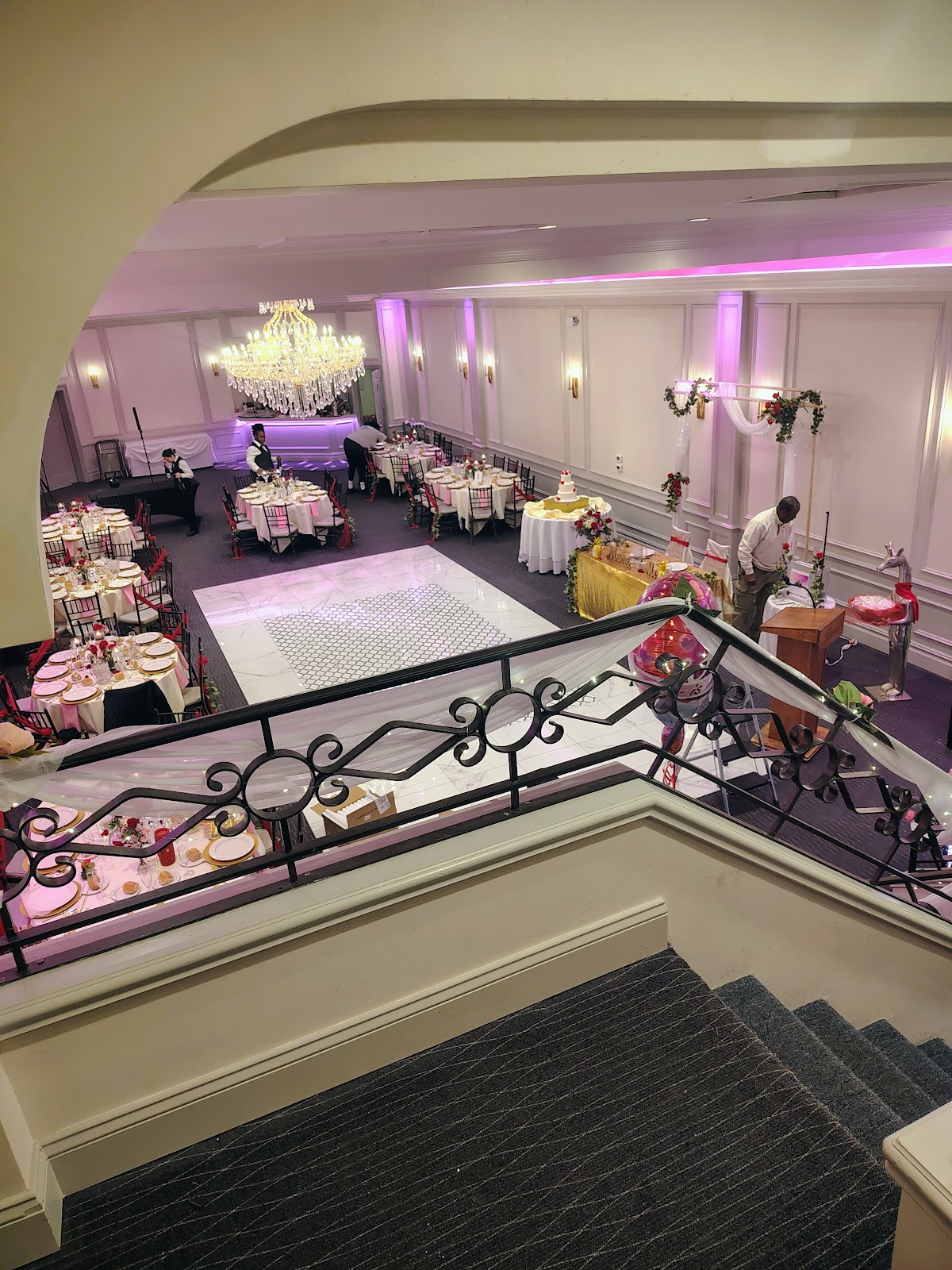
The Fiesta, Wood-Ridge: The Problem, and Four Ways Out
Mirrors, glass and polished stone everywhere. You are in every frame until you decide not to be.
The problem at a large modern banquet venue of this kind is reflection, and it is worth naming precisely because it is both a hazard and the best resource in the building.
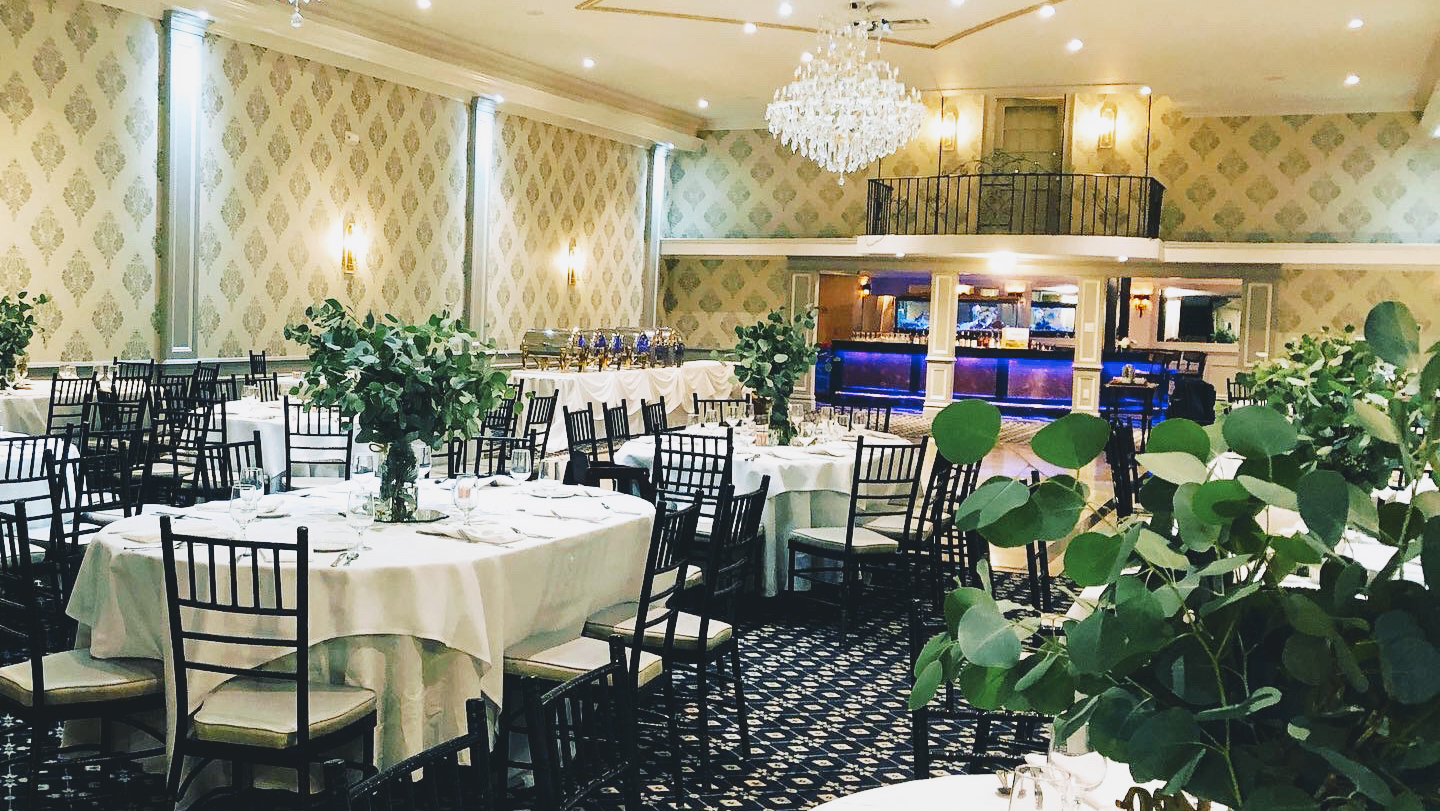
Venues built for spectacle use reflective surfaces deliberately, because they multiply light and space: mirrored walls and panels, large glass, polished stone or tiled floors, chrome and glass fittings, and mirror-topped tables. The effect in person is exactly what it is meant to be — bright, expansive and celebratory.
The effect in a photograph is that the photographer is in almost every frame. Point a camera at a mirrored wall and you are in it. Shoot across a polished floor and you and the equipment appear underneath the subject. Shoot toward glass and the room behind you is layered over the room in front.
There is a second consequence that is less obvious and more damaging. Reflective surfaces bounce light in unpredictable directions, which means the light on a face can be coming from somewhere that is not visible in the frame — a mirrored panel behind the camera, a glass door to one side — and it will be whatever colour that surface reflected. Skin tone becomes inconsistent from position to position for reasons that are invisible until afterwards.
And a third: reflective surfaces are specular, which means they read as either very bright or very dark depending on the angle, with almost nothing in between. A mirrored wall can be a blinding highlight in one frame and a near-black plane in the next.
There are four ways out. We have not photographed a wedding at the Fiesta; large modern banquet venues behave consistently. Which rooms are included, whether the lighting can be dimmed or set for particular moments, what daylight reaches the preparation rooms, whether more than one event runs on a date, and what the actual timings are are questions for their team.
Fiesta at a glance
| Where | A large banquet venue at Wood-Ridge, Bergen County |
| The problem | Mirrors, glass and polished floors put the photographer in every frame |
| Way one | Angle: a few degrees off perpendicular removes any reflection |
| Way two | Use them deliberately. Way three: control what they are reflecting |
| Way four | Find the matte surfaces, because every room has some |
Ways one and two: the angle, and using them on purpose
The first way out is geometric and it solves most of the problem in one move: a reflection only comes back to the camera when the camera is close to perpendicular to the surface. A few degrees off and the reflected ray goes somewhere else entirely.
That means almost every unwanted reflection is removed by moving the camera rather than by any equipment. The habit worth building is to check the background of the first frame in every new position and, if you are in it, shift a metre to one side or change the angle slightly. It takes two seconds and it is the single most useful thing to know in a building like this.
The same applies to a polished floor. Shooting straight down a reflective floor puts everything behind the camera into the lower half of the frame; shooting across it at an angle does not. And a lower camera exaggerates floor reflections while a higher one reduces them, which is a compositional lever as well as a fix.
The second way out is to use the reflections deliberately, because used on purpose they are the building’s strongest resource.
A mirrored wall doubles a room, which gives symmetry and apparent depth that nothing else provides — and a couple photographed with their reflection beside them, deliberately composed, is a frame available nowhere else. The requirement is exactness: a symmetrical reflection frame that is a degree off level or a metre off centre reads as a mistake rather than a device.
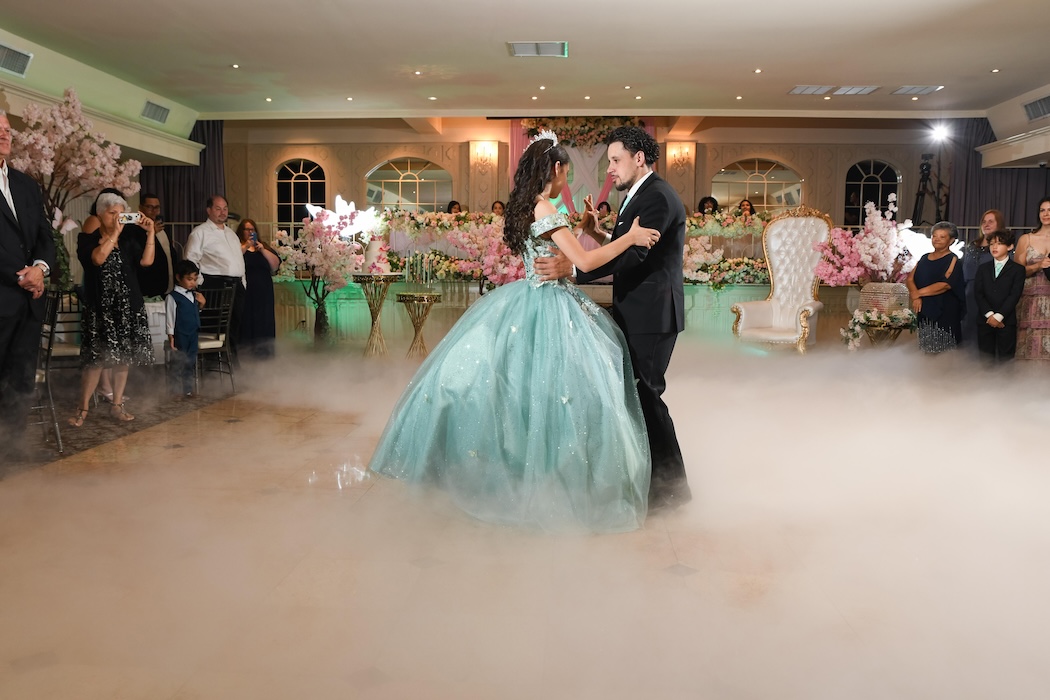
A polished dance floor is the best of them. A couple reflected in it during a first dance, with the room’s lighting doubled around them, is the single strongest frame a venue of this kind produces — and it needs the camera low, the angle chosen, and the exposure set for the couple rather than for the reflection, which runs about a stop darker.
Mirror-topped tables and glass fittings are the smaller version: a lit candle or a chandelier doubled in a table top is a foreground element that gives depth to a wide room frame. Composed low, with that reflection in the bottom of the frame, it layers a picture that would otherwise be flat.
And glass can be used as a layering device rather than a nuisance. A frame shot through a glass partition, with the interior beyond and a soft reflection of the room behind laid over it, is a genuinely strong effect when it is intended — the test is whether the two layers read as separate or as a muddle, and that depends entirely on the angle and on what is bright in each.
The rule that makes all of this work is deciding. A reflection deliberately composed reads as design; the same reflection accepted by accident reads as carelessness. There is no middle ground, and the difference is thirty seconds of looking at the background before the first frame.
Ways three and four: controlling the bounce, and the matte surfaces
The third way out addresses the invisible half of the problem, which is what the reflective surfaces are doing to the light on a face.
The diagnosis is straightforward: in any new position, look at the catchlights in someone’s eyes. They will show exactly where the light is actually coming from, which in a mirrored room is frequently not where it appears to be. A large bright rectangle in the eye that does not correspond to any visible fitting is a mirrored panel or a glass door reflecting something else.
Once it is identified there are two responses. Move the subject so the unwanted bounce no longer reaches their face — usually a metre is enough. Or make your own light dominant on the face, which is the more reliable answer at a venue where the reflected environment changes with every position.
Dominant means set a stop or more above what the ambient gives the skin, rather than the half-stop lift that a consistent room would need. That renders the face entirely by your light, which makes skin tone consistent across the whole evening regardless of what surface the couple happens to be standing beside — and at a venue with mirrors and coloured uplighting, consistency is worth more than subtlety.
The gel goes on to match whatever is dominant in the room, and the white balance follows the gel. And the same reflection rule applies to your own light: a source aimed at a subject standing near a mirrored wall will appear in that wall, which means the light has to be placed where its reflection is out of frame, or the camera angled so the reflection is.
The fourth way out is to find the matte surfaces, because every building of this kind has them and nobody photographs there.
Drapery is the best of them: a curtained wall is entirely matte, it absorbs rather than reflects, it goes dark two or three stops below a lit face, and it has texture rather than pattern. A subject against drapery is separated for nothing and there is no reflection to manage. In a venue full of mirrors, drapery is the equivalent of a dark stone wall.
Carpet is the floor equivalent and its usefulness is the same: heavily patterned carpet absorbs, which means the fall-off from an added source is steeper than on a polished floor and a background a few metres behind a subject drops away more than expected.
Corridors, service areas, stairwells and side entrances are where the matte surfaces concentrate, and they are reliably empty. A large plain painted wall in even light, with a subject placed deliberately against it, is a clean and honest frame — and plain surfaces demand precision, because an approximate composition against a blank wall looks like a mistake, but they give consistency that a mirrored room cannot.
The preparation rooms are worth assessing for the usual thing: whether there is a usable window. Where there is, a subject a metre from the glass turned about forty-five degrees to it gets horizontal light with steep fall-off behind, room lights off, custom white balance on the face. Where there is not, one source through a modifier placed to one side, with the room’s own light a stop under, gives window-like light that stays consistent.
And the ballroom exposure follows the standard method regardless of the reflections: expose the ambient about a stop or a stop and a half under what skin needs, so the fittings hold their structure and the room keeps depth, then add one source for the faces gelled warm to match, just above what the ambient gives the skin, diffused so it does not read as flash. A tall ornate ceiling is not a usable bounce surface; a pale nearby wall usually is.
- A few degrees off perpendicular removes any unwanted reflection
- Compose reflections deliberately or not at all — there is no middle ground
- Read the catchlights to find where the light is actually coming from
- Make your own light dominant, for consistent skin across the whole evening
- Drapery, carpet and plain walls are the matte surfaces. Use them
The Bergen County year
A large banquet venue is among the most weather-independent in this guide, which means the season affects the outdoor half of the day and the preparation-room light rather than whether anything works.
Winter is cold with snow in most years, and for a building like this it is close to irrelevant — the honest argument for a February date and a strong one. Guests arrive under cover and the whole event happens inside.
Where winter helps is the daylight positions. The December sun at this latitude reaches only about twenty-six degrees above the horizon, which means it enters any window almost horizontally and travels much further into a room than a high summer sun does — so a preparation room with a window is better lit in January than in June, and the usable band beside the glass is much wider.
Winter’s second advantage is the early evening. Any after-dark exterior frame — and at a venue with a lit façade or a lit porte-cochère that is worth making — is available from mid-afternoon rather than after eight, which means it fits comfortably inside a normal running order.
Snow is the outdoor asset: the best natural fill available, lifting every shadow and throwing light upward into faces. Snow against a dark façade gives the widest brightness range on the site — expose for the snow and let the building go dark, overexposing deliberately relative to the meter, which snow fools by about two stops.
There is one winter consideration specific to a reflective building: a cold camera carried from a winter street into a warm mirrored interior fogs, and so does a lens. Spares in an inside pocket and bodies bagged until they warm.
Early spring is the weakest outdoor part of the year in this region: bare trees, grey ground and wet footing. Indoors it makes no difference at all, which at a venue built entirely around its interiors is no loss — and it is a legitimate reason to weight an April wedding inward.
Late spring is mild and green, with street and grounds planting softening the exterior frames through May. The complication is the long days: in June the good low light arrives after eight in the evening, which at a venue with a fixed portrait slot means the best exterior light falls after the reception has started. Worth negotiating in advance rather than regretting.
Summer is hot and humid — commonly upper eighties Fahrenheit and above with high humidity — with afternoon thunderstorms a real feature from June into August. Indoors none of it matters; outdoors the middle of the day belongs to the porte-cochère and any solid-roofed structure rather than to open ground.
Autumn is the best season for the outdoor half and the most convenient for a scheduled venue. The humidity breaks in September, the air reaches its clearest of the year, and foliage in Bergen County peaks from the middle of October into early November — oak russet, maple scarlet, beech bronze and tulip poplar yellow, over two or three weeks because the species turn at different rates.
The scheduling advantage is that the days are short enough for the good light to fall inside a normal afternoon slot rather than hours after it, which at a venue running to a clock is the real argument for an October date. And for a building whose interiors are bright, mirrored and artificial, that outdoor colour is what gives the whole set of pictures a place and a season the ballroom cannot provide.
More frames from Fiesta
Fiesta wedding photography: common questions
What is the central problem here?
Reflective surfaces everywhere — mirrors, glass and polished floors — which put the photographer in most frames and bounce light from invisible directions.
What is the simplest fix?
Angle. A reflection only returns to the camera near perpendicular, so a few degrees or a metre to one side removes it entirely.
How do I use reflections well?
Deliberately and exactly. A symmetrical mirror frame or a couple reflected in a dance floor is strong; the same reflection by accident reads as carelessness.
Why does skin tone drift in a mirrored room?
Because light is bouncing off surfaces that are not in the frame, in whatever colour they reflected. Read the catchlights to find where it is coming from.
How do I keep skin consistent all evening?
Make your own light dominant on the face — a stop or more above the ambient — so the room contributes only the background.
Where are the matte surfaces?
Drapery, carpet, corridors, stairwells and plain painted walls. Drapery in particular behaves like dark stone: it absorbs and separates for free.
More New Jersey venue guides
We are writing a photographer’s guide to every venue we would happily shoot in New Jersey. Here are three more, plus the full index:
- Grand Marquis, Old Bridge: The Problem, and Four Ways Out
- Grounds for Sculpture, Hamilton: A Walk Through the Site
- Highlawn Pavilion, West Orange: The Light Through the Day
Planning a wedding at Fiesta?
A building full of mirrors, handled deliberately. Tell us your date.