 Woodwinds, Branford: The Problem, and Four Ways Out
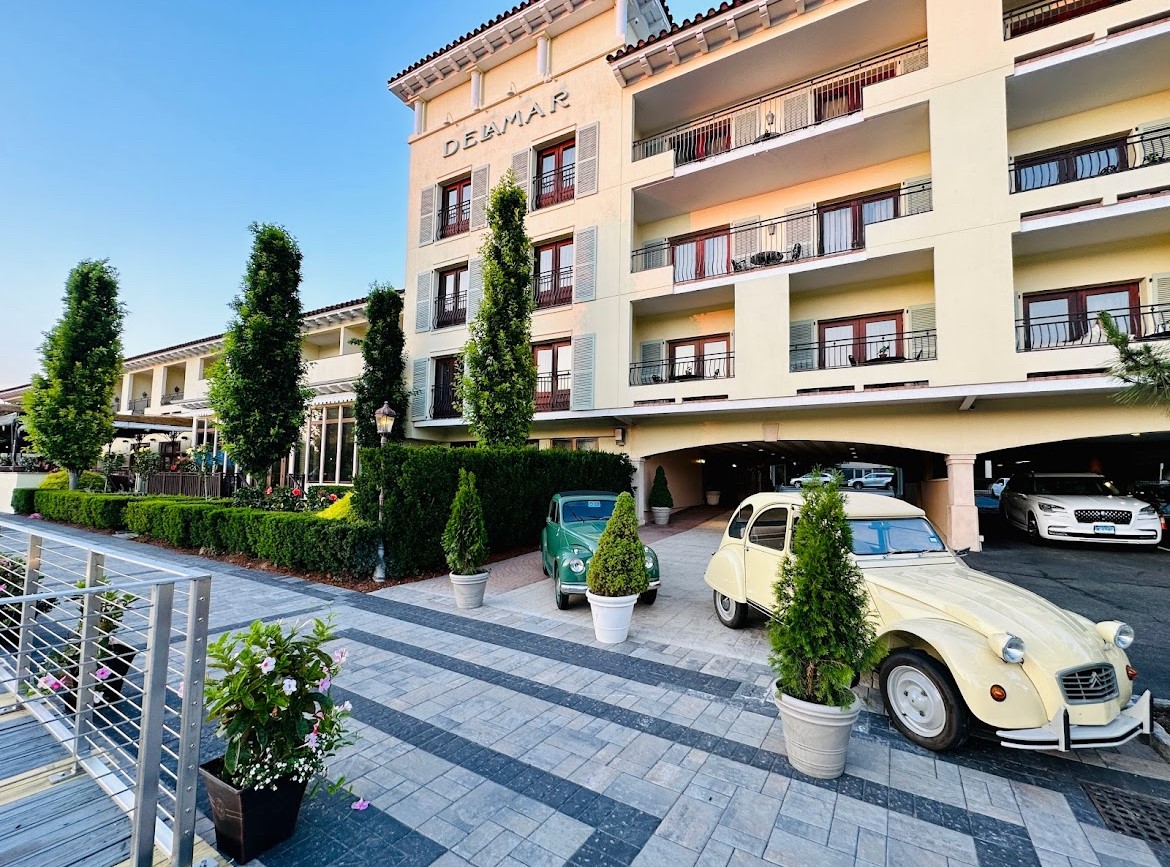
Delamar Hotel, Greenwich: One Frame, and How It Is Made
A harbour is better than an ocean for one reason: it has things in it.
There is one frame a harbourside hotel gives that an open-water venue cannot, and it is worth building properly because everything else on such a property is a variation on it.
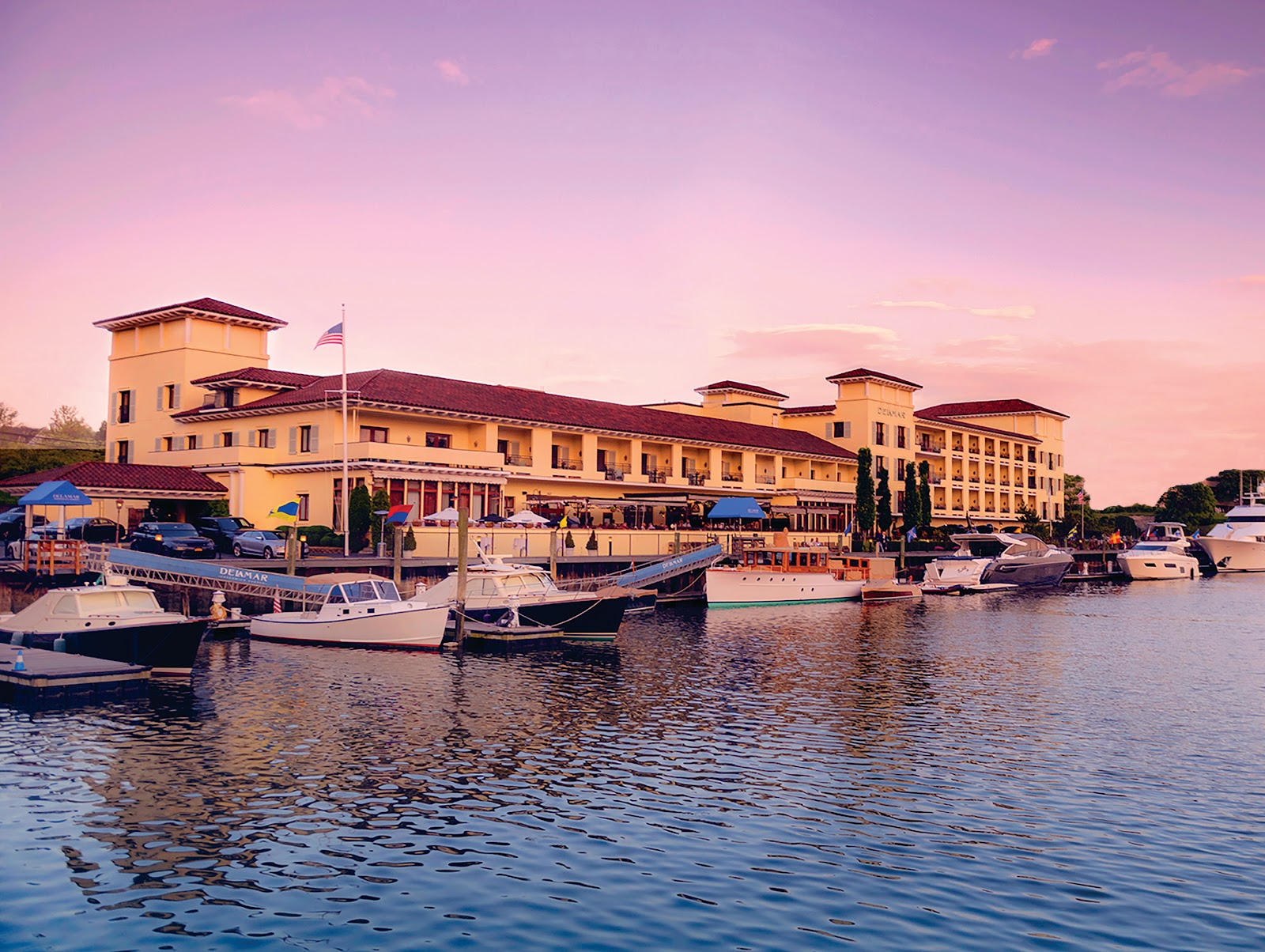
A couple stands on a terrace or a dock with a working harbour behind them: masts, hulls, rigging, a stone or timber edge, and water between. It is not a view of the sea — it is a view of a place, with structure and detail and human scale in it, and that is precisely why it photographs better than an empty horizon.
The reason it works is compositional rather than technical. An open ocean frame has three bands in it — water, horizon, sky — and nothing else, which means everything depends on the light and the subject alone. A harbour frame has verticals, diagonals, repetition and depth built into it: masts are strong verticals, rigging gives fine lines, hulls give repeated shapes, and the far shore closes the frame off so the picture has an edge rather than running out to nothing.
The reason it is difficult is that a harbour contains both the brightest and the darkest things on the property, frequently within one frame. White hulls in sun are as bright as anything in this guide; dark water in shadow under a dock is as dark. And the difference between them can be five or six stops.
The second governing fact is the location. Western Connecticut sits at the narrow end of Long Island Sound, sheltered by Long Island to the south, which means the water here is calm far more often than open coast — good for reflections, and the reason a harbour exists at all.
We have not photographed a wedding at the Delamar Greenwich; harbourside hotels on this shore behave consistently. Which rooms and terraces are included, what dock or waterfront access is available and under what conditions, the covered alternative, whether the ballroom lighting can be adjusted, and what the boat traffic is like on a given date are questions for their team.
Delamar Hotel at a glance
| Where | A harbourside hotel on the western Connecticut shore at Greenwich |
| The frame | A couple on the water’s edge with a working harbour behind |
| Why it works | Masts, rigging and hulls give structure an open horizon has not |
| The problem | Five or six stops between white hulls and shadowed water |
| Ask first | Rooms and terraces included, dock access, covered alternative, lighting |
How the frame is made
The lens is the first decision and it governs whether the harbour reads as a harbour. A wide lens spreads the boats out, pushes the far shore into a thin line and puts a great deal of empty water and sky in the frame — which is the opposite of the point, because the density of masts and hulls is what makes the picture.
A longer lens compresses. It stacks the masts into a thicket, brings the far shore forward so it closes the top of the frame, and squeezes the water out — which produces a background of pure structure behind the couple. That is the frame, and it is made from further back rather than from closer in.
The exposure is the second decision and it is where the harbour is unforgiving. A frame containing sunlit white hulls and a shaded face spans more range than one exposure holds, and there are two honest resolutions.
Expose for the hulls and light the faces. The ambient is set so white paint holds texture rather than clipping to a featureless blank, and a source lifts the faces to match. That keeps the harbour legible, which is the reason for the frame — and the source has to be close, because water and distance bounce nothing back: a source at two metres needs roughly a quarter of the output of the same source at four.
Or wait for the hulls to be out of the sun. A harbour is largely in shade for part of every day depending on which way it faces and what is around it, and a frame made when the boats are in even light needs nothing added at all. Knowing when that happens is a matter of one look at the water before the day, and it is worth doing.
What does not work is metering the average, which gives grey hulls and slightly dark faces — the standard failure, and precisely what automatic exposure produces.
The white balance needs its own decision because a harbour has three light sources in it. Open sky is cool. Water reflects that sky and is cooler still. And white hulls in sun bounce a bright neutral light that fills from the side. A custom white balance set on a face in the position it will occupy handles all three; a daylight preset renders the shaded version blue.
The horizon is the third decision and it is the one most often got wrong. Water gives an absolutely level reference line across the frame, which means a horizon a single degree off is glaringly obvious — more so than in any landscape, because the eye knows water is flat. Levelling to the water rather than to the terrace or the dock is the habit, because a dock is frequently not level and the water always is.
Masts are the same problem vertically. A moored boat’s mast is plumb, so a converging vertical in the frame reads as a lens error rather than a style — which argues for shooting from a height near the subject’s own rather than tilting up or down, and for correcting the rest afterwards.
Reflections are the frame’s bonus and they depend entirely on the water’s state, which is knowable on the day and not before. Flat calm gives a full mirror, which doubles the masts and roughly doubles the interest in the frame. A light chop breaks it into texture, which is a different and still good picture. Wind chop removes it altogether.
And tide is worth checking, because it changes the geometry. At high water the hulls sit high and the dock edge is close to the surface; at low water the hulls drop, mud or rock may be exposed, and the relationship between a person on a dock and a boat beside it changes by a metre or more. Neither is wrong; both are different frames, and knowing which one the date gives takes a minute.
What breaks it, and the rest of the building
Midday sun is the first thing that breaks the frame and it breaks it on both ends. High sun clips white hulls, flattens the water into glare, and puts hard shadows under every brow on the terrace — and there is no shade on a dock.
The answer is the hour rather than a technique. A harbour frame wants the light low enough to rake across the water and along the hulls, which means the first two hours or the last two. In the middle of the day the frame is available but it is a documentary record rather than a portrait.
Wind is the second and it breaks the frame in three ways at once. It removes the reflection, it makes a lightstand a liability and a held modifier a sail, and it makes a veil unpredictable — so a source in a hand or on a bracket is the configuration, planned from the start. A summer afternoon on this shore has a reliable sea breeze, which means the calm water is likelier in the morning and again in the evening.
Boat traffic is the third and it is worth a thought rather than a plan. A harbour is a working place: a boat moving through the background changes the frame, a wake removes a reflection for several minutes, and the composition arranged carefully can be altered by someone else entirely. It argues for making the frame several times rather than once.
Clutter is the fourth and it is the commonest way a harbour frame fails. Real harbours contain fenders, hoses, bins, signage, parked cars and cables, and a frame that includes them reads as a car park with boats in it. The fix is entirely positional: a step to one side, a longer lens, or a lower camera that puts the dock edge across the bottom of the frame and hides what is behind it.
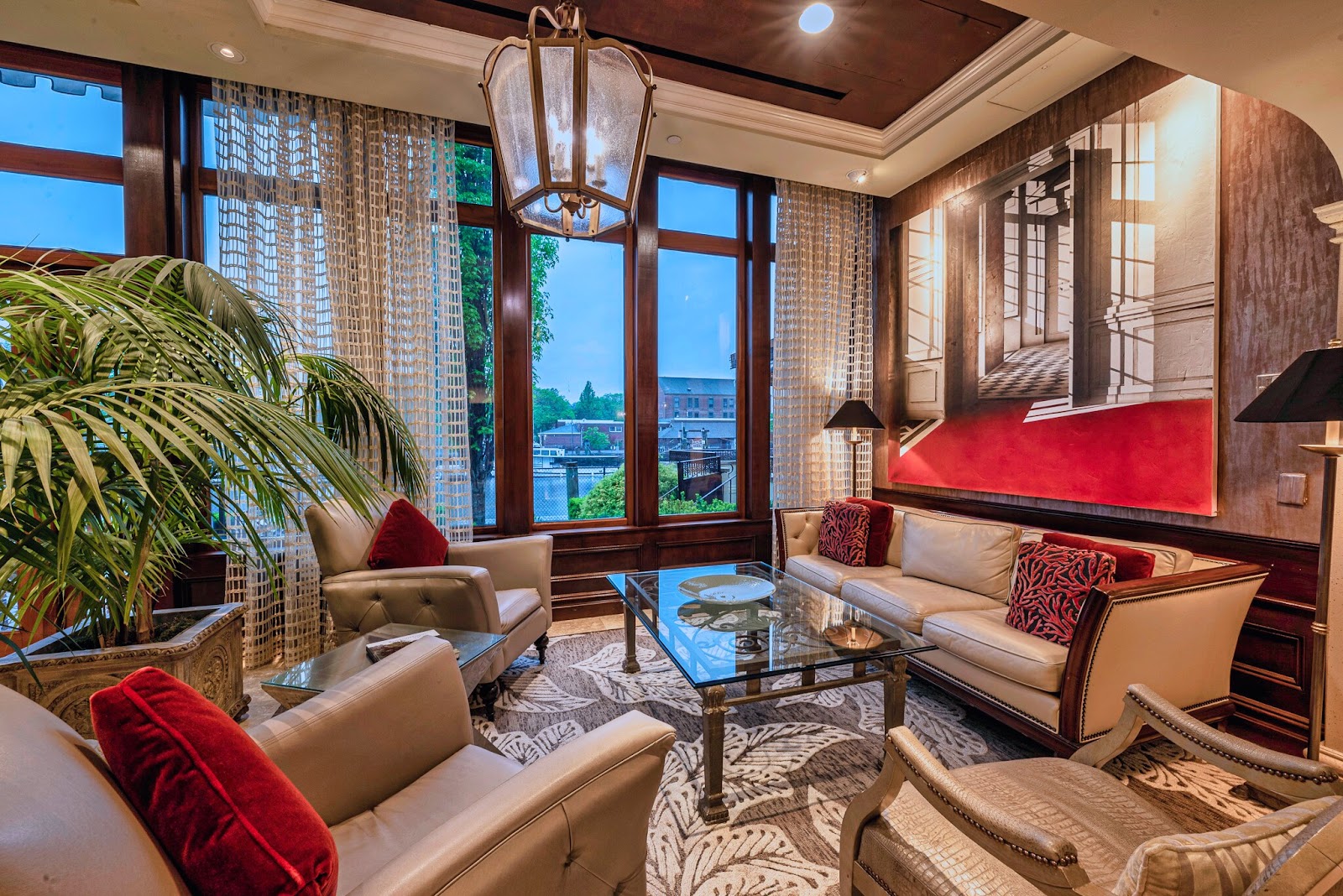
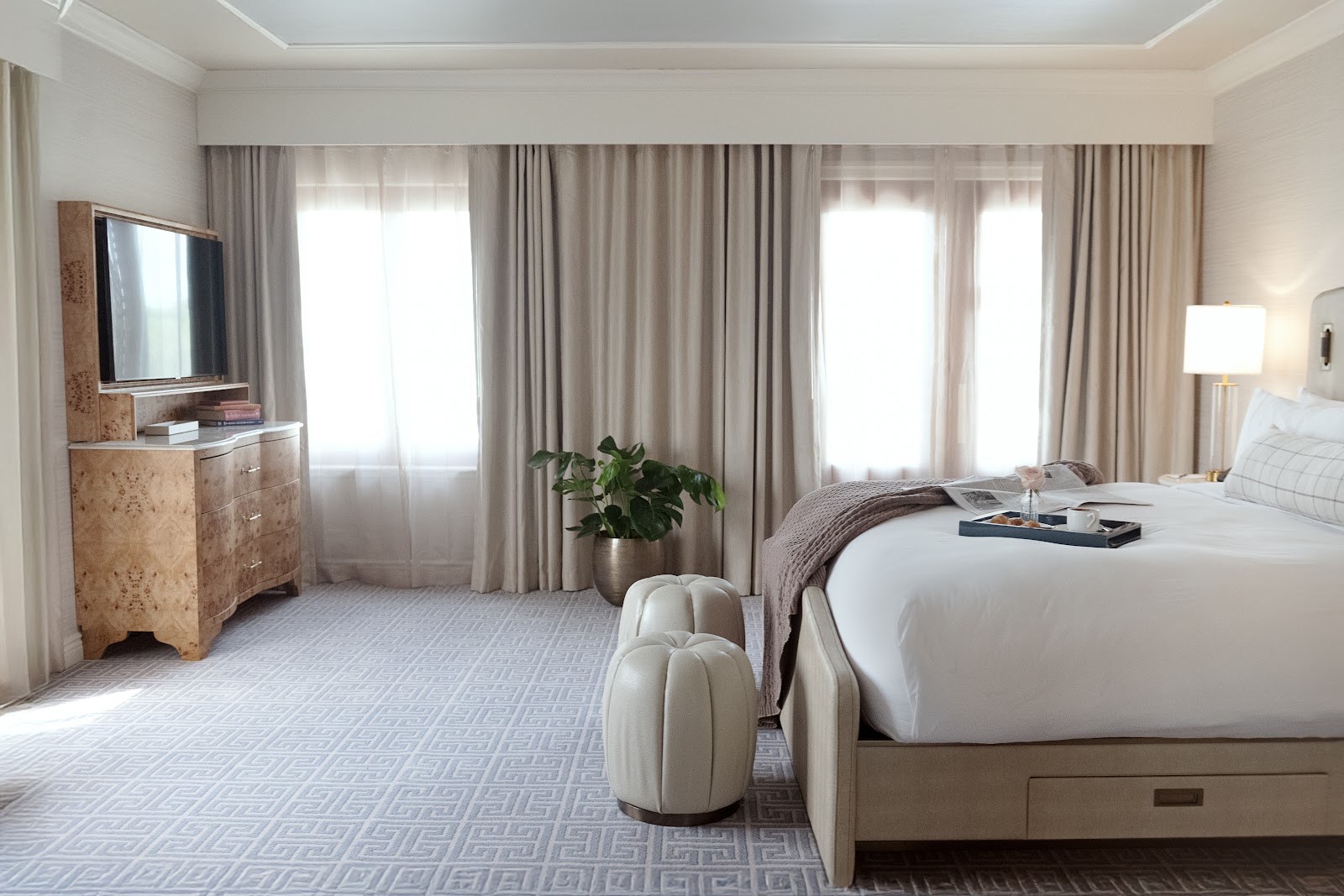
The rest of the building follows the standard logic of a modern waterfront hotel. Rooms facing the water have large glazing, which gives soft abundant light — and a subject a metre from that glass, turned about forty-five degrees to it, gets real modelling because the window is still much brighter than anything bouncing around the room.
Two rules there and both are free. Turn the room lights off, because warm bulbs mixing with cool water-reflected daylight put two colours on one face. And set the white balance on a face in position, because light off water is noticeably cool.
In a pale modern room the problem is separation rather than light: soft bounced light against pale walls gives no fall-off and no shadow side, so the frames read flat. The fixes are to find something dark and put it behind the subject, to use the glazing as a directional source, or to add a source at a stop above the ambient in order to create contrast rather than illumination.
Large glazing also reflects, which means a frame pointed at it at a shallow angle picks up the room and the photographer. A few degrees off perpendicular removes it, and finding that angle is the first thing to do in any glass-walled space.
The evening reception follows the standard approach: expose the ambient about a stop under what faces need so the room keeps its character, then add one warm-gelled source just above skin level with the white balance set to the gel. A modern room’s lower ceiling is a genuine advantage here — it is a usable bounce surface, which a high ballroom ceiling is not.
And the night frame is worth planning for, because a harbour does one thing after dark that nothing else in this guide does. Boat and shore lights on still water produce long vertical reflections, and a couple on a dock against that is a strong frame — a tripod, a few seconds, a close gelled source on the faces, and a party willing to stand still.
- Longer lens from further back: compress the masts, close the frame off
- Expose for the white hulls and lift faces close, or wait for even light
- Level to the water, not to the dock — the eye knows water is flat
- Watch for clutter; a step to one side is the whole fix
- Calm water is likelier in the morning and evening than in the afternoon
The western Connecticut shore year
This shore has a maritime version of a New England climate. The Sound moderates it, so summers are cooler and winters milder than inland Connecticut — and the narrow western end is more sheltered than the eastern, which is why the water here goes calm so often.
Winter is cold with snow in most years, and a harbour in January is a different subject entirely: boats hauled out and shrink-wrapped, empty slips, bare rigging, and sometimes ice at the margins. That is a spare graphic version of the frame rather than an absent one, and dark water against snow is the widest brightness range the site offers — expose for the snow and let the water go black.
Snow fools a meter by about two stops toward underexposure, so a snow frame needs deliberate overexposure relative to what the camera suggests. And the December sun at this latitude reaches only about twenty-six degrees above the horizon, so the whole short day rakes across the water rather than falling onto it — which means the surface texture and the modelling on hulls and buildings is available all day rather than for an hour.
Winter is also the clearest air of the year, which for a frame built on compressed distance matters more than at most venues, and it is when the long low reflections across still water are at their best.
The honest winter note is that the harbour frame depends on the boats being in the water, and in this region most are not between roughly November and April. That is a question for the marina rather than a guess, and it decides whether the site’s signature frame is available at all on a winter date.
Spring is late on the shore, because the water keeps the land cool: raw wet weather into May is genuinely possible, and the boats come back in progressively rather than all at once. Late spring is when the harbour refills and the trees leaf out, and it is the first reliably good season.
Summer is the harbour’s own season and it is the busiest. Temperatures in the low eighties Fahrenheit with high humidity are typical, the sea breeze is reliable in the afternoon, and thunderstorms are a real feature from June into August — which for a site whose best positions are outdoors makes a named covered alternative a requirement.
Humidity is the summer photographic factor and it works against the frame specifically: haze reduces clarity at distance, which softens exactly the compressed long-lens background the harbour frame is built on. A July afternoon is hazier than an October one by a clear margin.
Tropical storm season runs from roughly August into October on this coast. Direct hits are uncommon; the effects of a passing system are not, and heavy rain with strong onshore wind removes every outdoor option at once. It cannot be planned for, only acknowledged, and it is a reason a covered alternative matters for a September date.
Autumn is the best season and by a wide margin. The heat and humidity break, the air reaches its clearest, the water is at its calmest, the weather is at its most settled, the boats are still in, and the foliage on the far shore and around the harbour turns — typically from the middle of October into early November on this coast.
Autumn foliage behind a harbour is a specific and uncommon combination: warm scarlet and gold reflected in calm water, with white hulls and dark rigging in front of it. There is nothing else like it on this shore, the window runs two or three weeks because the species turn at different rates, and it is the reason October dates go first.
More frames from Delamar Hotel
Delamar Hotel wedding photography: common questions
Why is a harbour better than open water?
It has structure in it. Masts are verticals, rigging gives fine lines, hulls repeat, and the far shore closes the frame — an open horizon has none of that.
What is the exposure problem?
Sunlit white hulls and a shaded face can be five or six stops apart. Expose for the hulls and lift the faces close, or wait until the boats are in even light.
What lens should I use?
A longer one, from further back. It compresses the masts into a thicket and brings the far shore forward; a wide lens spreads everything out and empties the frame.
What is the commonest mistake?
An out-of-level horizon, because docks are rarely level and water always is — and including harbour clutter, which a step to one side removes.
When is the water calmest?
Morning and evening. A reliable afternoon sea breeze in summer removes the reflections that make the frame.
When is the site at its best?
Mid-October into early November: clear air, calm water, settled weather, boats still in, and foliage reflected behind white hulls.
More Connecticut venue guides
We are writing a photographer’s guide to every venue we would happily shoot in Connecticut. Here are three more, plus the full index:
- Eolia Mansion, Waterford: The Light Through the Day
- Fox Hill Inn, Brookfield: What It Suits and What It Does Not
- Foxwoods Resort, Mashantucket: The Problem, and Four Ways Out
Planning a wedding at Delamar Hotel?
A working harbour and one good frame. Tell us your date and we will time the water.