 Indianapolis Zoo: Reading a Day From Open Grounds to Underwater Glass
The Four Winds Casino, South Bend: The Problem, and Four Ways Out
A building with no windows takes away your best light and hands you back your whole schedule.
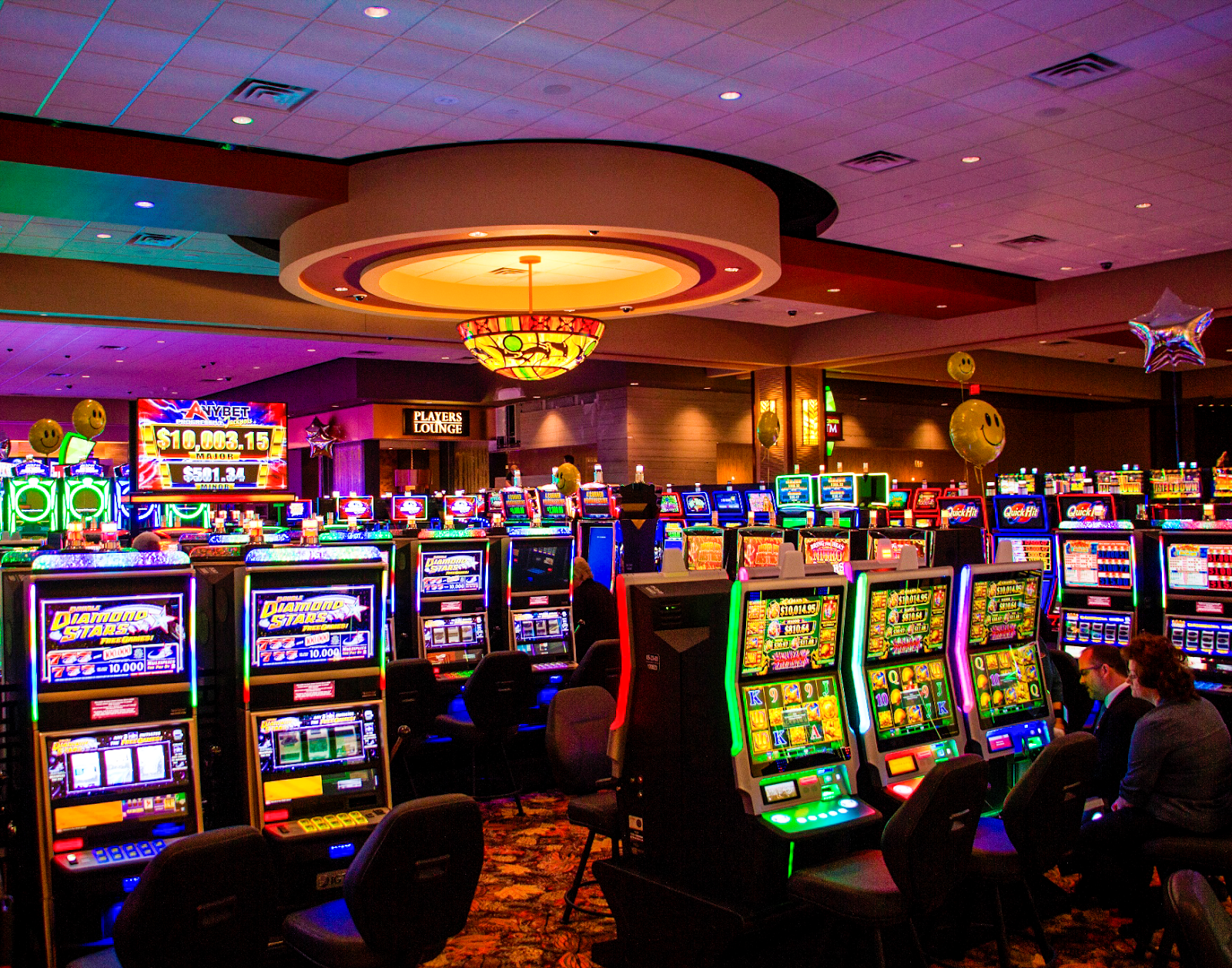
A casino venue is designed so that nobody inside can tell what time it is. No windows on the gaming floor, no clocks, no views — and that single design decision creates the central photographic problem and solves the central logistical one at the same time.
The problem is that there is no daylight. Not limited daylight, none: the public spaces are lit entirely by installed fittings, which are dense, overhead, mixed in colour and chosen for atmosphere rather than for faces. Every frame indoors is a frame made with artificial light, and the building has no dusk crossing of its own.
The gift is that nothing changes. A ballroom at ten in the morning is identical to the same ballroom at ten at night, which means every indoor frame is movable and the running order can follow the couple rather than the sun.
There are four ways out of the problem, and the gift is what makes them affordable. We have not photographed a wedding at the Four Winds Casino; windowless casino venues behave consistently. Which spaces are included, whether the lighting is adjustable and what may be attached are questions for their team.
The Four Winds Casino at a glance
| Where | South Bend, Indiana |
| The problem | No daylight in the public spaces, and dense overhead fittings |
| Way one | Direction, not brightness — one source off the camera axis |
| Way two | Bounce, which works here when it fails elsewhere |
| Ways three and four | The guest rooms, and going outside for the one timed frame |
Ways one and two: direction, and bounce
The first way out is direction, and it is the single most economical improvement available anywhere in the building. Dense downlighting puts light straight down, which fills eye sockets with shadow and cuts a hard line under every chin — and it is why an unlit frame on a casino floor looks tired even when the exposure is perfectly correct. No exposure correction fixes it, because the problem is geometry rather than quantity.
One source off the camera axis at face height changes the character of every face at once, and the amount needed is small: half a stop to a stop above the ambient, because the ambient is already doing the work of filling. Anything more and the room disappears, which at a venue chosen for its atmosphere is the opposite of the point.
The second way out is bounce, and it is worth stating clearly because it inverts the usual advice. Casino floors are unusual buildings: they run a great distance in every direction with a ceiling only three or four metres up, which is remarkable for a space of that size — and it means a flash aimed upward returns something genuinely usable.
In a conventional hotel ballroom with a five-metre ceiling, bounce is a wasted battery. Here it frequently works, and a bounced source is a very large soft light that needs no stand, follows a walking pace, and covers reportage without aiming. For the dancing and the crowd coverage that is exactly what is wanted.
It needs one test frame on arrival rather than an assumption, because the finish decides it: a dark or strongly coloured ceiling absorbs most of what hits it and tints the rest. Thirty seconds settles it and it changes what has to be carried for the whole evening.
Colour is the condition that underlies both ways. Expect warm decorative fittings, cooler recessed downlights, coloured accent lighting, illuminated signage and screens, and any uplighting installed for the event. Three temperatures on one face cannot be reconciled afterwards, so the method is to pick the one that should be correct, set white balance to it, and switch off or overpower whatever else lands on skin.
Coloured accent lighting is usually the worst offender and frequently the easiest thing to have turned off for the ten minutes the portraits need. That is a reasonable request rather than a compromise, and it removes a cast that cannot be corrected.
Two further conditions are worth a sentence each. Patterned carpet competes with faces at the same spatial frequency and fills the lower third of every standing portrait — camera height that excludes it is the fastest fix, distance and a wide aperture dissolve it. And reflective surfaces will show a badly placed light at full brightness, which fifteen seconds of checking from the camera position prevents.
Ways three and four: the guest rooms, and outside
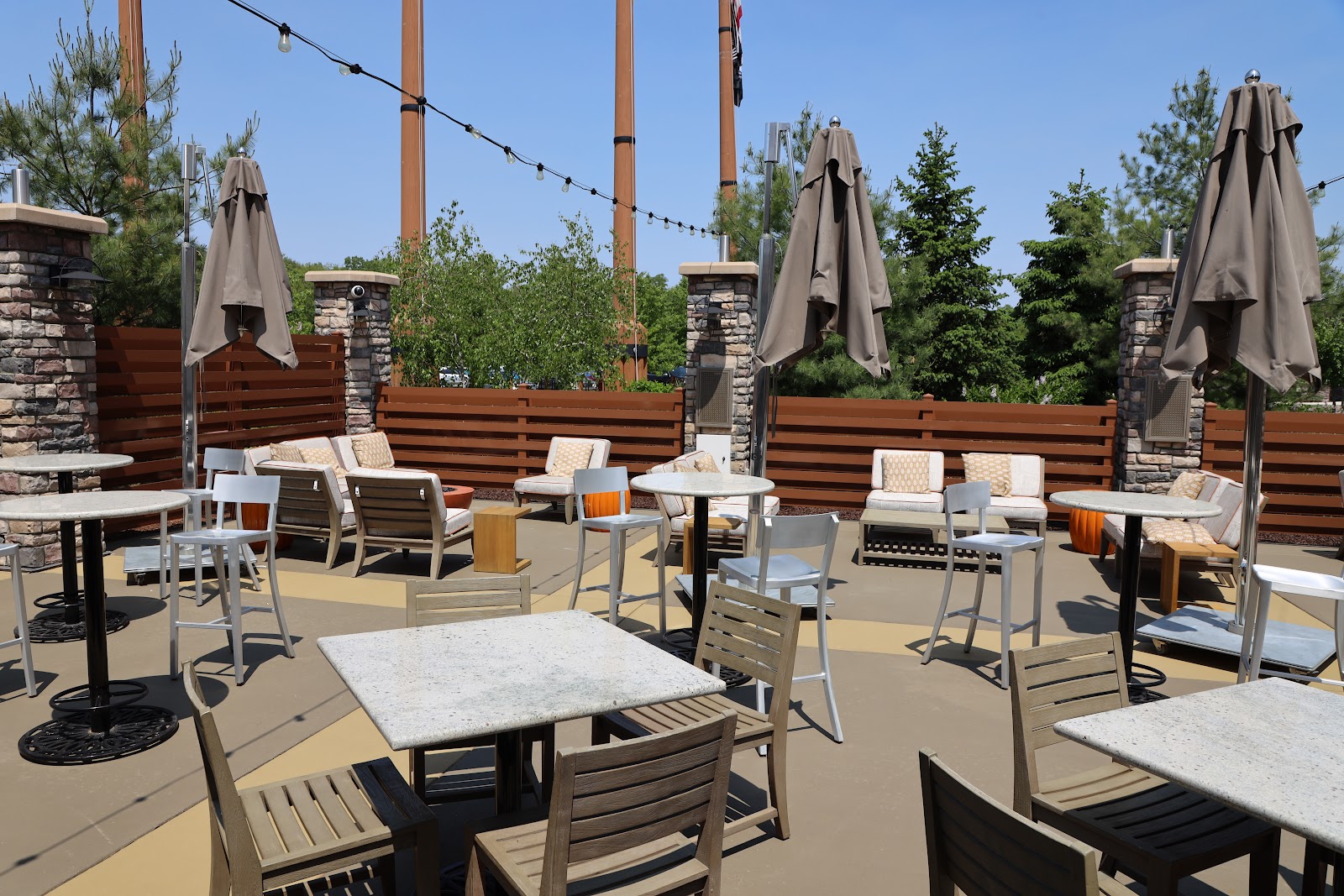
The third way out is the guest rooms, which are the only interior daylight and are therefore more valuable here than at an ordinary hotel rather than less.
The requests are the familiar ones: largest window on the shaded side, every overhead fitting switched off so the room has one colour of light rather than two landing on the same face, lamps moved out of frame, and two to three metres back from the glass so the fall-off is even across two faces rather than dropping off one of them.
South Bend sits at about forty-two degrees north, where the midday sun reaches roughly seventy-one degrees above the horizon in June and barely twenty-five in December. So a north-facing room is shaded all year — the most reliable option — while a south-facing one is a high source in summer and a low directional one through most of a winter afternoon. Orientation is therefore the question worth asking, and the right answer changes with the season.
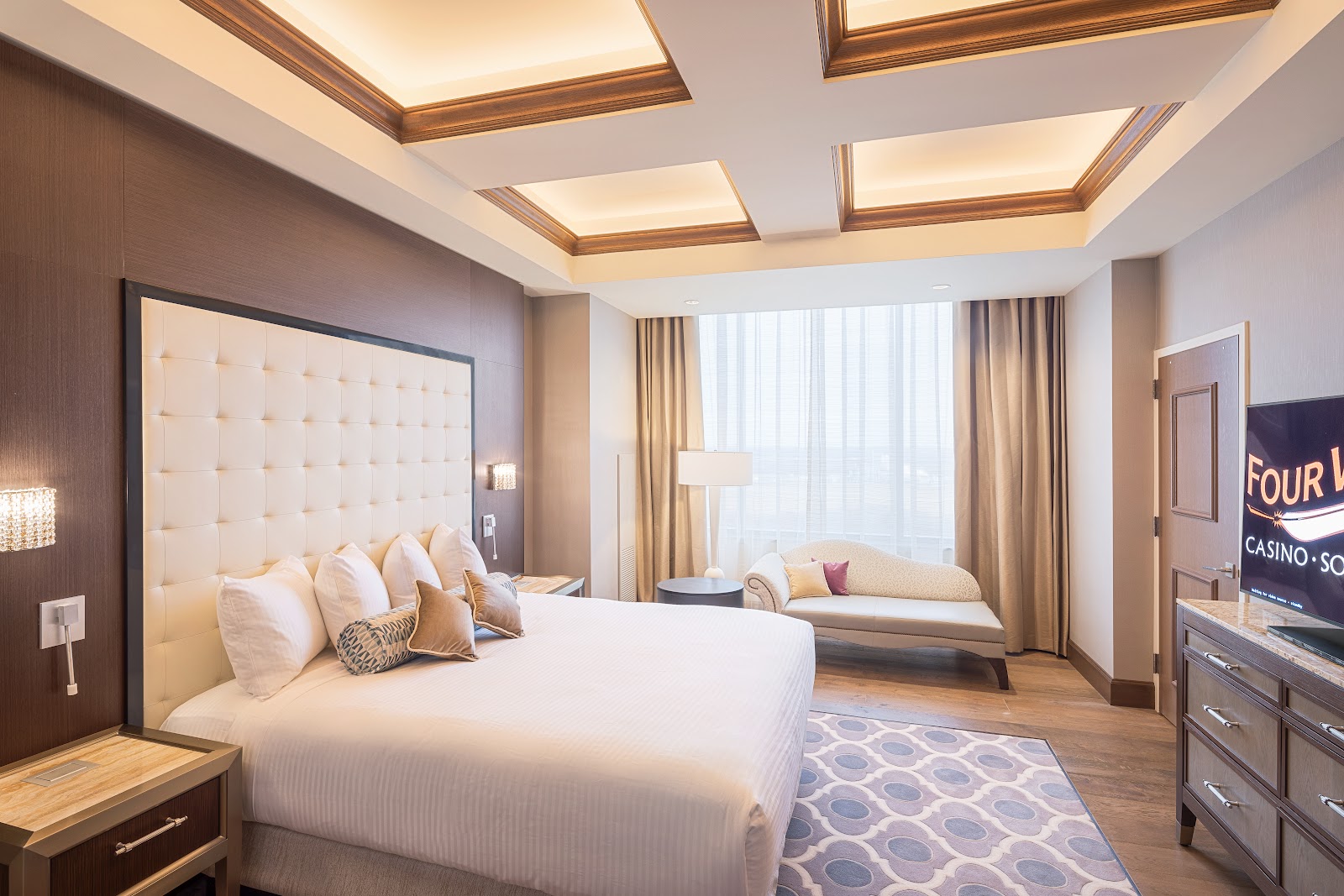
The fourth way out is to go outside, and it is the only place the day’s one unmovable frame exists. Because the public spaces have no windows, the building has no dusk crossing — that moment when interior and exterior sit at the same brightness, which at most venues is the best picture of the evening. Here it exists only outdoors and in a guest room.
The two exterior windows are the last hour of daylight, which rakes any facade and makes its material read, and the twenty-five to forty minutes after sunset, when the sky still holds colour while the building’s lighting comes up so one exposure holds couple, building and sky.
And this is where the gift pays for the problem: since the interior does not change, nothing indoors is lost by leaving for fifteen minutes. That is worth saying to a couple explicitly, because a request to step out of the reception sounds larger than it is — ten minutes at the right time is the difference between having the picture and not.
The transitions are the last thing worth using rather than losing. A corridor gives depth and repetition, with a subject at the far end sitting against a background that darkens by itself — the cheapest separation available in any building. A doorway frames. A stair gives elevation, a line for a descent and rows of faces rather than the backs of heads, and it wants light from one side because overhead light on a stair shadows every eye socket at once.
Working those requires a configuration that is already correct — a fast lens, a known ISO, a gelled source on a bracket or in a hand — rather than a setup rebuilt at each stop. In a building where spaces can be some distance apart, the rebuild costs more than the walk.
And separation is the underlying task in the pale function spaces: distance between subject and background, the darker end of the room rather than the bright end, depth behind rather than a near wall, and a source brighter on the face than the room is on the wall.
- Direction, not brightness — one source off-axis fixes every face at once
- Test bounce on arrival; low casino ceilings usually return something usable
- Ask for coloured accent lighting off for ten minutes
- Ask the guest room’s orientation; north is shaded all year at this latitude
- Protect the crossing outdoors; the interior costs nothing to leave
Outside, and Indiana's year
South Bend has one climatic feature that changes what a photographer should expect for months at a time, and it is worth knowing before a winter date is chosen: the city sits in the lake-effect snowbelt southeast of Lake Michigan.
The mechanism is straightforward. Cold air crossing relatively warm lake water picks up moisture and drops it downwind, which means substantially more snow than places at the same latitude away from the lake — and, more importantly for photography, persistent overcast. Winters here are among the cloudiest anywhere in the country outside the Pacific Northwest.
That is genuinely good rather than merely tolerable. Overcast is the best soft source there is, which means a guest-room window on a grey January day gives even, shadowless, flattering light with no direct-sun problem at all — and the question of which way the room faces stops mattering, because on a grey day every window is a north window.
Snow compounds it. Snow turns the ground into an enormous reflector, so a guest-room window in February is brighter and softer than the same window in June, with light arriving from below as well as above so facial shadows nearly vanish. In a building whose only daylight is those windows, that makes February the month the venue performs best.
Outdoors, snow is the best natural fill available, lifting exactly the shadows a low sun carves while fooling a meter by about two stops toward underexposure — so a snow frame needs deliberate overexposure relative to what the camera suggests. And a lit facade above snow at dusk is a strong exterior frame.
The short December day is the real winter constraint: at this latitude sunset falls in the middle of the afternoon, which compresses the outdoor block into a couple of hours and means the positions should be decided in advance rather than explored. At a venue where every indoor frame is movable, that is entirely manageable as long as it is planned.
Summer is hot and genuinely humid, and the humidity rather than the heat is the photographic fact: moist air scatters light, which softens shadows and slightly flattens distance — good for faces, less good for long views. Severe afternoon thunderstorms are a real possibility from late spring onward, which at an entirely indoor venue costs a decision rather than a picture.
The humid fogging problem is the equipment issue that matters most here, and a casino makes it worse because the floor is cooled hard for full occupancy: a body carried straight out into July air fogs on every surface at once and does not clear quickly. Opening a bag twenty minutes before going out rather than at the door is the whole fix — and at a venue whose one unmovable frame is a timed crossing, a fogged lens means missing it.
Autumn is the best exterior light of the year: the humidity drops, the air clears, the deciduous cover turns, and low sun arrives at a civilised hour, usually mid-to-late October.
More frames from The Four Winds Casino
The Four Winds Casino wedding photography: common questions
What is the central problem?
No daylight at all in the public spaces. Every indoor frame is made with installed light, and the building has no dusk crossing of its own.
What is the gift?
Nothing changes. Every indoor frame is movable, so the running order can follow the couple — and stepping out for the one timed window costs nothing.
Why does bounce flash work here?
Because casino floors run a great distance with a ceiling only three or four metres up, which is unusual for spaces that size. Test it — a dark ceiling absorbs.
How much light should be added?
Half a stop to a stop above the ambient. The ambient is already filling; anything more and the room disappears.
Which guest room should be requested?
North-facing is shaded all year at this latitude and is the most reliable. A south-facing room is a low directional source through a winter afternoon.
When does the venue perform best?
February. Persistent lake-effect overcast plus snow turns every guest-room window into a large soft source with light coming from below as well as above.
More Indiana venue guides
We are writing a photographer’s guide to every venue we would happily shoot in Indiana. Here are three more, plus the full index:
- The Morris Performing Arts Center, South Bend: A Walk Through a Historic Theatre
- The Oliver Mansion, South Bend: A House Built Before Electric Light
- The Studebaker Mansion, South Bend: The Light Through a Day
Planning a wedding at The Four Winds Casino?
No clock indoors, one frame outside. Tell us your date and we will protect it.