 The Whitby, New York: A Walk Through a Midtown Hotel
The Metropolitan Museum of Art: Photographing a Very Large Museum
At this scale the question is not which room is best but how far apart the good rooms are.
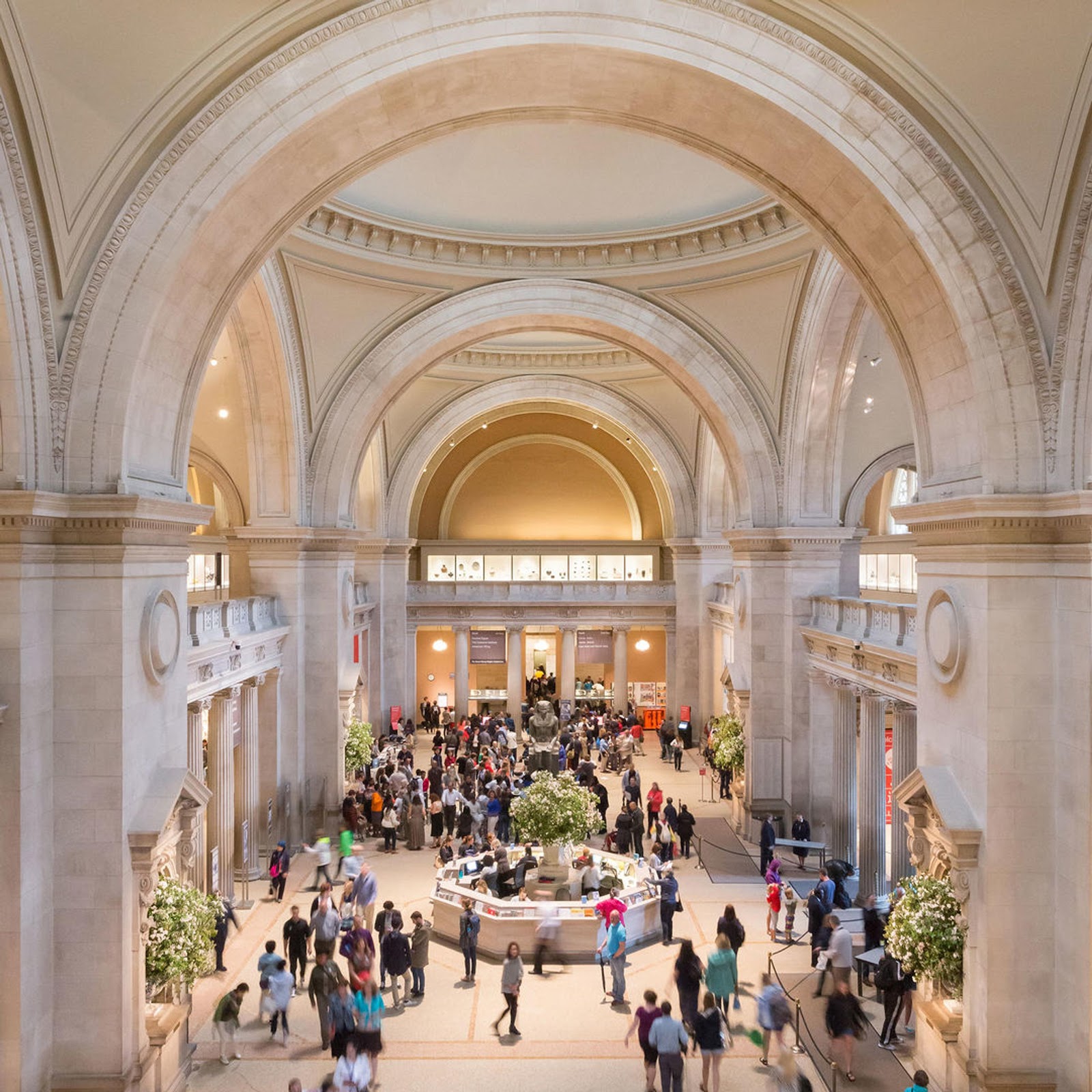
The Great Hall, with its majestic arches and bustling atmosphere, could be a spectacular setting for candid moments of guests mingling, as the venue’s own material puts it.
Bustling is the word worth pausing on, because it points at the logic of a museum this size. The Met is not a large venue but a very large one, and at that scale the governing facts are different in kind rather than in degree. Distances between spaces are measured in minutes rather than paces. The public areas are genuinely public, with visitors present in numbers that no amount of waiting will clear. And there are more good rooms than any single day can use, which means the risk is dilution rather than scarcity.
So the logic is a route and a short list, not a shot list — and within that, the Great Hall is the venue’s own nomination and the right place to build around, because it is generously lit, monumental, symmetrical, and holds nothing light-sensitive.
This follows the venue’s own logic. We have not photographed a wedding at the Met; very large museums behave consistently. Which spaces a booking includes, how long it takes to move between them, whether photography is permitted in galleries, and whether stands and flash are permitted are the questions for their team — and at an institution of this scale all of them will be answered precisely and firmly.
The Metropolitan Museum of Art at a glance
| Where | New York, New York |
| Character | A very large art museum with a monumental Great Hall and many wings |
| The logic | A route and a short list, because distances are measured in minutes |
| The best room | The Great Hall — generously lit, symmetrical, no conservation limit |
| Ask first | Spaces included, travel time, gallery photography, stands and flash |
The Great Hall, and what it needs
A monumental museum hall of this kind holds nothing light-sensitive, which is the reason it is generously lit and the reason it is the best room in the building. It is tall and arched, so the composition has ready-made geometry; it is symmetrical, so a centred frame is half made before the camera is raised; and it is finished in pale stone, which reflects and raises ambient across the whole volume.
The light arrives largely from above, through high openings or a lantern, which makes it soft and even and the same everywhere — so groups are easy and position barely matters. The cost is the usual one: eye sockets darken and a line marks under the nose on everybody in the frame. A reflector held low, a lifted chin, or one small source at face height fixes it, and in a hall this size a reflector is often easier to place than a light.
Exposure needs a deliberate correction, because pale stone and a bright upper volume fill most frames and push a meter towards underexposure. Add a stop or more, exactly as for snow, and check the stone still holds texture rather than clipping to blank cream.
Pale stone also bounces neutral-to-cool light, which renders skin slightly grey in flat conditions — so a warm reflector or a warm-gelled source is worth carrying specifically for a building like this.
Symmetry rewards precision and punishes near-misses. A frame centred on an arched axis collapses if the camera is off centre or a degree out of level, because the arches stop being symmetrical and the whole composition reads as careless. Level with the electronic level, and either centre exactly or step clearly to one side.
The arches themselves are worth using rather than merely including: an arch is a frame built into the architecture, and placing a couple within one — rather than in front of a wall beneath it — gives a composition the building supplies for free. And pointing the camera up once, at the vaulting or the lantern, is worth a minute for a frame almost nobody takes.
The crowd is the Great Hall’s defining practical condition and it cannot be waited out. The tools are long lenses, which compress and blur a moving crowd into unreadable tone; tight framing, which excludes; and low angles, which put more architecture and less floor in the frame. And a crowd used deliberately — a couple still while people move around them at a slow shutter speed — is a genuinely good frame and specific to a place like this.
The stairs, the galleries, and the route
A grand staircase is the second space worth building around and it solves the group problem that museums otherwise handle badly. Steps make rows automatically, so thirty people arrange themselves with everybody visible where no gallery floor will — and almost every group photograph in a building like this belongs there.
It also gives three genuinely different frames: from the bottom looking up, from the top looking down with the couple small inside the sweep, and from a landing level with them. The one from the top is most often missed because it means climbing, and in a building this size climbing is not a trivial decision — which is exactly why it should be planned rather than left to chance.
Galleries are the part to plan around rather than into. Conservation caps the light two or three stops below comfortable; display fittings aim down from the ceiling at works, which darkens eyes and draws a hard line from the nose; and museum fittings are frequently narrow-spectrum, chosen for low ultraviolet output rather than colour rendering, which renders skin sallow or plum even at technically correct white balance. No adjustment recovers a wavelength that was never emitted.
Where photography is permitted at all, keep any added light small: a gridded source on the couple alone, spilling onto nothing, about a stop under a correct reading for the room. A dim gallery with a small pool reads as atmospheric; flooded, it reads as a lit room with pictures in it, and it is also the version most likely to breach the rules.
Artworks behind people need the standard decision — commit to one deliberately so both read, or subordinate everything with a long lens at a wide aperture. Half-in fails, and a large saturated work throws its own colour onto a nearby face.
The route is the thing the scale makes non-negotiable. In a museum this large, moving a wedding party between two wings can consume fifteen minutes each way, and three such moves swallow an hour of coverage. Two spaces plus the Great Hall is a full day; five spaces is a day spent walking.
So the useful preparation is a walk of the route in advance, with a stopwatch rather than an impression, and a short list of three or four positions with the frame each one gives. Four known positions beat an hour of exploring anywhere, and in a building of this size they beat it by a much wider margin.
And the permissions question is more extensive here than at a smaller institution: whether photography is permitted, whether stands are permitted, and whether flash is permitted are three separate questions with three possible answers, and works on loan may carry conditions of their own. All of it belongs in writing before a schedule exists.
- Add a stop or more in a pale stone hall, and carry a warm gel for it
- Place the couple inside an arch, not in front of the wall beneath it
- Long lens and low angle to handle the crowd; it cannot be waited out
- Put the group on the stairs, and plan the frame from the top
- Walk the route with a stopwatch; two spaces plus the hall is a full day
Outside, and New York's year
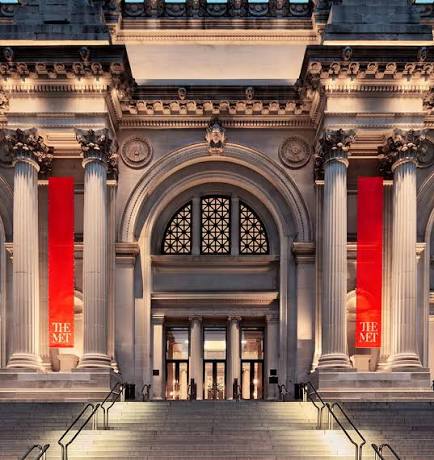
Outside, New York imposes a constraint that is the exact opposite of most cities in this series: there is no room to stand back. A monumental facade cannot be photographed whole from across a street that is narrower than the building is tall, which means the exterior frames are fragments, details and looking up rather than establishing views. That is worth accepting rather than fighting: a couple at the foot of a column, a flight of steps receding, a cornice against sky — those work, and the wide view does not exist.
Museum steps are the exception and the exterior’s best asset. A monumental flight gives elevation, tiers for a group, and a stone background, and it is the one place outside where a large group can be arranged properly. It is also public, which means other people, so early is quieter than late.
Manhattan’s street grid is rotated about twenty-nine degrees from true north, which has a practical consequence worth knowing: the cross streets run roughly east-north-east to west-south-west, so low sun runs down their length while the avenues stay in shadow. That alignment is close to exact only around the ends of May and the middle of July, which is when the effect is strongest — but for most of the year the cross streets remain the ones that take low light and the avenues the ones that do not.
Most street-level light in Manhattan is therefore bounced down from lit facades above rather than direct, which is soft, directional and available for much of the day. It is genuinely good portrait light and it is not golden-hour light — the distinction is worth making in advance, because a couple expecting raking sun on a cross street in October will be disappointed and a couple expecting soft even light will not.
Glass towers add a specific effect: a facade catching low sun reflects it down into a street as a moving patch of hard light, which appears and disappears as the sun moves. Those patches are usable and unpredictable, and worth watching for rather than planning around.
Central Park is the other nearby asset where a museum adjoins it: mature canopy in the middle of the city, which gives continuous shade in summer and genuine colour in late October. Dapple is the hazard as always — hot spots several stops above the surrounding shadow, shifting with any breeze — so full shade, open light, or wait. And a park in New York means permits and people, both of which need establishing rather than assuming.
New York’s seasons are four real ones. Summer is hot and humid with afternoon thunderstorms a real possibility, which for a very large museum is entirely an advantage indoors. Autumn gives the clearest air and the best light of the year. Winter is cold with short days, sunset in the middle of the afternoon in December, which compresses the outdoor window — and snow turns a street into a very large reflector, so any window light arrives softer and more even than at other times.
The fogging risk applies in both directions in this climate, so let equipment come towards the temperature of where it is going before it gets there — and in a building this size, plan one outdoor excursion rather than several, because each one costs more walking than it would elsewhere.
More frames from The Metropolitan Museum of Art
The Metropolitan Museum of Art wedding photography: common questions
What is different about a very large museum?
Scale changes the logic in kind. Distances are minutes rather than paces, the public areas are genuinely crowded, and there are more good rooms than a day can use — so the risk is dilution.
Where is the best light?
The Great Hall. It holds nothing light-sensitive, so it is generously lit, and it is tall, symmetrical and pale-surfaced — soft even light where position barely matters.
How do you handle the crowd?
Long lenses to compress and blur it, tight framing to exclude it, and low angles to fill the frame with architecture. Or use it: a still couple with people moving at a slow shutter is a good frame.
What should the route look like?
Two spaces plus the Great Hall is a full day. Walk it in advance with a stopwatch, and leave with three or four positions and the frame each one gives.
Why can't you photograph the facade whole?
Because in New York there is no room to stand back — a street narrower than the building is tall makes a wide establishing view impossible. The frames are fragments and looking up.
What does Manhattan's grid rotation mean in practice?
The cross streets run roughly east-north-east, so low sun runs down them while the avenues stay in shadow. The alignment is closest around late May and mid-July.
More New York venue guides
We are writing a photographer’s guide to every venue we would happily shoot in New York. Here are three more, plus the full index:
- The New York Botanical Garden: Four Ways Out of the Scale Problem
- The New York Public Library: Photographing a Building Made of Marble
- The Peninsula New York: What It Suits, and What It Does Not
Planning a wedding at The Metropolitan Museum of Art?
A route and four positions beat a shot list here. Tell us your date and we will walk it.