 The House of Blues, Cleveland: What It Suits and What It Does Not
The KeyBank State Theatre, Cleveland: The One Decision That Governs Everything
A 1920s theatre has two great rooms and only one of them can be photographed properly.
The KeyBank State Theatre’s elegant, sweeping spaces envelop a couple in historic charm, as its own description has it — and the phrase points at the right room.
One decision governs the photographic day at a restored picture palace, and it is which of two great rooms leads. The auditorium is the more impressive space and the harder one: it was engineered so that when the house lights dimmed the architecture would recede, which means deep absorbing surfaces, an enormous volume with nothing reflective in it, and ornament that vanishes under flat overhead light. The lobby is the less obvious space and the better one: theatres of this era built their front of house as public theatre in its own right, with tall street-facing glazing, monumental stairs and ornament every bit as elaborate as the auditorium’s — several stops brighter.
Deciding in advance that the lobby leads and the auditorium supplies two or three specific frames produces a far better gallery than treating them as equals. Made the other way round, the day is spent fighting a room that cannot be lit.
We have not photographed a wedding at the State Theatre; restored 1920s theatres behave consistently. What the house lighting can be set to, whether the stage rig is available and who operates it, and where a photographer may stand are the questions for their team.
The KeyBank State Theatre at a glance
| Where | Playhouse Square, Cleveland, Ohio |
| Character | A restored 1920s theatre with an elaborate lobby and a large auditorium |
| The decision | Let the lobby lead; let the auditorium supply two or three frames |
| Why | The lobby has daylight and the same ornament; the auditorium eats light |
| Ask first | House lighting control, stage rig and operator, permitted positions |
Why the lobby is the better room
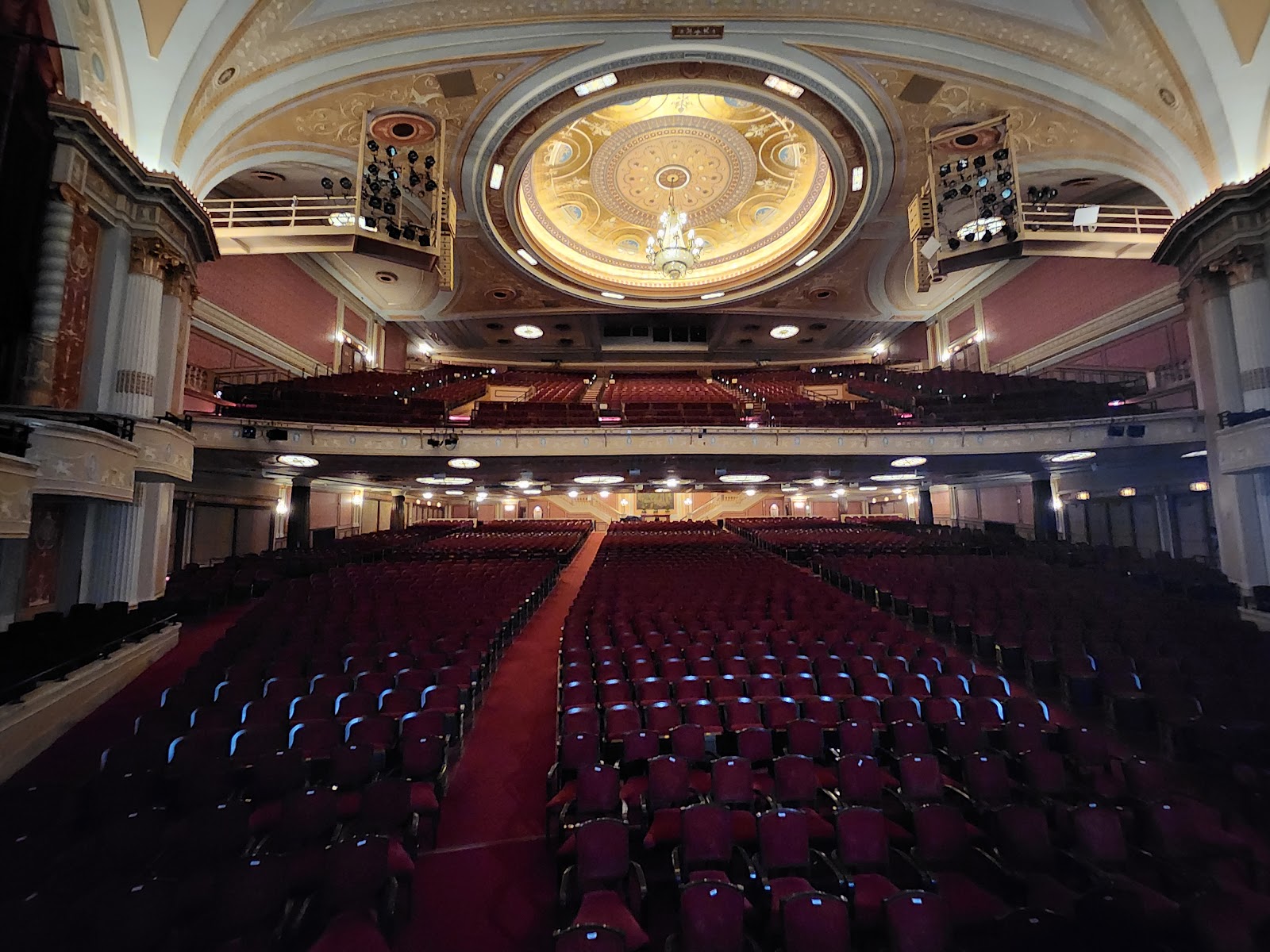
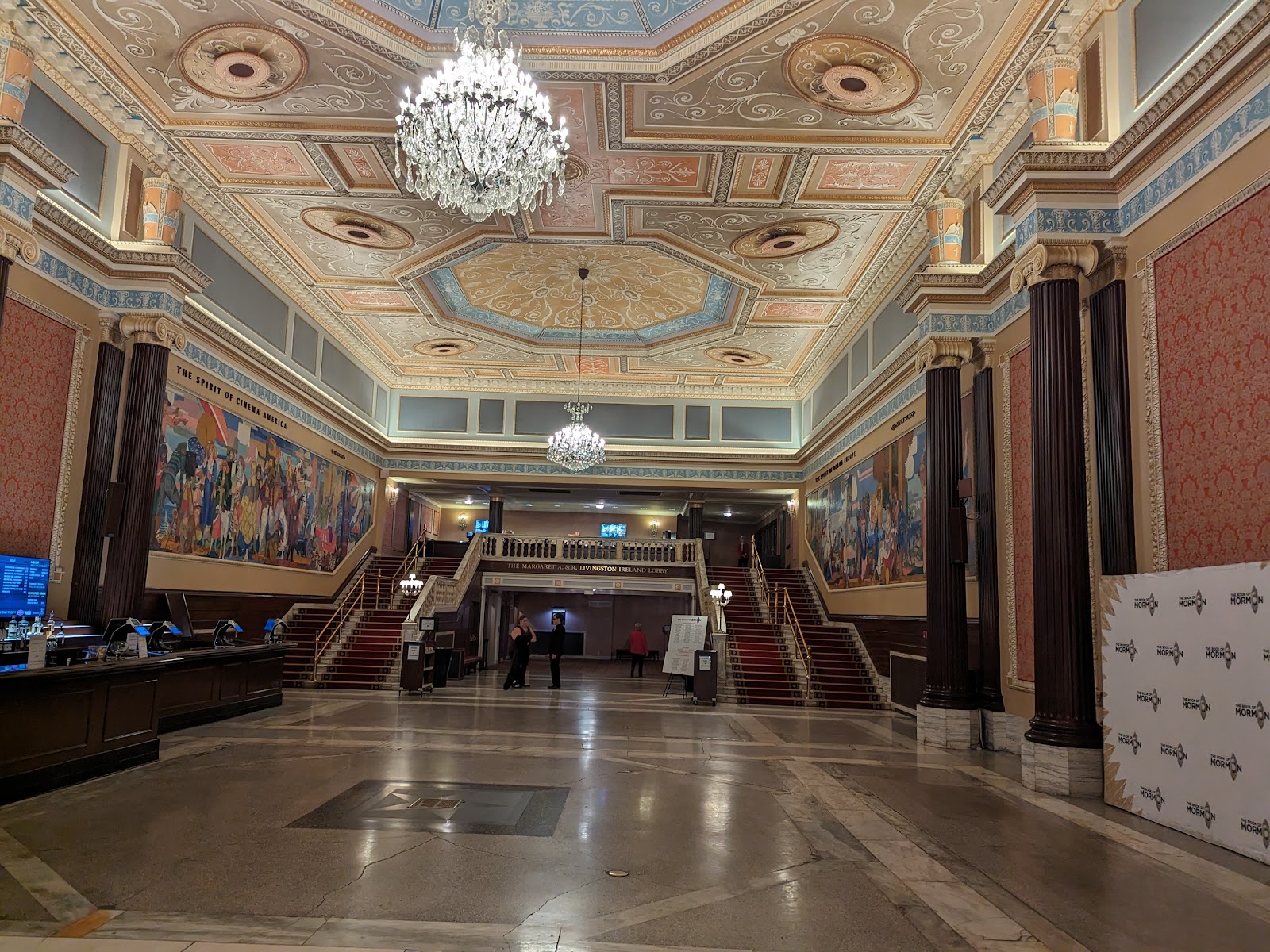
A 1920s theatre lobby was designed to be walked through and looked at before a performance, which means it has four properties that make it photograph well. It is tall, so a couple reads as small inside something large. It has tall street-facing glazing, which is the only daylight in the building. It has monumental stairs, which give elevation and make rows for a group automatically. And its ornament is concentrated where the eye travels — the ceiling, the doorcases, the stair balustrades — at the same standard as the auditorium’s.
The glazing is the decisive advantage. Tall street-facing windows put a broad soft key on anybody standing two or three metres inside them, which is architectural-scale lighting requiring no permission, no stand and no cable. Which elevation the front faces decides whether that light is soft all day or hard for part of it — and in Cleveland, one of the cloudiest major cities in the country, it is soft on the majority of days regardless.
The stairs solve the group problem that theatres otherwise handle badly. Steps make rows, so a group of thirty arranges itself with everybody visible, which no auditorium aisle or flat floor will do. And they give three genuinely different frames: from the bottom looking up, from the top looking down with the couple small inside the curve, and from a landing level with them.
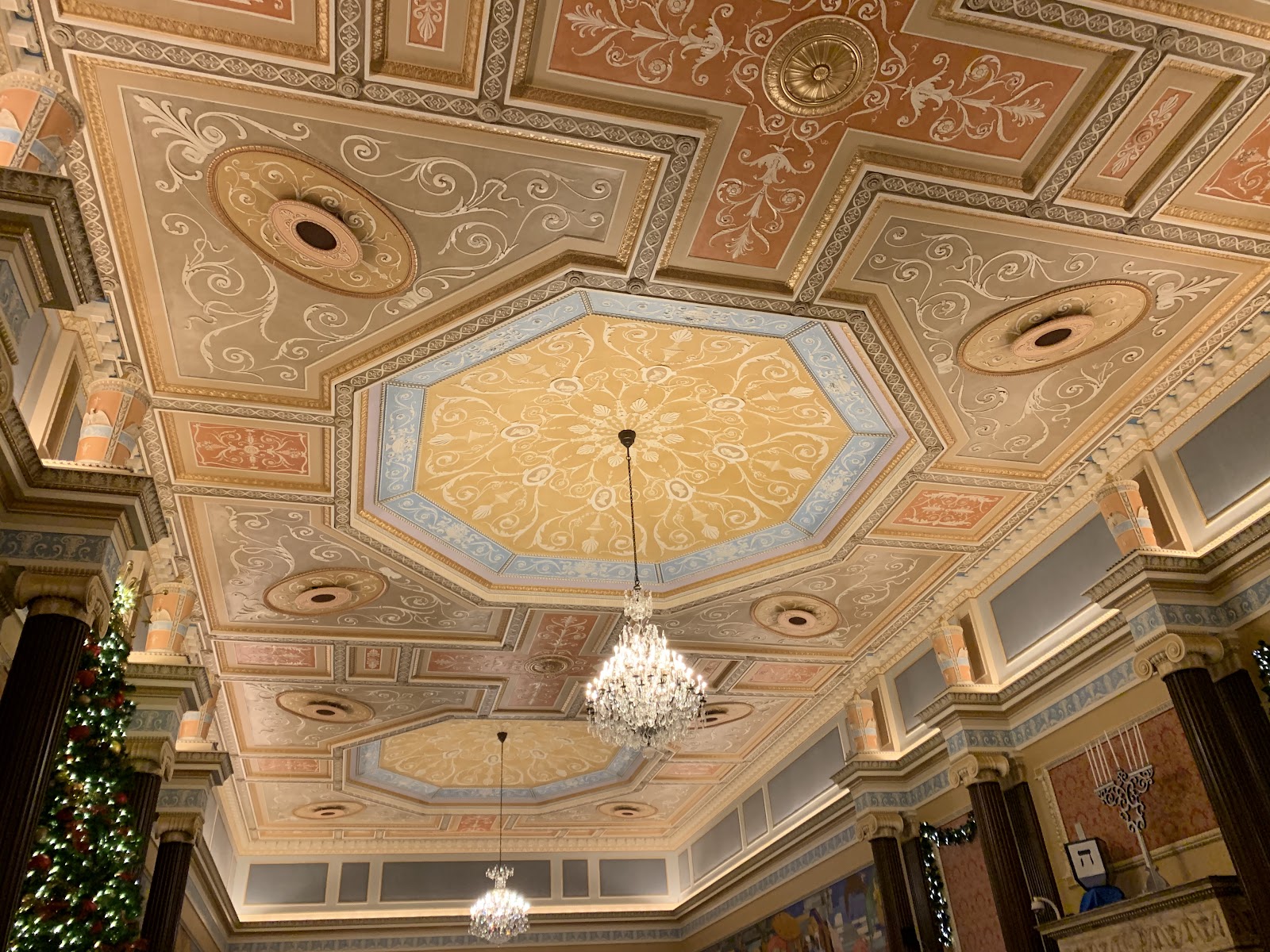
Ornament in a lobby needs the same treatment as anywhere: it is three-dimensional, so it reads only when light crosses it at an angle and casts small shadows. Under the flat downward wash most restored lobbies are lit with, elaborate plasterwork flattens into a pale field — and one source placed to graze a surface rather than face it brings it back. It is a one-light problem rather than a big-kit one.
Lobbies of this period are also often finished in strongly coloured marble, paint or gilding, which bounces its own colour onto nearby skin. Because the cast is localised, global white balance cannot separate it — so a custom white balance set on a face in the position being used, or one gelled source owning the faces, is the answer.
Ceiling height removes bounce in the taller lobby volumes, so test it with one frame on arrival and plan for a pale wall or direct modified light where it fails.
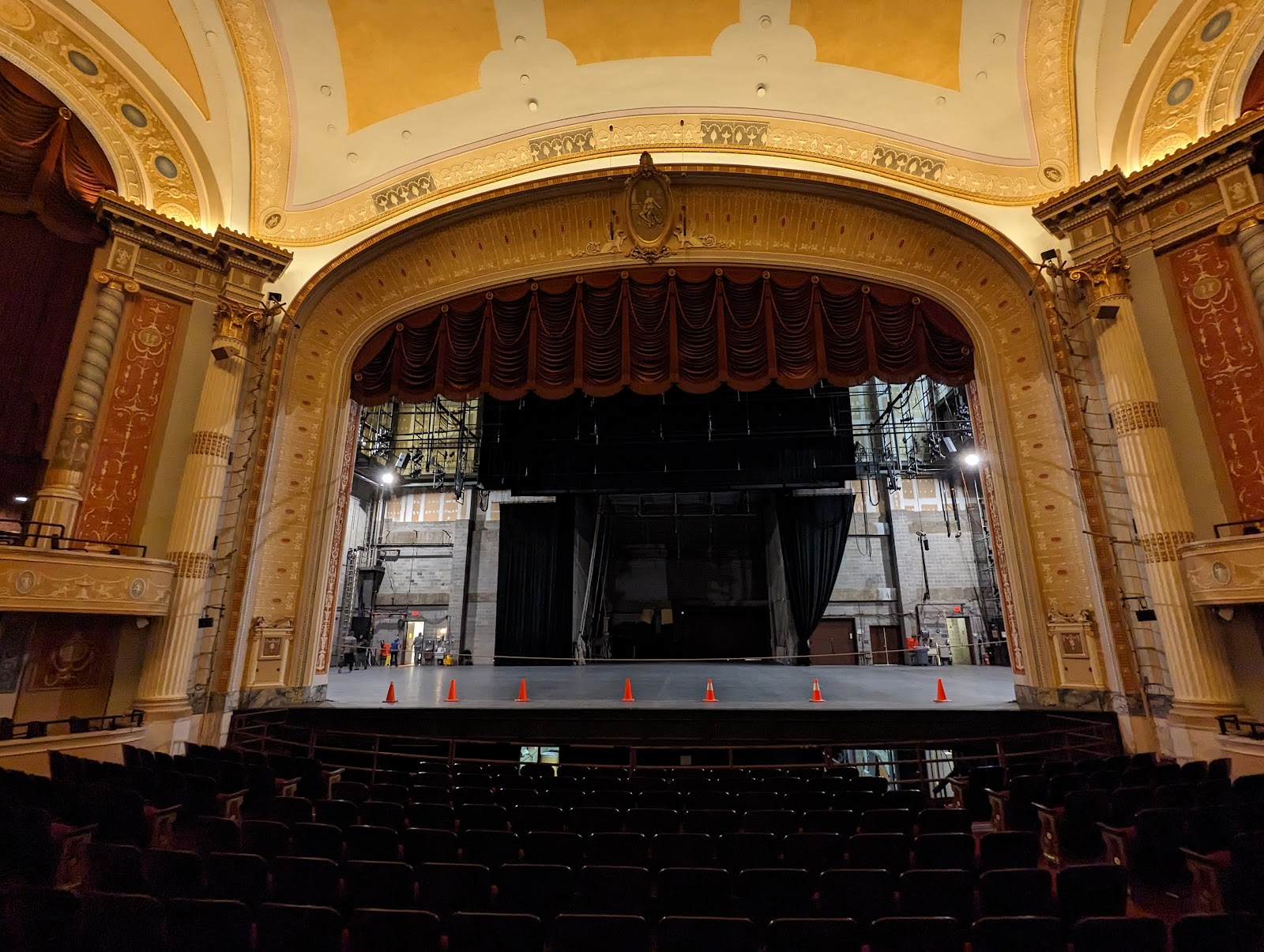
What the auditorium can give, in two or three frames
The auditorium is not unusable; it is a room that gives a small number of very strong frames and nothing else. Knowing which frames in advance is what makes twenty minutes there worthwhile.
The first is the long view down the house from the stage, or from a rear position towards it. Rows of seating receding into darkness are pure repetition, and the frame reads instantly as a theatre. It is symmetrical and axial, so it rewards precision: off the centre line by half a metre or a degree out of level and the convergence goes crooked. Level, centre exactly, and take the two minutes.
The second is a couple standing in a single pool of light on an otherwise dark stage, in front of an empty house. That is one of the strongest frames any venue type can produce, and it needs no equipment of yours — it needs a board operator, which is why the stage rig belongs in the contract rather than in a conversation on the night. Coloured washes are a separate matter: a saturated wash renders skin unrecoverably in its own colour, so under one either commit to shape and silhouette or add a neutral source on the faces and let the wash light the set behind.
The third is the ornament, grazed. A proscenium arch, a box front or a ceiling rose photographed with one source placed to one side reads as the elaborate object it is; photographed under the house wash it reads as a brown field. This is a detail frame rather than a portrait one and it is worth two minutes.
Beyond those, the auditorium resists for reasons worth naming once. Deep-toned surfaces absorb rather than bounce, so the ambient is far below what the fitting count suggests. The volume is beyond the reach of any flash, so bounce is unavailable and distance has to be assumed in every power decision. House lighting is low, warm and overhead, which darkens eyes and marks the line under the nose at a level that also forces a high ISO.
One warm-gelled source at face height, off the camera axis, exposed so the room still reads as the dim ornate space it is, covers everything else — the aim is a catchlight and a shoulder edge, not an evenly lit theatre. A theatre lit to an even brightness stops being a theatre. And the steep fall-off in a large dark room is free separation, which should be exploited rather than filled in.
- Let the lobby lead; its glazing is the only daylight in the building
- Put the group on the lobby stairs, and take all three stair frames
- Graze the ornament with one source, in both rooms
- Know the auditorium’s two or three frames in advance; twenty minutes is then enough
- If the stage rig is available with an operator, it beats anything you carry
The marquee, the street, and Cleveland's year
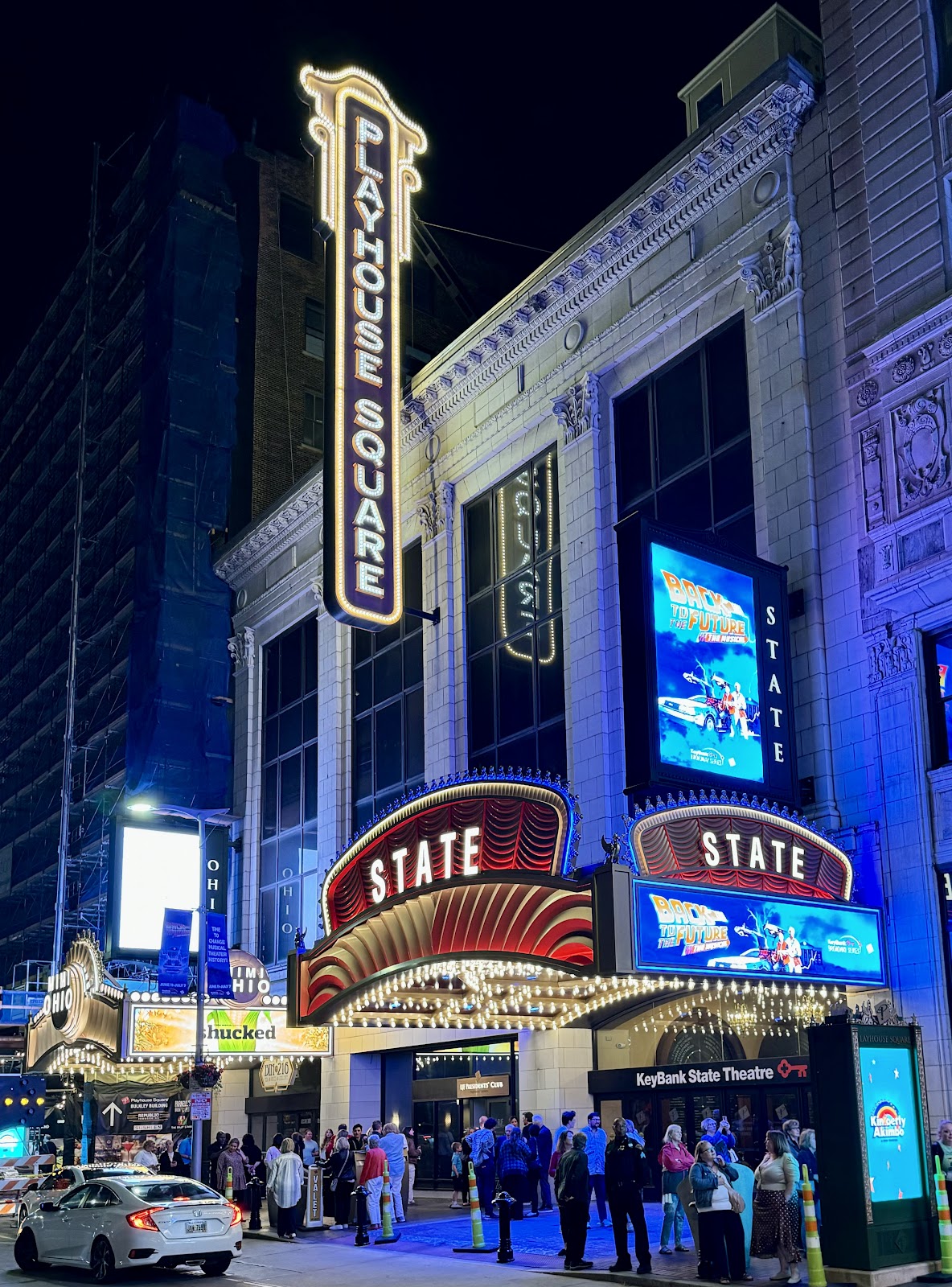
A theatre of this era has one exterior frame no other venue type offers and it is time-critical. A lit marquee against a sky that still holds colour is the image the building type is known for, and it exists only in the twenty to thirty minutes after sunset — before that the sign is invisible against a bright sky, and after it the sky is black and the frame becomes a lit sign floating in nothing.
The reason is a brightness comparison: a marquee is several stops dimmer than a daylit sky and brighter than a night street, so only during the crossing do both sit inside one exposure. Take the sunset time, add fifteen minutes, be standing in the street with the couple already there, and bracket a sequence as the sky falls.
It also needs confirming that the marquee will be lit, which outside performance hours is a request rather than a given — and it is the single question that determines whether this frame exists at all.
In a theatre district there may be several lit signs and facades at once, which is an advantage: a street of marquees gives a background of layered light that a single theatre does not, and a long lens compresses them into bands behind a couple.
At street level, Cleveland’s older commercial fabric is brick and stone at a largely low-rise scale, which means low sun reaches street level and runs the length of a block. Both materials show their texture only when light runs along them, so a short walk to find which side is being raked is worth more than any accessory. Alleys are the most dependable positions, giving directional light from walls on both sides and a contained background.
Cleveland’s weather is largely helpful for a sealed theatre and one thing it is not. Persistent overcast through much of the late autumn, winter and spring — this is one of the cloudiest major cities in the country — makes the lobby’s tall glazing soft and even on the majority of days, which is a real advantage for the room that leads the day.
The sealed auditorium means the interior day is entirely unaffected by weather, which is the practical argument for a theatre in this city. The only casualty is the marquee frame, which needs a sky — so on an unsettled evening it is worth taking early and taking twice.
Lake-effect snow in winter is localised, sudden and heavy, and it is a logistics question for guests as much as a photographic one. It is also the best natural fill there is, lifting exactly the shadows a low sun carves while fooling a meter by about two stops — and snow falling through the light of a lit marquee is one of the best frames a theatre district can give. Winter days are short, with sunset in the middle of the afternoon in December, which moves the marquee window early. And a heated lobby with cold street air fogs a lens in both directions, so let a body reach ambient before the marquee window rather than carrying it out cold.
More frames from The KeyBank State Theatre
The KeyBank State Theatre wedding photography: common questions
Why should the lobby lead?
Because it has the only daylight in the building, tall glazing, monumental stairs and ornament at the same standard as the auditorium — several stops brighter.
What does the auditorium actually give?
Two or three strong frames: the long view down the house, a couple in a single pool of stage light before an empty house, and the ornament grazed. Nothing else.
Why does the auditorium eat light?
Deep absorbing surfaces, a volume beyond the reach of any flash, and house lighting that is low, warm and overhead — which darkens eyes while forcing a high ISO.
Is the stage rig worth asking for?
It is the biggest single question. A pool of light on a dark stage with a couple in it beats anything you can carry, and it needs a board operator rather than equipment.
When can the marquee be photographed?
Twenty to thirty minutes after sunset, and only then. Before it the sign is invisible against a bright sky; after it the sky is black and the frame is a sign in a void.
Does Cleveland's cloud help?
For the lobby, considerably — persistent overcast makes its tall glazing soft and even on the majority of days. The sealed auditorium is unaffected by weather entirely.
More Cleveland, OH venue guides
We are writing a photographer’s guide to every venue we would happily shoot in Cleveland, OH. Here are three more, plus the full index:
- The Lago Events Center, Cleveland: A Walk Through a Glazed Event Venue
- The Music Box Supper Club, Cleveland: How the Light Moves
- The Rock & Roll Hall of Fame, Cleveland: A Walk Through the Building
All Cleveland, OH Wedding Venues →
Planning a wedding at The KeyBank State Theatre?
Let the lobby lead and know the auditorium’s frames. Tell us your date.