 Indianapolis Zoo: Reading a Day From Open Grounds to Underwater Glass
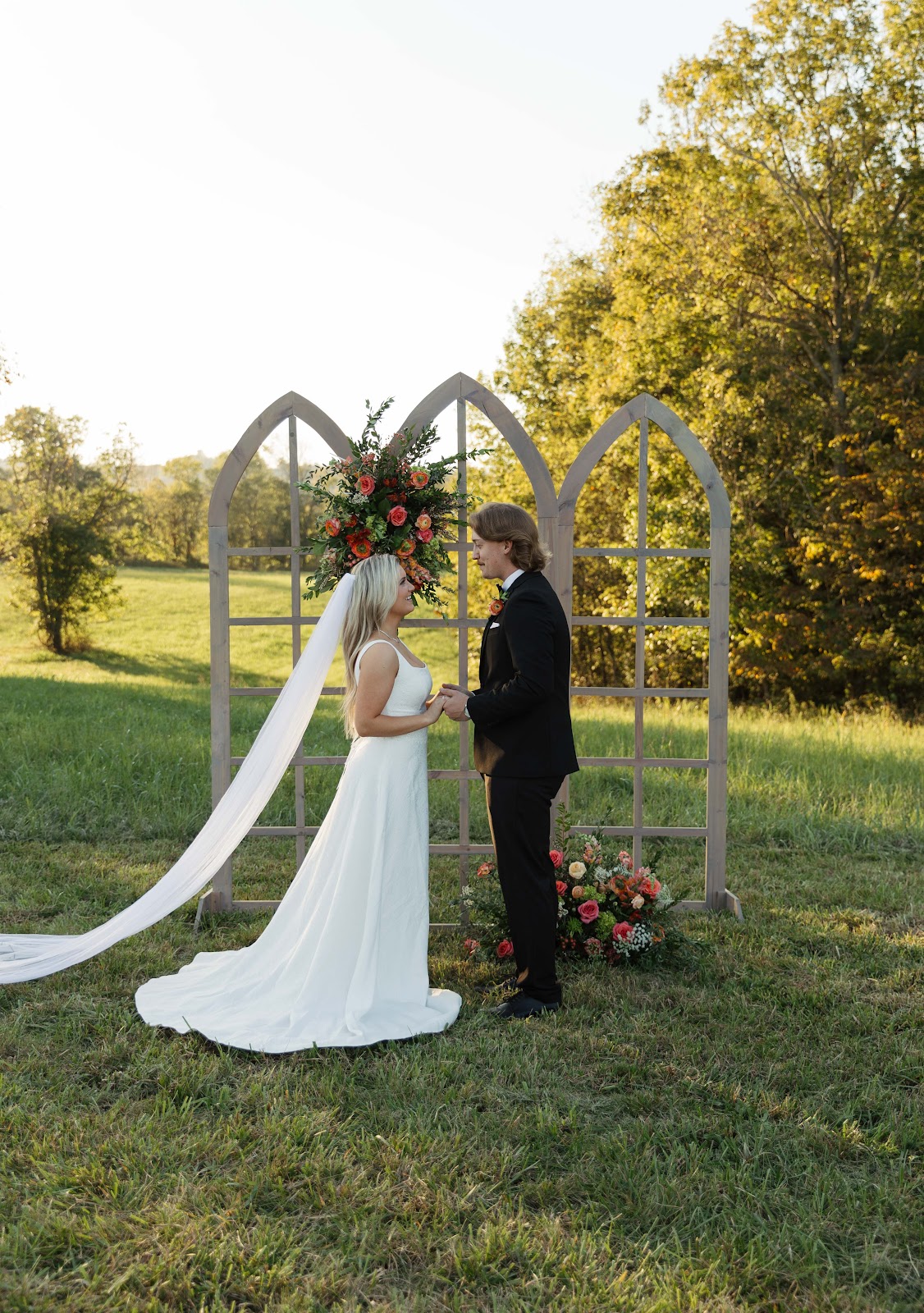
The Riverbend Barn, LaPorte: A Walk Through the Site
A bend means the water faces more than one way. That is the whole advantage.
The useful way to describe this site is to walk it, and the element worth walking to is the bend.
A straight stretch of river faces one way. A bend faces several — which means that within a few hundred metres of shoreline there is a section that takes the morning light, a section that takes the evening light, and sections in between that are in shade when the others are lit.
That is a genuine and unusual advantage. At a lake or a coastal venue the shore’s orientation is fixed, and it decides whether sunrise or sunset is over the water. At a river bend both are available, and the only question is where along the curve to stand.
The rest of the site is what northwest Indiana farmland is: rolling glacial moraine ground with deep soil, large fields, conifer windbreaks along the boundaries, and a barn. LaPorte sits inland of Michigan City, close enough to Lake Michigan for the lake to shape the weather in every season.
The walk runs barn, fields, windbreak, river — from the most controlled light to the least — and each stage does a different job.
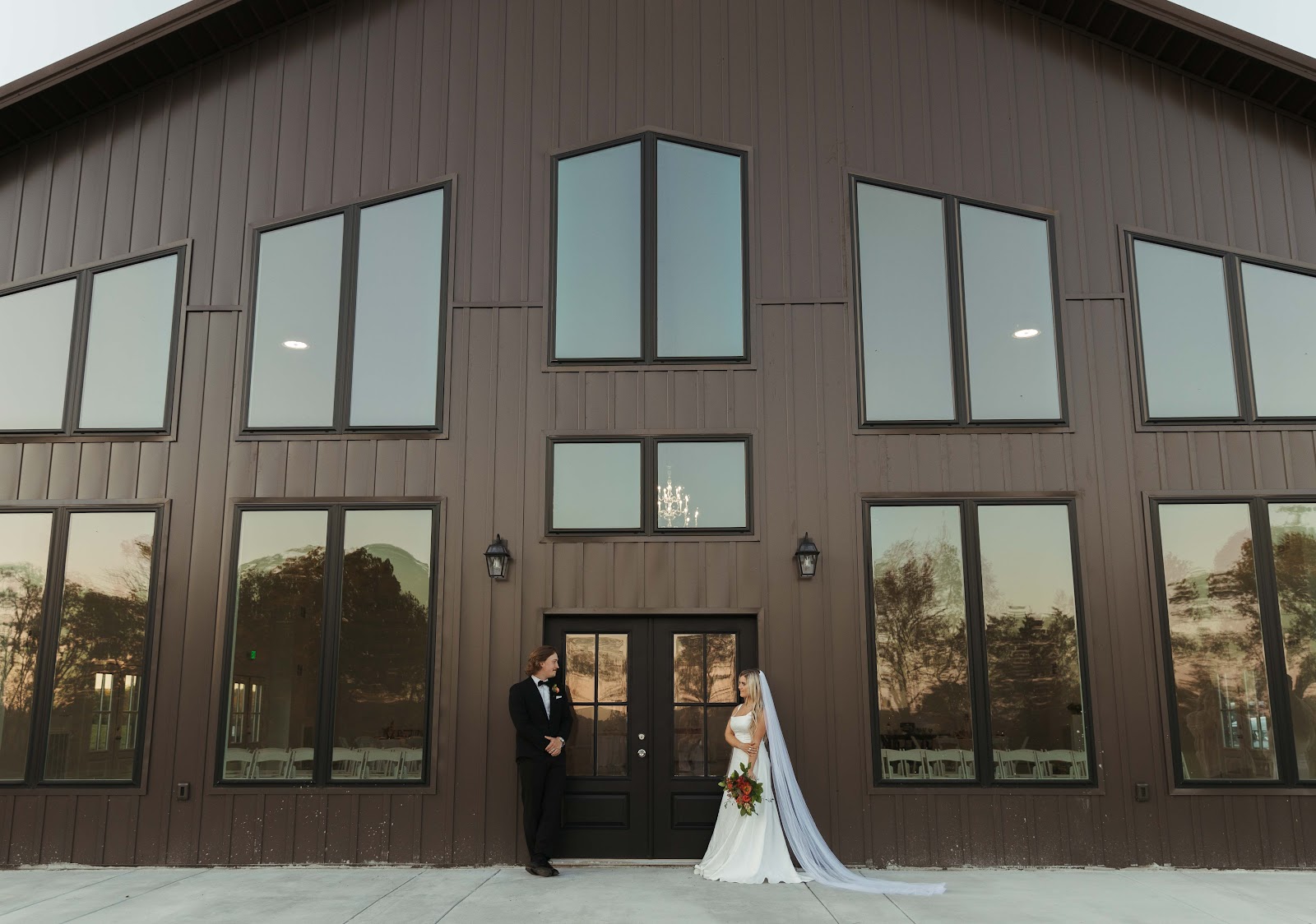
The barn is the light: a dark volume with a few very bright openings, which is what a studio is, and it works in any weather. The fields are the scale and the sky. The windbreak is the separation: a hundred metres of near-black conifer wall with a usable edge along all of it. And the river is the variety, because a bend gives what a straight shore cannot.
LaPorte sits at about forty-one and two-thirds degrees north. The June noon sun reaches around seventy-two degrees, the December noon sun about twenty-five, days run from about nine hours five to fifteen hours fifteen, and civil twilight is around thirty-one minutes.
We have not photographed a wedding at this venue. Which spaces and grounds are included, what access there is to the river, what covered alternatives exist and what the permitted hours are, are questions for their team.
The Riverbend Barn at a glance
| Where | A barn venue on a river bend near LaPorte, northwest Indiana |
| The advantage | A bend faces several ways — both sunrise and sunset over water are available |
| The sequence | Barn (light), fields (scale), windbreak (separation), river (variety) |
| The lake | Lake Michigan nearby shapes the weather in every season |
| Ask first | Included grounds, river access, covered alternatives, hours |
The barn, the fields and the windbreak
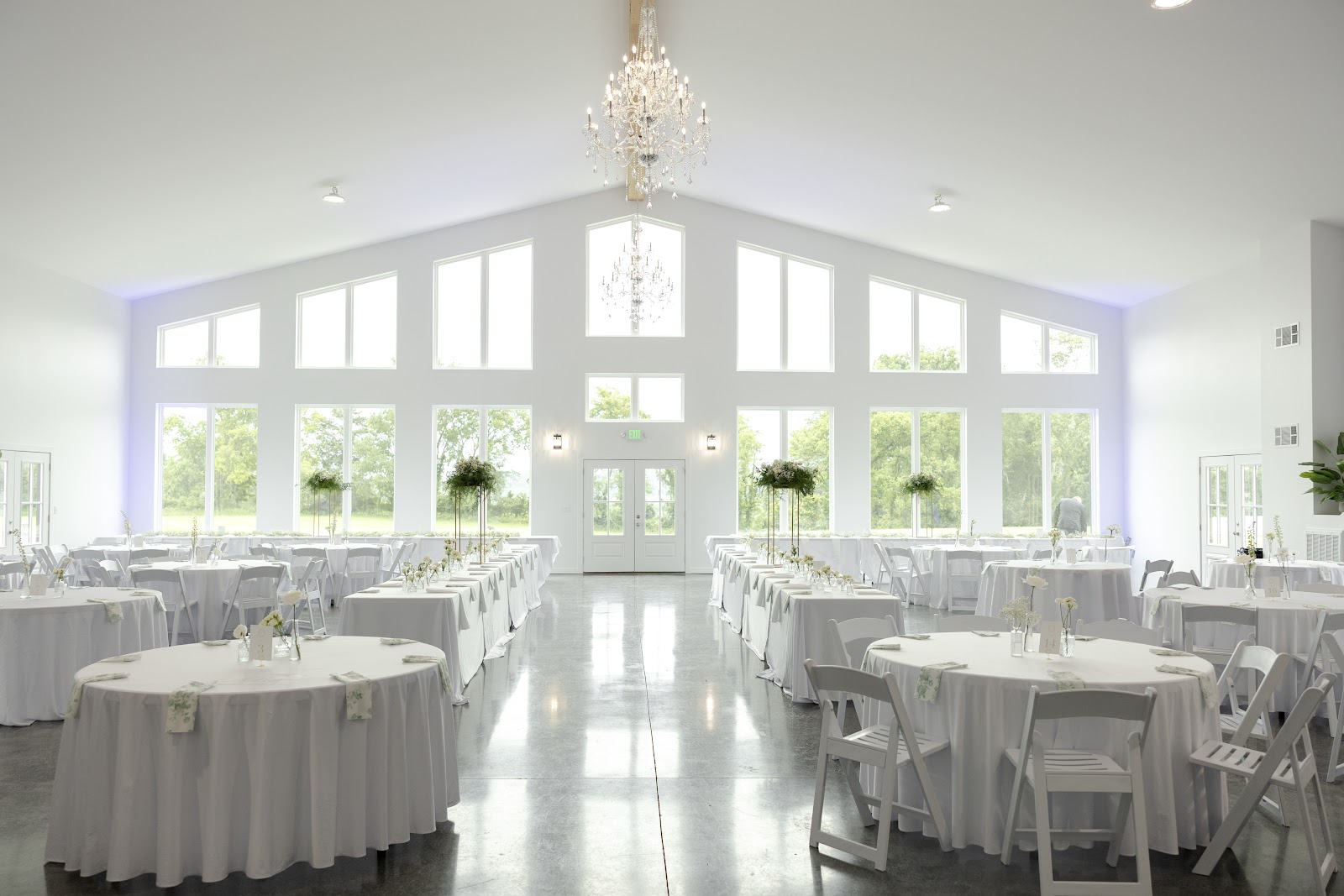
Start in the barn, because it is the most controlled light on the property and the only element that does not depend on the weather.
The main doors are the strongest light and depth back from them is the whole control. At the threshold the light is bright and nearly frontal and the result is flat; a metre in it acquires direction; three metres in the ratio is dramatic and the interior behind has fallen four or five stops. Deciding that depth deliberately, rather than standing where the party has stopped, is the single most useful thing anyone does inside a barn.
Opposing doors are the specific gift: a subject lit from the near one and backed by the blown rectangle of the far one gives key light and rim light in one frame, with no equipment. Both doors have to be open, which is worth asking for.
Board gaps produce hard parallel stripes across the interior when there is direct sun outside. Behind and around a subject they are structure; on a face they are unusable. Stand the subject in a shadow band and let the pattern fall behind them — and remember that the angle changes through the day and the contrast collapses under overcast, so the effect is a timed one.
Meter on skin, never on the scene: a camera reading a dark barn with a bright doorway overexposes everything that matters. And set a custom white balance on a face in the position being used, because aged timber biases warm and warms further with depth.
Then the fields. Open ground on rolling moraine gives long sightlines, a low horizon and a great deal of sky, which makes it group ground and low-camera ground. What the sky is doing matters more here than at a venue with relief: a clear blue sky is even and featureless, a structured convective sky is the best background this landscape ever has.
In summer a standing crop is a wall rather than a floor — eight feet or more of dense green, tall enough to fill the frame behind standing subjects, uniform enough to be a clean background, and moving in any wind. Its limitation is that it is green, and skin sits close to green in luminance and complementary to it in hue.
Row geometry matters: straight down a row gives a corridor, square across gives a rhythm of stems, and any angle between gives converging clutter. Use it or avoid it; do not drift into it.
Then the windbreak, which is the most under-appreciated element on any moraine farm. A planted row of spruce or pine along a field boundary is a hundred metres or more of dense near-black vertical wall, and that is one of the best backgrounds available anywhere.
Its value is the length as much as the darkness. A single tree gives one position; a windbreak gives fifty — which means the same excellent light, soft and directional from the open field with three or four stops of dark behind, is available with many different foregrounds and at many different angles to the sun.
The position is a metre inside the edge, facing out toward the lit field. Not deeper, where the light falls away; not at the very edge, where the background is not yet dark. And the line itself — bright field meeting near-black conifer — is the best single compositional element on a farm of this kind.
The bend, and working it
The river is the last stage of the walk and the bend is what makes it worth the walk.
Establish the geometry first: which way each section of the curve faces. That takes five minutes with a compass or a phone and it determines the whole plan for the ends of the day, because a bend means the morning frames and the evening frames belong to different parts of the same shoreline.
A section facing east takes the sunrise over the water: a low warm sun coming straight off the surface into the subjects’ faces, with the water lit and the bank behind them in shade. A section facing west takes the sunset the same way. And the sections in between are in shade while the others are lit, which gives the twice-daily gift at close range: a subject standing in even shade on the shaded bank with a brightly lit far bank behind them.
That last frame is the easiest good picture a river gives and it is worth taking deliberately, because it needs nothing added.
Where the sun is over the water and behind the subjects, the standard backlight problem applies and three answers work. Add a close warm-gelled source at about a stop over the ambient and expose for the sky and water. Expose for the sky alone and silhouette, which works well on a river because the far bank’s treeline gives a clean horizontal base. Or turn around and use the low sun frontally with the water behind, which cannot fail and should be taken first when time is short.
The water does two further things. It is a horizontal reflector, filling faces from below where a high sun leaves them dark — which makes a portrait at the bank at noon more workable than the same portrait twenty metres inland. And it fools the meter: a frame with bright water and bright sky underexposes by a stop or more unless the compensation is deliberate and checked on skin.
A river is also more reliably calm than a lake, because it is narrower and sheltered by its own banks — which means reflections are available at more hours here than at an open water venue. The reflection rule applies: a reflection runs about a stop darker than what it reflects, so compose so the reflection is of the far bank’s dark trees rather than of open sky, and the two sit within a stop and need nothing.
The water colour is worth knowing. A northwest Indiana river carries sediment and tannin from agricultural land and leaf litter, which makes it brown-green rather than clear — so it reflects the sky rather than showing its own colour, and any blue in a water frame comes from above.
The bank vegetation is riparian and it differs from the field margins. Sycamore is the tree to look for: it lines watercourses in this part of the country and sheds its bark in plates to reveal smooth cream-white wood beneath, which makes a mature sycamore the brightest natural vertical element in the landscape and an excellent anchor in a frame that would otherwise be undifferentiated.
Cottonwood and willow fill in around it, both with high open canopies and constantly moving leaves — useful as background and poor as cover, because a moving canopy gives shifting dapple.
And the gradient is available throughout, because rolling moraine means a rise is never far. From below the subjects they stand against open sky with no horizon behind them, which is the cleanest background in any conditions; from above them the fields and the river fill the space behind.
Two practical notes. Mosquitoes are a real consideration near a river at dusk from about June into September. And northwest Indiana sits in the Great Lakes severe-weather region with a peak from April into June — on open ground or a riverbank with no cover, a named indoor alternative in those months is a requirement, and the barn is entirely indifferent to rain.
- Depth back from the barn door is the whole lighting control
- A windbreak gives fifty positions, not one — work along it
- Map the bend’s orientations before planning either end of the day
- The shaded bank with a lit far bank behind is the easiest good river frame
- Compose reflections against the far bank’s trees, not the open sky
The northwest Indiana year
Four real seasons, and Lake Michigan nearby makes each of them behave unlike the same season further inland.
Winter brings lake-effect cloud reaching this far inland persistently: from November through February low overcast is the normal condition rather than an interruption, and this region has some of the cloudiest winters in the United States. Lake-effect snow bands can drop a great deal locally.
For a barn that hardly matters — the interior frames are metered on skin and lit by a doorway, and they are the same in February as in July. For the exteriors it matters a great deal, because the raking light that makes weathered timber come alive is frequently unavailable. The practical reading is that a winter date here is a barn date, and the barn is strong enough to carry it.
Snow, when it lies, is the best natural fill available: it lifts shadows to within a stop and fools a meter by about two, so open up deliberately. A dark weathered barn against a snow-covered field, with near-black windbreak conifer behind, is the cleanest composition the property offers.
The river in winter is worth a note. A moving river freezes late and incompletely, which means open water with ice at the margins and, on cold mornings, mist rising off the surface where the water is warmer than the air. Mist over dark water with bare sycamore and near-black conifer behind is the most atmospheric winter frame here, and it depends on a clear cold morning rather than on the sun.
Spring is late on this side of the state because the cold lake holds the temperature down, and it brings the wettest ground of the year on deep moraine soil along with the severe-weather peak from April into June. Leaf-out runs into May; redbud and flowering dogwood come in late April and early May, and magenta redbud against silvered barn timber is the strongest colour combination outside autumn.
Lake fog can reach inland in May and June, and it is a very large diffuser — soft, shadowless, and it erases the far bank entirely, which turns any river frame into a subject against nothing. Beautiful once; monotonous five times.
Summer is long and generous: over fifteen hours of daylight at the solstice with thirty-one minutes of civil twilight, which means an unhurried schedule and a genuine blue period as a separate session. The convective cloud that builds over the Midwest on a summer afternoon is the best background this landscape ever has.
The costs are the middle of the day at seventy-two degrees of sun elevation, humidity haze, mosquitoes at the river at dusk, and a crop at full height that turns the fields from a surface into a green wall.
Autumn is the best season here on every count. Northwest Indiana turns in the first half of October — ahead of the southern hills, because the timing runs southward — with sugar maple orange and red, hickory gold, oak russet and sassafras orange-scarlet, and cottonwood along the river turning a clean bright yellow.
For a farm, autumn also means harvest: stubble, bales and bare worked soil, which is the working landscape at its most photographically legible. Warm colour in the riparian trees, doubled in the river’s reflection, above harvested stubble, with near-black windbreak conifer and a low sun — that is the strongest thing this site produces, and the window runs through most of October.
By November the lake-effect cloud has arrived, the fields are bare, and the barn resumes being the whole venue.
More frames from The Riverbend Barn
The Riverbend Barn wedding photography: common questions
What does a river bend give me that a lake shore does not?
Several orientations within a few hundred metres, so both sunrise and sunset over water are available from the same property.
What is the easiest good river frame?
A subject standing in even shade on the shaded bank with the brightly lit far bank behind them. It needs nothing added.
Is a river more reliable than a lake for reflections?
Yes. It is narrower and sheltered by its own banks, so calm water is available at more hours of the day.
Why is a conifer windbreak so useful?
It is a hundred metres of dense near-black wall, which gives fifty positions with the same excellent light rather than one.
What about a winter date?
It is a barn date. Lake-effect overcast removes the raking light the exteriors need, and the barn’s interior frames are unaffected.
When is the site at its best?
Through October: warm riparian colour doubled in the river, above harvested stubble, against dark windbreak conifer.
More Indiana venue guides
We are writing a photographer’s guide to every venue we would happily shoot in Indiana. Here are three more, plus the full index:
- Sand Creek Country Club, Chesterton: Field Notes, Problem and Solution
- The Story Inn, Story: One Frame and How It Is Made
- The Columbia Club: Field Notes on Photographing a Private Club
Planning a wedding at The Riverbend Barn?
A barn, a windbreak and a bend. Tell us your date and we will map it first.