 Venue at Willow Creek, Huntsville: The Problem, and Four Ways Out
Retreat at Yellowhammer, Athens: What It Suits and What It Does Not
A venue built for weddings has thought about everything except the camera.
A purpose-built outdoor wedding venue is a particular proposition, and the honest way to describe it is by what a designed ceremony site suits and what it does not.
The shape of it is deliberate. A property built for this purpose has a laid-out ceremony area with fixed seating or a defined aisle, a structure at the end of it, level paths, planted borders, an adjacent reception building, parking and services — all arranged so that a wedding can run without improvisation.
That produces real advantages. The logistics work: the ground is level and dry, the distances are short, the guests can be seated comfortably and the transitions are smooth. The sightlines are clear, because the site was laid out so that everybody can see. And the planting is maintained, which means it looks its best rather than its wildest.
It also produces a specific limitation and it is worth naming plainly: a site designed for the guests’ view is not necessarily designed for the camera’s. The ceremony position, the direction the seating faces, the structure’s orientation and the background behind the couple were all chosen for how the event feels from a chair — and none of those decisions can be changed on the day.
Which means the photographic quality of the ceremony is decided months in advance by whoever laid the site out, and the only variable left is the hour.
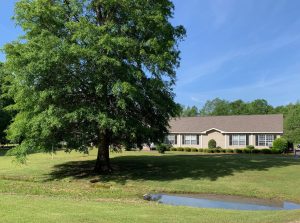
The setting is north Alabama’s Tennessee valley — mixed hardwood and pine, red clay, open farmland, and a genuine late autumn.
We have not photographed a wedding at the Retreat at Yellowhammer; purpose-built outdoor venues behave consistently. Which direction the ceremony seating faces, what the ceremony structure is and whether it has a solid roof, the covered alternative and its capacity, how late the decision on it can be made, and what power is available are questions for their team — and the first of those decides the ceremony coverage.
Retreat at Yellowhammer at a glance
| Where | A purpose-built outdoor venue at Athens, north Alabama |
| Suits | Clear sightlines, level ground, short distances and maintained planting |
| Does not suit | Anyone hoping to change the ceremony position or its background |
| The fixed part | Seating direction and structure orientation were decided for the guests |
| Ask first | Seating direction, structure roof, covered alternative and its deadline |
What it suits
It suits clear sightlines, and for a ceremony that is worth more than it sounds.
A designed ceremony area is laid out so that everybody can see, which means the aisle is clear, the seating is arranged in a way that does not block, and there is space to work at the front and along the sides. At a venue that was not designed for this — a garden, a field, a barn — a photographer spends the ceremony finding a line of sight; here the lines exist.
That means the standard ceremony frames are all available: down the aisle from the back, across the front from the side, the couple’s faces from the front quarter, and the guests’ reactions from beside the couple. A designed site gives all four without anyone having to move, which is not true of most venues.
It suits level ground and short distances. A purpose-built site has paths, hard standing and mown ground rather than farm track and rough grass — which means a wedding party in formal shoes can move around the whole property, the portrait route can be chosen for the light rather than for the footing, and a twenty-minute session is genuinely twenty minutes of photography rather than ten minutes of walking.
It suits maintained planting. A designed venue’s borders, beds and specimen trees are looked after, which means they look their best on the date rather than whatever the season has done to them — and it means there is usually a hedge or a dense border somewhere, which is the best background in any outdoor venue: a dark even mass two or three stops below a subject with nothing in it to distract.
The metering correction at any dark hedge is the standard one: meter on skin rather than on the hedge, because a dark mass makes a meter overexpose a face by a couple of stops, and the bright open ground a few paces away fools it the other way.
It suits weather resilience if the covered alternative is real, and in Alabama that matters. The state has a genuine severe-weather season in spring and near-daily thunderstorms in July and August, which makes a named indoor space with capacity for the full seated guest list a requirement rather than a courtesy — and a purpose-built venue usually has one, which is a strong argument for this kind of property over a garden or a field.
It suits a clean evening. A designed venue’s reception building typically faces the ceremony area and the open ground beyond it, which means the low light at the end of the day is unobstructed — and in north Alabama that light is long, warm and diffuse because of the humidity, which flatters skin and stretches the golden period into something broad rather than brief.
And it suits a couple who want the day to run without incident, which is the whole point of the design. The photographic corollary is that a smooth day gives a photographer time to work rather than time spent solving logistics — which shows in the pictures in ways that are hard to attribute but real.
What it does not suit
It does not suit anyone hoping to change the ceremony’s light, and that is the honest limitation.
The seating direction is fixed, which means the relationship between the couple, the guests and the sun is fixed too — and it produces one of three situations. With the sun behind the couple they are rim-lit and their faces are in shadow, while the guests have it in their eyes. Facing the sun, the couple squint and the guests are comfortable. With the sun to one side, everybody is side-lit, which is usually the best.
Which of those a wedding gets depends entirely on the ceremony time and on a layout decision made when the venue was built. Asking the direction explicitly, and combining it with the time, tells you exactly what the light will do — and almost nobody asks.
Where the couple will be backlit, the frames are exposed for the background with the faces lifted by a close warm-gelled source, placed in advance and left because it cannot be moved during a ceremony. Where everyone is in hard midday sun, there is no technique that fixes it and a later hour is the free answer.
The ceremony structure is the other fixed element and its roof decides whether it helps. A structure with a solid roof is genuinely useful: it blocks the overhead component, restricts the light to a horizontal band that models a face properly, and cannot dapple. A structure with an open frame, slats, a gapped canopy or drapery over an open top is not shade but a dappling machine — and at a purpose-built venue that is frequently what the ceremony structure is, because it looks better than a solid roof from a chair.
That is worth asking about directly, because it decides whether the couple’s faces during the vows are evenly lit or striped. The test is universal: look at the face rather than the ground, and any hard edge on skin means the structure is not doing the job.
It does not suit variety, which is the same limitation that applies at any compact designed site. The number of distinct positions is finite, the planting is uniform because it was planted at once, and the wide frames from different parts of the property resemble each other.
The answer is contrast rather than distance: a hedge-backed portrait, a frame in the reception building’s doorway, a canopy-edge frame under whatever mature trees the property has, a close detail frame, and one wide site frame — that is a varied set within a short distance, where five wide views are the same picture five times.
It does not suit a couple who wanted wildness, and that is worth saying because some book a rural venue expecting rough country. A purpose-built site is maintained by definition: mown, edged, planted and tidy. What it is not is a meadow, a wood or a working farm, and a couple who wanted those should know that in advance.
Two further limitations. Young planting is the commonest one at a newer venue: specimen trees and borders take a decade or more to become the shade and the backgrounds they are intended to be, which means a recently built site may have very little real canopy at all — and in that case the reception building’s shaded wall and any solid-roofed structure are the only dependable shade.
And the boundaries are bounded. A purpose-built venue in farming country usually has a working landscape beyond its planting: fields, tracks, outbuildings, poles and wires. Walking a full circle from the ceremony position and noting which directions are clean is ten minutes that decides the coverage — and a low camera with a border or a hedge across the bottom of the frame hides most of what is at ground level behind it.
Overhead wires are the specific thing to watch, because the eye edits them out and a photograph does not: looking at the sky in the viewfinder before the first frame in any position is worth the second it takes.
- Ask which direction the ceremony seating faces; it decides the vow light
- Ask whether the ceremony structure has a solid roof or an open top
- Hedges and dense borders are the best free backgrounds here
- Get variety from contrast, not distance — the wide frames repeat
- Look at the sky in the viewfinder; wires are invisible to the eye
The Tennessee valley year
North Alabama has a humid subtropical climate with a genuine four-season feel — cooler winters than the Gulf coast, hot humid summers, and a real autumn.
Winter is mild but not warm: hard freezes occur, snow is occasional and rarely lies, and the deciduous element is bare. At a purpose-built outdoor venue that is the honest weakness of the season — the planting is dormant, the borders are cut back and the grass is off-colour, which means the designed landscape is at its least designed.
What winter gives instead is the light. The December sun at this latitude reaches about thirty-four degrees above the horizon, which is low enough that the whole short day rakes rather than floods — removing any dappling problem, modelling the ground and the buildings, and meaning that a ceremony at any hour falls in good light rather than only at the ends of the day.
That is a real advantage at a venue with a fixed ceremony time: in December there is no bad hour outdoors and in July there is. And whatever evergreen planting the property has — holly, cedar, magnolia, boxwood — is unchanged, which means the dark backgrounds are still available.
Snow, when it comes, is the best natural fill available and it simplifies a designed landscape considerably: beds become shapes, edges disappear, and the whole site reduces to a clean plane. Expose for the snow and let everything else go dark, overexposing deliberately relative to the meter, which snow fools by about two stops.
Frost on red clay and morning fog in the valley are the more common winter conditions, and a designed site with a building rising out of fog is a strong frame.
Late winter into spring brings the flowering and at a maintained venue it is deliberate: bulbs, then redbud and dogwood through March and April, azaleas in the borders, and wisteria on anything it can reach. That is when the planting looks most like what it was designed to be.
The honest spring caveat is severe weather, and in north Alabama it is as pronounced as anywhere in the country. The region sits in one of the most tornado-prone areas in the United States with a peak from March through May, which makes the covered alternative and the deadline for deciding on it the season’s most important practical questions.
Spring proper is the most comfortable season and the one the venue was designed for: warm, green, long-lit, the borders full and the ground at its best.
Summer is hot and humid and it is the hardest season. Low nineties Fahrenheit with high humidity pushes the heat index considerably higher, a designed outdoor site has limited shade unless the planting is mature, and a seated ceremony at three in the afternoon is uncomfortable in a way that shows in the photographs.
The answers are scheduling and the building: a late-afternoon or evening ceremony, the reception building’s shade for the middle of the day, and water available. Afternoon thunderstorms are near-daily in July and August, which makes the covered alternative’s deadline an operational matter.
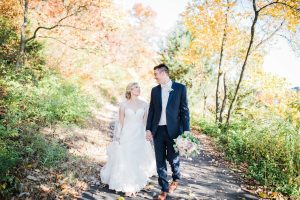
Autumn is the best season overall. The heat breaks in October, the humidity drops, the air clears, and the hardwood colour arrives late — typically from the last week of October into mid-November in north Alabama, weeks later than New England.
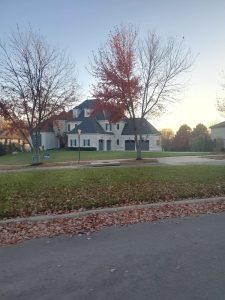
At a designed venue the autumn effect depends on the age of the planting: mature specimens turn as whole objects with room around them, which is composed and strong, while young planting contributes little and the colour comes from the surrounding countryside instead.
Late October and early November are the easiest and most beautiful dates of the year here on every count, with the caveat that November is the state’s second severe-weather peak.
More frames from Retreat at Yellowhammer
Retreat at Yellowhammer wedding photography: common questions
What does a purpose-built venue suit?
Clear sightlines, level ground, short distances and maintained planting — which together mean the ceremony coverage is straightforward and the day runs smoothly.
What is its limitation?
The ceremony position, the seating direction and the background were decided for the guests’ view, not the camera’s — and none of it can change on the day.
What should I ask first?
Which direction the seating faces, and whether the ceremony structure has a solid roof. Those two decide what the couple’s faces look like during the vows.
Why does the structure's roof matter?
A solid roof restricts light to a horizontal band and cannot dapple. An open frame, slats or drapery over an open top stripes a face instead.
How do I get a varied set?
From contrast rather than distance — a hedge-backed portrait, a doorway, a canopy edge, a close detail, and one wide site frame.
When is the site at its best?
Late October into mid-November for colour and comfort — and December, when a low sun means a fixed ceremony time falls in good light whatever hour it is.
More Alabama venue guides
We are writing a photographer’s guide to every venue we would happily shoot in Alabama. Here are three more, plus the full index:
- Riverchase Golf Club, Hoover: What It Suits and What It Does Not
- Springs at the 191, Clanton: Field Notes
- Stone Ridge Venue, Heflin: The Problem, and Four Ways Out
Planning a wedding at Retreat at Yellowhammer?
A site designed to run well. Tell us your date and the ceremony direction.