 The Bierstube: What Changes When the Reception Is in a Bar
The 320 Guest Ranch, Big Sky: The Problem, and Four Ways Out
At a ranch in a canyon, the terrain decides when you work. Here are four ways to make that an advantage.
A guest ranch along a mountain river is mostly outdoors, and that means the terrain rather than the schedule decides when the photography happens. The ridges shadow the valley for much of the day, the sun arrives late and leaves early, and what is left between those two events is a few hours of light that is harder than at sea level because there is a quarter less atmosphere above it to soften it.
That is the problem, and stated baldly it sounds like a constraint. In practice a canyon ranch gives more good light than most venues, not less — it is just distributed differently, and it comes with four distinct ways of working that have to be chosen between rather than stumbled into.
Each of the four has a cost. Knowing which one is in use at any moment is what produces a coherent gallery rather than a mixed one.
We have not photographed a wedding at the 320 Guest Ranch; mountain guest ranches and river canyons behave consistently. Which areas are included, what the ceremony site’s aspect is, what the river access rules are and what the weather arrangements are are questions for their team.
The 320 Guest Ranch at a glance
| Where | A river canyon at Big Sky, Montana |
| The problem | The terrain controls the timing; direct sun is short and hard |
| Way one | Work the long open shade, which is most of the day |
| Way two | The conifer edge. Way three: the river |
| Way four | The buildings — porches, eaves and timber interiors |
Ways one and two: open shade, and the conifer edge
The first way out is to stop treating open shade as a waiting period. Before the sun clears the eastern ridge and after it drops behind the western one, a canyon is lit by the strip of sky overhead and by whatever bounces off the slopes — which is soft, arrives downward at an angle rather than from a point, and contains no hard shadows at all.
That is a good portrait condition on its own terms, and it has one property nothing else in the day has: it is the only time when a subject and the distant ridges sit within a manageable brightness range of each other. Once the valley is in sun the range opens up; in the evening, when the peaks are lit and the valley is not, the gap is wider still.
The one thing open shade lacks is direction, and it is supplied by geometry rather than equipment. Standing near something solid — a building, a stand of trees, a canyon wall — blocks the light from one side and restores direction to it, which is the difference between a flat frame and a shaped one. The middle of an open meadow in overcast shade is the flattest light on the property; three metres from a dark wall is the best.
The cost of this approach is that it looks nothing like the brochure. Open shade is subtle, cool and quiet, and a couple expecting golden mountain light needs to be told in advance that this is what most of the day actually offers — and shown why it is good.
The second way out is the conifer edge, and it is the most reliable frame on any property in this country. Standing at the edge of a dense evergreen stand, in its shade, facing out into lit open ground gives light from the bright meadow in front and near-total darkness behind — which is directional, soft and separates a subject by three or four stops with no equipment at all.
Evergreen absorbs almost everything falling on it, which is what makes it the darkest natural background available, and unlike a deciduous background it does not change through the day or through the year.
It has one exposure trap. A meter looking at dark conifer tries to lift it towards mid-grey, which overexposes everything else in the frame by two stops or more — so the background must be allowed to stay dark, which means metering on the faces or off a hand in the same light, and working in manual rather than trusting the camera.
Its cost is sameness: conifer is a beautiful background and every frame made against it looks like every other frame made against it. Four or five is a set; twenty is a wall.
Ways three and four: the river, and the buildings
The third way out is the river, and in a canyon it is the one element that behaves differently from everything else.
It reflects, which doubles anything lit and gives a second version of the ridges and the sky for free — and that follows one rule: camera height decides everything. A low camera looking across the surface sees a mirror; a high camera looking down sees through to the stones. Half a metre of camera height changes the frame completely, and on a mountain river the low position also hides the water’s colour, which is frequently a strong blue-green that reads oddly on skin nearby.
It bounces light upward, which fills exactly the shadows a high sun carves under eyes and chins — so a position in shade beside water is materially better light than the same shade beside grass.
And it moves, which makes shutter speed a deliberate choice: a long exposure turns a mountain river into a smooth white field, a short one holds every drop. Both are correct, and in bright high-altitude light the long version needs a neutral density filter. A polariser is the other filter worth carrying, because moving water in sun produces specular glare several stops above everything else, which clips and fools any meter.
The river’s costs are practical and worth stating plainly. Mountain rivers are cold, fast and uneven underfoot; the banks are loose; a long dress near fast water is a hazard; and a camera dropped in is gone. Nothing photographic is worth a fall, and frames near water should be composed so that nobody needs to stand on an edge.
The fourth way out is the buildings, and at a ranch they offer two things.
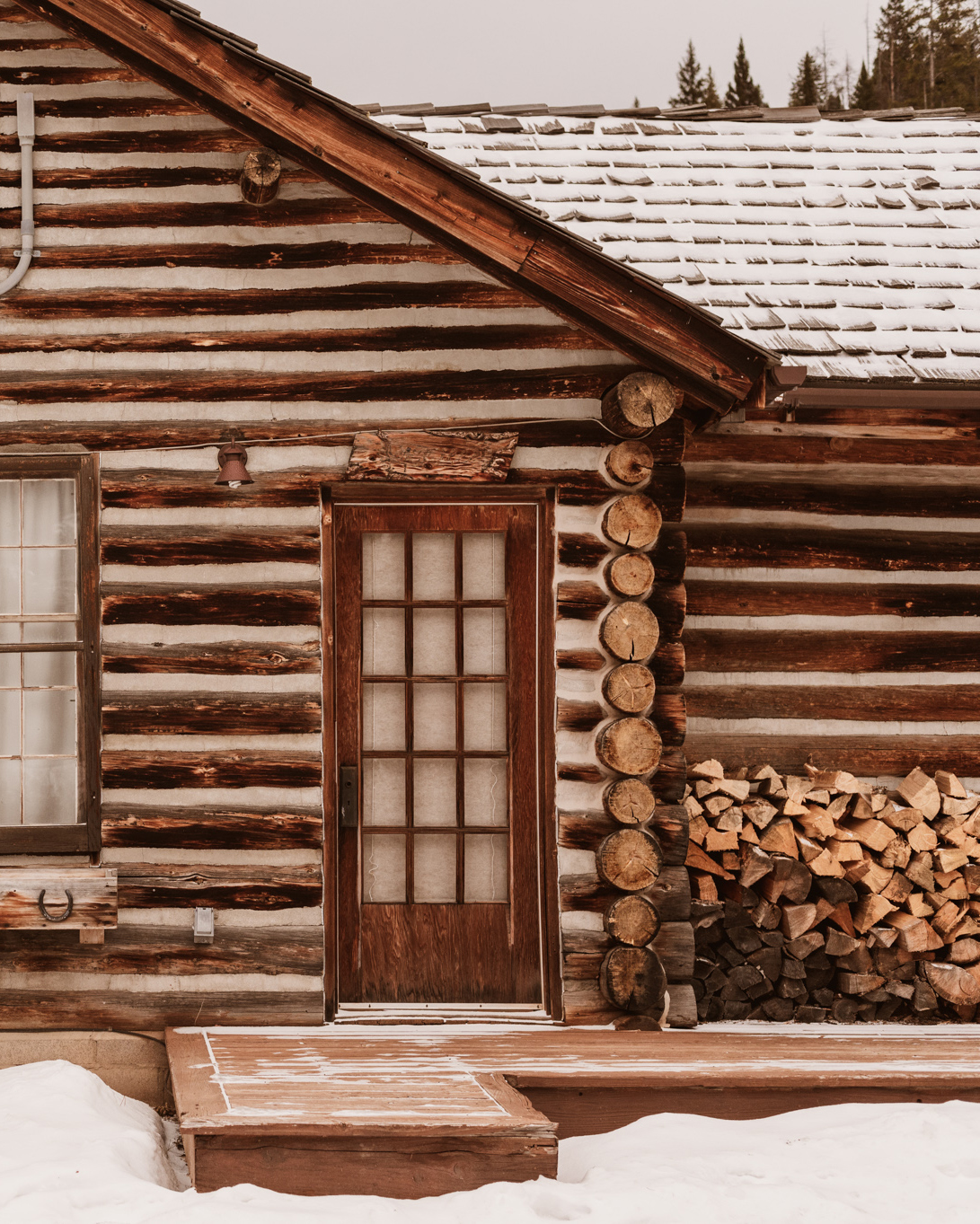
The porches and eaves are the first and they are the most useful architectural feature here. A roof above with an open face restricts the light to a horizontal band, removing exactly the overhead component that ruins faces, and the timber floor and wall bounce it back to fill. That is a soft directional source at the scale of two people, available at any hour — and it is rainproof, which in a mountain summer of afternoon storms is the difference between having an outdoor block and cancelling it.
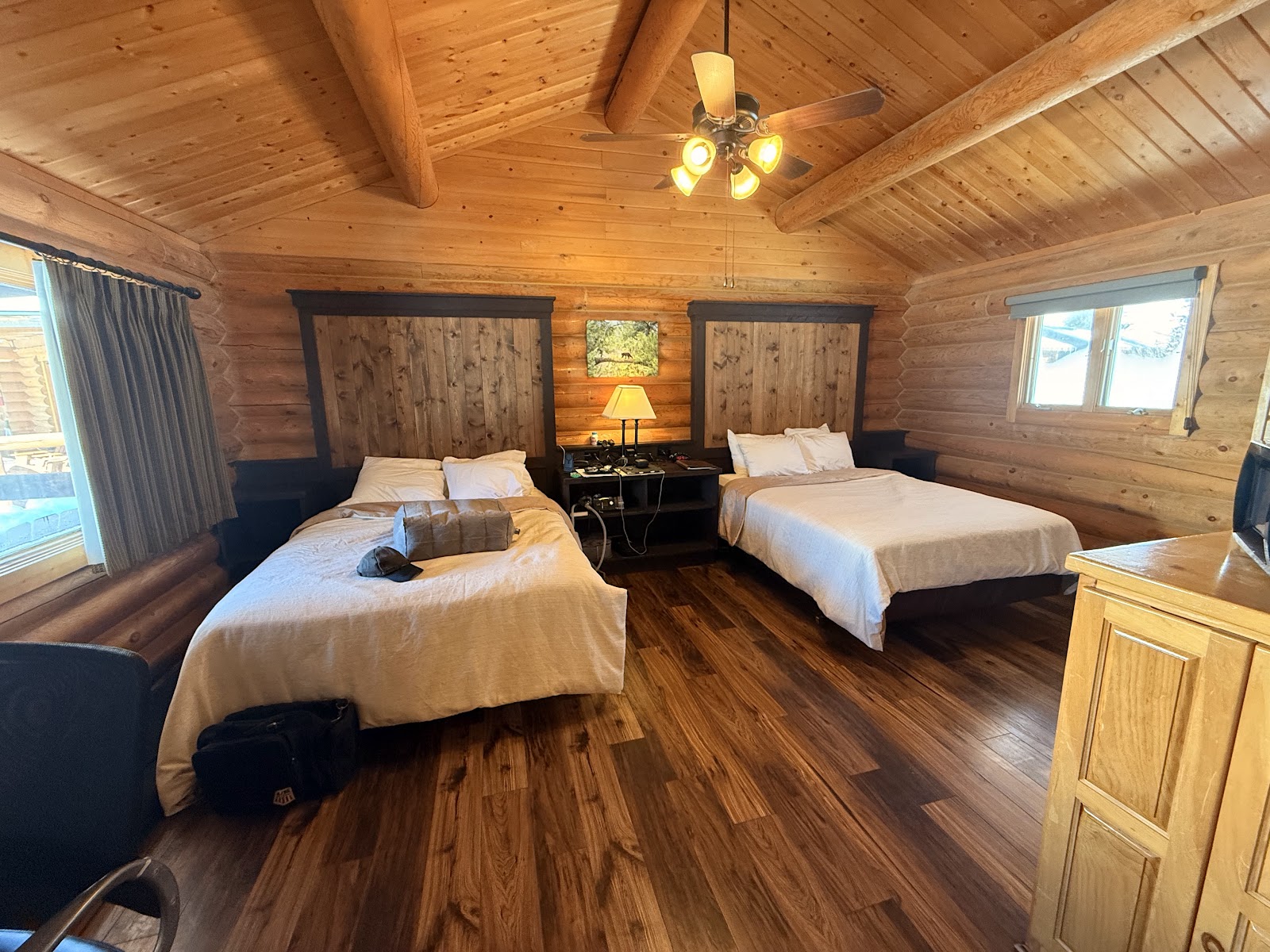
The interiors are the second and they are harder. Ranch buildings are timber, which absorbs: a timber-lined room sits two or three stops below a pale one with the same fittings and returns very little to a bounced flash, which removes the advantage a low ceiling usually gives. One test frame aimed at the ceiling settles it, and the usual answer is to light directly into a modifier instead — one source, off the camera axis, at face height, gelled warm to match the room’s own fittings with white balance set to the gel, exposed about a stop above the ambient so the room still reads as the warm dark space it is.
The compensations are steep fall-off, which gives free separation, and generous windows, because ranch buildings are oriented to look out.
- Open shade is the day, not the gap — stand near something solid for direction
- Work the conifer edge, but ration it: four or five frames, not twenty
- Camera low across the river for the mirror; carry a polariser and an ND
- Use the porches: directional, rainproof and available at any hour
- Test bounce indoors; dark timber returns almost nothing
The mountain year, and the practicalities
Summer in a mountain canyon is short, green and cool, and the river is at its fullest in early summer as snowmelt comes through — which makes it louder, faster and more dramatic in June than in September, and correspondingly more hazardous to stand near.
Afternoon thunderstorms build over high terrain from roughly July into September and they produce lightning, which in open ground or beside water is a genuine hazard rather than an inconvenience. A named indoor alternative is a requirement, and the decision to use it belongs to whoever is responsible for the party rather than to whoever wants one more frame. The compensation is that mountain cloud is the best diffusion available here, and cloud moving through a canyon is more atmospheric than a clear day.
Late August into September brings wildfire smoke, which deserves naming honestly because it has become a reliable part of the western calendar. Smoke from fires elsewhere in the region can settle in mountain valleys for days: long views flatten to grey, the sun turns orange and loses its edge, and the deep blue sky that altitude normally gives disappears entirely.
It is not all loss — smoke is diffusion, so faces are softly and warmly lit, successive ridges separate into flat grey layers which is genuinely striking, and the sun becomes a disc that can be photographed directly. But a couple booking late August should know the clear canyon panorama is not guaranteed, and that belongs in the booking conversation.
Late September and early October are the best short window of the year: the smoke has usually cleared, the aspen and cottonwood along the river turn strong yellow against the dark conifer, the afternoons are stable, and sunset falls at a reasonable hour. It lasts a week or two either side of peak.
Winter is long. At this latitude — about forty-five degrees north — the December midday sun reaches only around twenty-one degrees above the horizon, which means the whole short day is raking light rather than overhead light, and for once the canyon’s timing problem disappears. Snow on the ground with dark conifer behind and a river running black through the middle of it is the strongest frame the property offers.
Snow is useful twice: outdoors it is the best natural fill available, lifting exactly the shadows a low sun carves while fooling a meter by about two stops toward underexposure; indoors it turns the ground into an enormous reflector and improves every window. And snow with conifer in one frame is the widest natural brightness range a photographer meets — expose for the snow, which holds the detail and clips irrecoverably, and accept the trees as near-black.
The practicalities at altitude are consistent. Cold and elevation both drain batteries, so spares belong in an inside pocket. The diurnal swing is large — well over twenty degrees Celsius between afternoon and evening — and a canyon cools faster than open ground because the sun leaves it earlier, so a party comfortable at four is cold by seven and coats are the answer. Ultraviolet is markedly higher here, including under cloud and over snow. And anyone arriving from sea level feels seven thousand feet, which argues for a short portrait route close to the buildings.
One last note specific to this country: it is bear habitat, which is the venue’s business rather than a photographer’s, but it is a reason not to leave an open bag in a meadow and walk away from it.
More frames from The 320 Guest Ranch
The 320 Guest Ranch wedding photography: common questions
What is the central problem?
The terrain controls the timing. The ridges shadow the valley for much of the day, so direct sun is short, and at altitude it is harder than at sea level.
Is open shade usable?
It is most of the day and it is good light. It only lacks direction, which is supplied by standing near something solid rather than in the middle of a meadow.
Why ration the conifer frames?
Because it is a beautiful background and every frame against it looks like every other one. Four or five is a set; twenty is a wall.
What does the river give?
Reflection, upward fill that softens facial shadows, and a shutter-speed decision. Camera height decides whether it reads as a mirror or as stones.
Why are the porches so useful?
A roof with an open face removes the overhead component that ruins faces, the timber bounces to fill, and it works in rain — which a mountain summer requires.
What about smoke?
Late August into September it can sit in the canyon for days — warm diffusion, no panorama, no blue sky. A couple booking then should be told.
More Big Sky, MT venue guides
We are writing a photographer’s guide to every venue we would happily shoot in Big Sky, MT. Here are three more, plus the full index:
- Big Sky Resort, Montana: A Venue Built Around Winter
- Buck’s T-4 Lodge, Big Sky: What It Suits, and What It Does Not
- Lone Mountain Ranch, Big Sky: The Light Through a Mountain Day
Planning a wedding at The 320 Guest Ranch?
Four ways to work a canyon. Tell us your date and we will choose between them.