 Woodwinds, Branford: The Problem, and Four Ways Out
Whitney Center, Hamden: The Problem, and Four Ways Out
There is plenty of light here. There is no contrast, and that is a harder problem.
The problem at a modern function venue is the opposite of the one most people expect, and stating it correctly is what makes it solvable.
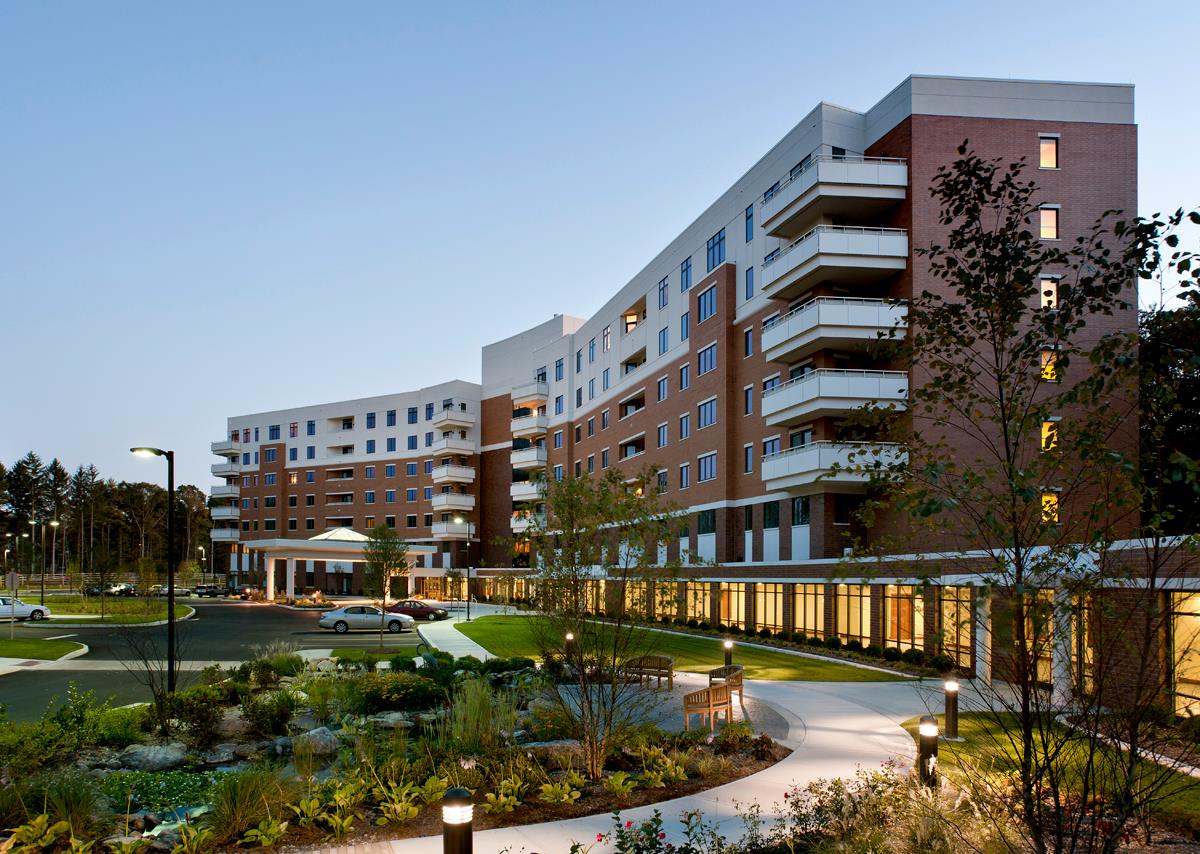
There is no shortage of light. Modern interiors have large glazing, pale walls, pale ceilings and bright finishes, which means daylight enters and then bounces off every surface — filling shadows, lowering contrast and producing even, flattering illumination almost anywhere in the room. Nobody’s face is underlit.
What is missing is contrast, and without it a frame has no structure. A subject in soft bounced light against a pale wall has nothing separating them from the background: no fall-off, because the light does not fall off; no shadow side, because it has been filled; and no tonal difference, because everything in the frame is the same brightness.
The result is a picture that is technically correct and visually flat, and — worse — one that looks the same wherever in the building it was made. That is the real cost: a whole day of pictures that could be one picture.
The second half of the problem is that modern architecture gives very little texture. Flat planes, straight lines and plain surfaces mean there is nothing incidental in the frame to carry interest, which puts all the weight on the light and the composition.
The counterpart is the setting. South-central Connecticut has traprock ridges — steep basalt ridgelines standing abruptly above gentle country — and New England woodland, both of which give exactly the contrast and texture the interiors lack.
There are four ways out. We have not photographed a wedding at the Whitney Center; modern function venues behave consistently. Which rooms and outdoor areas are included, whether the lighting can be dimmed, the covered alternative, and what daylight reaches the preparation rooms are questions for their team.
Whitney Center at a glance
| Where | A modern function venue at Hamden, south-central Connecticut |
| The problem | Plenty of light, no contrast — flat frames that all look alike |
| Way one | Find the dark, deliberately |
| Way two | Use the glazing as a source. Way three: add light for contrast |
| Way four | Go outside, where the contrast and the texture are |
Ways one and two: finding the dark, and using the glass
The first way out is to find the dark, and in a pale building that is a deliberate search rather than something that happens by accident.
What counts is anything two or more stops below the subject’s own light, and a modern building has fewer of those than an old one — but it does have some. A doorway with an unlit room behind it. A corridor receding away from a window. A recessed area, a stairwell, a lift lobby, a service passage. A dark panel, a dark piece of furniture, a dark-framed window seen against a bright exterior.
Walking the building once and listing three or four of those is ten minutes of work and it is the difference between a varied set of pictures and a uniform one.
The exposure follows: metering on skin, in manual, and letting the dark background stay dark. In a pale building the instinct is the opposite — a meter looking at large bright surfaces underexposes, which is the correction that applies everywhere else in the room — so a day here needs the correction in both directions depending on where the camera is pointing.
The second way out is to use the glazing as a source rather than as a background, and it is the single most effective technique in a modern building.
A large window is much brighter than anything bouncing around a room, which means it is still directional even in a space that fills every shadow. A subject a metre from the glass, turned about forty-five degrees to it, gets a lit side, a shadowed side and a gradient between them — real modelling, in a room that otherwise produces none.
The catchlight confirms it: broad and low on the window side of each eye means the geometry is working. And the two free rules apply — turn the room lights off, because warm interior sources against cool daylight put two colours on one face, and set a custom white balance on a face in position.
Glazing carries one technical note that matters in modern buildings more than old ones: it reflects. A frame pointed toward a large window at a shallow angle picks up the room, the camera and the photographer, and a few degrees off perpendicular removes it. Finding that angle is the first thing to do in any glass-walled space.
And a window is a subject as well as a source. Exposing for the view silhouettes the subject; exposing for the subject whites out the view; and the resolution when both are wanted is a close source at roughly the window’s brightness. Averaging the two is what automatic metering does and it fails at both ends.
The geometry of a modern building is the other resource that comes with these two solutions, and it needs using deliberately rather than tolerating. Flat planes, straight lines and repeated elements — columns, mullions, light fittings, chairs, paving joints — are compositional material: a subject placed against a large plain surface with deliberate negative space reads as intentional, and repetition used as a rhythm behind a subject reads as design.
The requirement is precision. Plain surfaces punish approximation: a frame a degree off level or a subject placed almost-but-not-quite deliberately looks like a mistake, where the same imprecision would hide entirely in woodland. Square, level, and placed on purpose.
Ways three and four: adding contrast, and going outside
The third way out is to add light, and the reason is the opposite of the usual one. In a dark venue a source supplies illumination; here it supplies contrast.
One source off the camera axis, set about a stop above what the room’s ambient gives the skin, re-establishes the shadow side that the room’s own bounce has filled in. That is what turns a flat frame into a modelled one, and it works anywhere in the building regardless of what is behind the subject.
The gel depends on what the room is doing. Modern interiors are frequently lit with warm LED alongside cool daylight from large glazing, which means the ambient colour varies from position to position — so setting the gel to match the dominant source on the face and the white balance to the gel is the working method.
Low ceilings are the modern building’s genuine advantage and they should be exploited rather than ignored. A ceiling under three metres is a large usable bounce surface, so a flash aimed into it returns soft overhead-forward light across a whole room — which in a tall historic ballroom is simply not available, and which makes a modern reception space considerably easier to light than a grand one.
The caution is colour: a warm-painted ceiling colours the bounce and the white balance has to follow it, and a coffered or heavily detailed ceiling returns less than a flat one.
For the evening reception the approach is standard. Expose the ambient about a stop under what faces need, so the room keeps some depth rather than going uniformly bright, then add one warm-gelled source just above skin level, bounced in a low room rather than aimed directly. The white balance goes to the gel.
Whether the lighting can be dimmed is the most valuable question to ask in advance, because a pale bright room with the house lights up is the single hardest environment to get depth in — and a room whose lights come down for the first dance changes completely.
The fourth way out is to go outside, where south-central Connecticut supplies exactly what the interiors lack.
The traprock ridges are the first of it and they are the region’s most distinctive terrain: steep, narrow basalt ridgelines standing several hundred feet above otherwise gentle country, wooded on their flanks. A ridge like that is close and steep, which means a longer lens brings it forward as a mass behind a couple — real texture and real tonal depth, which is precisely the contrast a pale interior cannot give.
A wide lens reduces the ridge to a low band above a lot of foreground, which throws away the one piece of topography available. And in clear autumn or winter air the compression holds detail; in summer haze it does not.
The ridges also decide the timing. A steep ridge on the western side takes the sun well before a sunset table says — sometimes by forty minutes in summer — which brings the evening forward and produces the interval frame: the ground in soft even shade while the ridge above is still brilliantly lit, for twenty or thirty minutes. That is made by exposing for the lit ridge and lifting the faces with a close warm-gelled source.
Woodland is the second outdoor resource and it gives what no interior does: a background three or four stops below the subject, for nothing. The canopy edge is the position — a metre or two inside at the margin of an opening — and it is the same physics as a window in a dark room.
The standard woodland rules apply. Maple, oak, birch and hickory filter as much as they block, so they dapple: look at the face rather than the ground, and a bright patch on skin means move a metre. Hemlock and white pine give the real full shade and the darkest backgrounds.
And the practical constraint is time. If the outdoor positions are a walk away, a twenty-minute session is a forty-minute absence, which has to be in the running order rather than hoped for. Knowing the real distances beforehand is what makes it happen.
- Find three or four dark backgrounds before the day; a pale building has few
- Glazing at forty-five degrees is the one free direction indoors
- Add a source to create a shadow side, not to supply light
- Bounce off the low ceiling — the modern building’s real advantage
- Outside, the ridge and the woodland give the contrast the interiors lack
The south-central Connecticut year
This part of the state has four genuine seasons with moderate influence from the Sound a few miles south, and because a modern building is weather-independent the calendar decides what the outdoor half of the day gives rather than whether the wedding works.
Winter is cold with snow in most years, and for an indoor venue that is close to irrelevant — the honest argument for this kind of building on a February date.
Outdoors winter is transformative and it solves the venue’s central problem better than any other season, for a specific reason: snow against dark bare woodland or a dark traprock ridge is the widest brightness range available anywhere near the property. That is the contrast the interiors lack, in abundance, and it is free.
Snow is also the best natural fill available, lifting every shadow and throwing light upward into faces. It fools a meter by about two stops toward underexposure, so deliberate overexposure relative to the camera is the rule.
The December sun at this latitude reaches only about twenty-six degrees above the horizon, so the whole short day rakes rather than floods, which removes any open-ground problem and models every surface. In leafless woodland the same low sun comes horizontally through the trunks, and on a snow-covered traprock ridge it picks out the columnar basalt structure that summer foliage hides.
There is one winter consequence of the ridge: a low sun on a short day means it blocks the light even earlier, so a December afternoon here ends remarkably early. The compensation is that the whole day is good light rather than an hour of it.
The costs are a short day, cold hands, batteries draining faster, and a cold camera fogging when brought back into a heated room. Spares in an inside pocket and bodies bagged until they warm.
Early spring is mud season and the weakest outdoor part of the year: bare trees, brown ground, wet footing and no colour. On an April date the indoor approaches are the honest plan, which is a legitimate choice rather than a compromise.
Late spring is genuinely good: new foliage transmits light beautifully, the ridges go from grey to green, and the light is lengthening. Late May under a new canopy is among the most flattering light of the year — and it needs a custom white balance, because transmitted green light renders skin badly on a preset.
Summer is warm and humid — mid to upper eighties Fahrenheit with high humidity — with afternoon thunderstorms a real feature from June into August, building quickly over the ridges. Those are visible on the ridgeline before they arrive, which is useful warning and a dramatic subject in its own right.
The humidity reduces clarity at distance, which softens the compressed ridge frames, and it warms and diffuses the light at the ends of the day in a way that flatters skin.
Autumn is the season and it is where the outdoor trip is most worth arranging. Colour in south-central Connecticut peaks in the second half of October, and a steep wooded traprock ridge in full colour is a wall of scarlet, gold and russet several hundred feet high rather than a distant hillside.
For a venue whose interiors are pale, even and characterless, that is the single most valuable thing available: twenty minutes against a ridge in full colour gives the whole set of pictures a place, a season and a tonal range the building cannot provide. Autumn also brings the clearest air, the most settled weather and the most comfortable temperatures of the year.

More frames from Whitney Center


Whitney Center wedding photography: common questions
What is the problem at a modern venue?
Not light — there is plenty. It is contrast: pale bounced light against pale walls gives no fall-off, no shadow side and no tonal separation.
How do I fix it indoors?
Find something genuinely dark to put behind the subject, use the glazing as a directional source at forty-five degrees, or add a source to create a shadow side.
Why does precision matter more here?
Plain flat surfaces punish approximation. A frame a degree off level or a subject placed almost deliberately looks like a mistake.
What is the building's real advantage?
A low ceiling, which is a usable bounce surface. A tall historic ballroom ceiling returns almost nothing.
What is outside worth?
The contrast and texture the interiors lack — a steep wooded traprock ridge on a longer lens, and woodland that gives a background three stops down.
When is that most worth it?
The second half of October, when the ridge is a wall of colour — and deep winter, when snow against dark woodland gives the widest range available.
More Connecticut venue guides
We are writing a photographer’s guide to every venue we would happily shoot in Connecticut. Here are three more, plus the full index:
- Woodwinds, Branford: The Problem, and Four Ways Out
- The Bond Ballroom, Hartford: One Frame, and How It Is Made
- The Hartford Club, Hartford: Suits and Does Not Suit
Planning a wedding at Whitney Center?
A bright building and a ridge outside it. Tell us your date and we will use both.